Showing posts with label Fly by Night. Show all posts

Saturday, March 10, 2012

When Maurice Sendak and Randall Jarrell Teamed Up

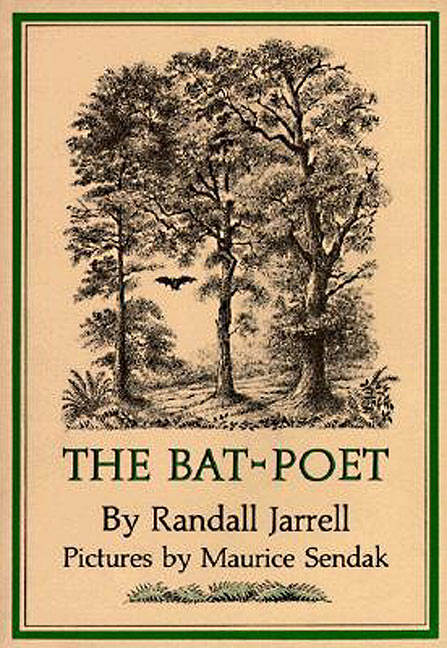
The other day I was in a great little used bookstore in Salt Lake City and found a book I'd never seen before by poet Randall Jarrell, with illustrations by Maurice Sendak, Fly by Night. I brought it home to form a trio with two other books created by Jarrell and Sendak: The Animal Family and The Bat-Poet. Here's a look at all three:

Fly by Night (1976)

This is a fairly random piece of writing, which I suppose makes sense, considering it's about the world of dreams. Jarrell tells of a boy who can fly—or float, actually—at night. He appears to be somewhere between 8 and 10. In the first few paragraphs David seems pretty ordinary, living in a pretty neighborhood where he climbs trees with the cat. But then we learn "At night David can fly." Though apparently he has trouble remembering these dreams and how to fly when morning comes. Anyway, we follow David one night as he floats into his parents' bedroom, where he can see what they are dreaming:
He comes to his mother's and father's bedroom, and floats in over them. His father is a big mound under the blanket, with his head sticking out at the top. His mother is a medium-sized mound, but where her head should be there's nothing but pillow—she's put the pillow over her head to help herself go to sleep.

His mother and father are dreaming: he can see their dreams. Just over his father's head it's round and yellow and warm, like firelight, and his father, looking very small, is running back and forth with David on his back, only David is as big as ever. His father is panting. His mother is dreaming she is making pancakes: she pours them out, and turns them over, and piles them in a pile on a plate. Her dream is round and yellow too, but it has got mixed up with the pillow, so that the feathers the pillow is stuffed with float through her dream like snowflakes.

After David floats out of the house, the cat on the porch advises him:
Wake by night and fly by night,
The wood is black, the wood is white,
The mice are dancing in the moonlight.

The mice and rabbits talk to him, too, and then David floats out into the woods, where he meets a female owl that takes him under her wing and back to her nest to join her nestlings till morning. This is where I came to my favorite metaphor in the book, when we're told that the owl has caught a fish which "shines in the moonlight like a spoon."

At the owl's nest, David meets the baby owls, which surprise him by being white and by having "a sad, absurd look." Then we get a long narrative poem from the mother owl titled "The Owl's Bedtime Story." (About this point you'll probably decide that the mother owl is a stand-in for David's own mother.) The owl escorts floating David home, and when he wakes up in the morning, as promised, he can't quite remember his dream.

This is a solemn tale, one that probably has more appeal for dreamy adults than for kids. It also makes an interesting counterpoint to the book Sendak published six years earlier, In the Night Kitchen (1970). Compare the two illustrations shown above right, for example. I should point out that Jarrell's piece was first published in 1969, so it's entirely possible that the text of Fly by Night was one of the inspirations for Sendak's own book, In the Night Kitchen, though that book is much more jovial in tone and takes off in a different direction. Still, both books feature naked floating boys who are dreaming. Which is to say, the child in Fly by Night looks a little like Mickey five years later, still up to nighttime adventuring.

I will say, aside from the fact that a lot of people dream about being naked in an embarrassing way, there's something inherently naked about dreaming, about the way one's psyche is bared in dreams.

The nicest piece of art in the book is a full spread of David floating away home, with the owl's face filling a large piece of space on the upper right and views of a mother with a baby below left and a lamb with its mother below right, plus other interesting things like a fox, a shepherdess, two ducks on a pond, a bridge, a couple of rabbits, and some marvelous trees (all in a scene vaguely reminiscent of the old masters).

Fly by Night is an odd book, but if you're a collector of Maurice Sendak's work, let alone Randall Jarrell's, it's worth tracking down a copy. There's something sweetly surreal about this one.


The Animal Family (1965)

Another slightly surreal tale from Jarrell, The Animal Family, is about a hunter who lives alone on the coast of a nameless country. He has no neighbors, and he is lonely now that his parents have died. But one night he hears someone singing, and he goes down to the shore to find out who or what it is. Little by little he befriends a mermaid, teaching her his language. He tries to learn hers, but he's pretty bad at it. There's gentle humor here:
The hunter said her words awkwardly and ruefully, like something learned too late, but she said his like an old magician learning a new trick, a trick almost too easy for her to need to learn. The hunter said to her, bewildered: "You never make mistakes."

"What is mistakes?"

"The wrong word—the wrong sound, one you don't mean to make. The way I do. Mistakes are what I make when I try to talk the way you talk."

The mermaid repeated in a satisfied voice: "Mistakes." She had one more word.

The mermaid ends up moving into the hunter's cottage. She is intrigued by his world, amused by things like the way he uses fishing gear to catch fish instead of just swimming and grabbing them like everyone else in the ocean does. I should not
e that she respects dolphins but thinks seals are numbskulls. (Like I said, funny!)

In time the hunter feels a longing for a child. This is expressed in a dream he does not understand, but the mermaid figures it out. "It means you want a boy to live with us. Then you'll be your father's shadow, and I'll be your mother's, and the boy will be yourself the way you used to be—it will all be the way it used to be." So the hopeful hunter goes out and brings home a bear cub. The new addition to the family turns out to be messy, yet loved. A few years later the hunter finds a lynx cub and brings home a second baby. But it is the lynx that finds the last child to join this strange little family...

Jarrell's story is full of funny details about how the mermaid perceives the hunter's world and about what it's like to raise the bear and lynx babies, not to mention the youngest child. The gentleness, even tenderness of the story is balanced out by the author's rather matter-of-f
act tone. Again, I'm having trouble picturing the child who will appreciate The Animal Family—maybe a creative kid, a bit of a deep thinker. The book might make a nice bedtime read-aloud. I do know a lot of grown-ups who would probably like it and would consider the book something of a fable. It is certainly a nice riff on families. (E.g., the way even the most seemingly homogenous families are made up of disparate, surprising personalities.)

I should note that Sendak deliberately avoids showing the characters in his illustrations. Instead he mostly gives us scenery in his pen-and-ink drawings (see example, right). About the only details that allude to the characters are a boat and a bow and arrow. I
think the illustrator was wise to go this route, since these characters, especially the mermaid, might have been spoiled by being captured in artwork. The timelessness of the tale is thus preserved.


The Bat-
Poet (1964)

I once loaned this third book to a friend who's a children's playwright, and when she returned it she said, "It's about what it's like to be a poet!" I would agree, but I will add that The Bat-Poet is more broadly about what it's like to be a writer or a creative person. Now, for the next few paragraphs, I'm going to steal from myself, since I wrote about The Bat-Poet in June 2010:

Character is king, and especially in this book. The little brown bat at the heart of poet Randall Jarrell's tale is just so eager and sweet and shy and curious, yet manages all this, like a real human child, without being overly sentimental. The small bat wants to know things, and then he wants to sing, and when that doesn't work, he begins to make up poems, trying to give shape to the yearning he has inside, a powerful need for self-expression. That description sounds like pop psychology, I'm afraid, but all of these ideas are couched in a nice little plot about a bat who's not like the others. He sets out to explore the day world, for example, and he gets a creative crush on the vain yet talented mockingbird. Little by little, he puts his observations into words.

Here's a piece of his first poem about the day, for example:
At dawn, the sun shines like a million moons
And all the shadows are as bright as moonlight.
The birds begin to sing with all their might.
The world awakens and forgets the night.

To which another bat responds, "The sun hurts... It hurts like getting something in your eyes." But the bat-poet eventually finds a better audience in the form of a semi-interested chipmunk.

Poetry fans will find two of Jarrell's most well-known poems embedded in this story, descriptions of an owl and of a baby bat. (The latter begins, "A bat is born/
Naked and blind and pale.") I'm noticing Jarrell really liked owls!

Sendak depicts the animal characters in this one, still using pen-and-ink. My only quibble is that Jarrell's owl in the poem is pretty terrifying, but Sendak's owl isn't. The chipmunk and the little bat are wonderful, however. And again, the illlustrator gives us a superb full spread near the end of the book. It shows a bat in flight above a forest with a lioness and her cub.

The Bat-Poet won't appeal to every child, only the more thoughtful, patient reader, probably in the 10-to-12 range. If you have a child who writes poetry, or if you write poetry yourself, this is a book for you to share, a peaceful yet gently humorous story about the joy of creating.

All three of these books are as much for adults as they are for children. At least, they are for a rather special kind of young reader. Randall Jarrell's poetic voice is clear and touched with perfect metaphors. It is also thought-provoking and poignant. I suggest you experience the quiet beauty of his children's books—and the power of Maurice Sendak's illustrations.

Friday, July 8, 2011

A Review of Fly Trap by Frances Hardinge

This author got a lot of attention last year for The Lost Conspiracy, but did you read her book, Fly by Night, a few years back? It was one of those odd, cool, and yes, under-appreciated MG fantasy novels. Now Mosca Mye is back and better than ever in a sequel, Fly Trap.

Talk about world building! Hardinge takes the ideas of astrology and religion and creates a society with hundreds of "Beloveds," or minor deity that dominate every day and night of the year. In Fly Trap, for example, each chapter is titled with a Beloved. The first five are "Goodman Springzel, Bringer of Surprises," "Goodlady Plenplush, Binder of Bargains," "Goodlady Whenyouleast, Mistress of Reunions and Remembered Faces," "Goodman Postrophe, Guardian Against the Wandering Dead," and "Goodman Jayblister, Master of Entrances and Salutations." Each chapter reflects the theme implied by its Beloved.

And there are more Beloveds mentioned in the text, say, "Goodlady Emberleather, She Who Prevents the Meat from Becoming Chewy and Unwholesome." Or sometimes, we're just given additional information. I like Goodman Springzel's other title, for example: "He Who Tips Ice Water Down the Collar and Hides the Pearl in the Oyster," for this Beloved is in charge of "surprises both good and ill."

Mosca and her companions, a violent goose named Saracen and a rotund, urbane con artist named Eponymous Clent, launch our story in a pretty pickle, then make their way to a strange town named Toll, where the Beloveds play a greater role than they did even in the first book. Here's Mosca in the first few pages, when Clent has been thrown in jail for damages done by Saracen, leaving her to offer her reading services in the icy streets of a strange town:
The rain washed people, stalls, and barrows from the market square, leaving only that one figure like a particularly stubborn stain. Drips fell from the tip of a pointed nose. Beneath a drooping bonnet with a frayed brim, hair spiked and straggled like a tempest-tossed blackbird's nest. An olive green dress two sizes too big was hitched at the waist and daubed knee-high in thick yellow mud. And behind the clinging strands of damp hair, two large black eyes glistened like coal and gave the marketplace a look that spoke of coal's grit, griminess, and hidden fire.

This shivering, clench-jawed scrap of damp doggedness had a name, and that name was Mosca Mye. Mosca meant fly, a housefly name well suited to one born on an evening sacred to Palpitattle, He Who Keeps Flies Out of Jams and Butter Churns. It was a name that would have been recognized in her home village, where a number of people would have had questions to ask about the burning of a mill, the release of a notorious felon, and the theft of a large and savage goose.
Mosca manages to spring Clent from debtor's prison, but not before she is kidnapped by a murderous conspirator named Skellow who is heading for the secret midnight auction of the Pawnbrokers Guild and needs someone to read for him. Then Mosca falls afoul of an old enemy, Mistress Bessel.

Soon on the road, or rather, the run, again, Mosca and Clent (and Saracen!) head for Toll, the city that guards the only bridge over the treacherous cliffs of the River Langfeather. In this strange city, Mosca discovers that her name will eventually make her part of the night Toll, while Eponymous is destined to be one of the day folk.

Here's where Hardinge gets exuberantly creative: every night, a bugle sounds and all of the people of the day city not only lock themselves into their houses, but are locked in by certain mysterious denizens of the night. Even the streets and buildings are reconfigured when darkness falls, creating a whole new city, the poverty-and-crime-filled Toll-by-Night. Toll therefore has two populations, those with negative Beloveds and names who may only come out at night, and those with positive Beloveds and names who may walk by day. In fact, a baby born with a night Beloved to a day-dweller must be given up for adoption to a night family and vice versa.

In someone else's hands, this might not have worked, but Hardinge is a brilliant storyteller, and she sweeps us along into the strangeness that is Toll.

What's more, Clent and Mosca are in the city with a mission, hoping to rescue the mayor's too-sweet, too-lovely daughter Beamabeth Marlebourne from a kidnapping plot planned by Skellow. Of course, they're in it for the reward money, which will allow them to pay their way out of the far gate of Toll. (This is necessary because Clent is too well known as a scammer in the lands they've left behind; he needs new sheep to fleece!)

The plot is further complicated by the need to investigate the kidnapping in night Toll as well as in day Toll. It's actually very difficult and dangerous to cross from day to night. Another factor is the town's Luck, a treasure which keeps the rather precarious bridge from falling down--and which Mistress Bessel pressures Mosca to steal for her.

In fact, there's so much scheming and color here that your head might well spin, but I can assure you, you'll be glad of it!

One of the best things about this book is the characterization, especially the way mostly selfish Clent and mostly survival-oriented Mosca subtly look after each other. Their relationship, a sweet-and-sour version of the father-daughter bond, is touching beneath its rough surface. Take this sample interaction between the two:
"...And what, pray, are your plans for me between now and the end of the mutton haunch? Have you auctioned my last hour to a press gang or a road-building crew?"

"Actually, Mr. Clent," Mosca suggested quietly, "I was thinking we could spend the time running away a lot."

You may find it intriguing to learn that Mosca tends to doubt the existence of the Beloved--and then worries about whether she should.

Other great characters include the saccharine Beamabeth and her anguished swain, Brand Appleton, a midwife named Mistress Leap, and the still-creepy Locksmith, Aramai Goshawk (last seen in Book One). I especially liked Laylow, a girl smuggler who wears claws on one hand and defies the Locksmiths each night, springing across the rooftops.

Watch, too, for the dreaded visitation of the skeletal Clatterhorse, and take a look at the way Hardinge uses the apparition-cum-protection racket to do some wild things with her already-convoluted plot. She also raises questions about class, prejudice, and injustice, weaving them seamlessly into her tale.

Furthermore, Hardinge is a brilliant wordsmith. In particular, her metaphors are as fresh as new bread and are utterly suited to their context. Here's a sample description to give you an idea. Note the incorporation of the villainous Skellow, who would be happy to catch up to our heroine and kill her.
...Mosca clutched the bonnet to her head as the cart jolted and jarred its way across the moor, the road before it little more than a conspiracy of stones.

The moor was less ominous in daylight, but Mosca still caught herself flinching each time a parchment-colored leaf spiraled down from a tree, or when a change in the wind splayed the dry grass that sprouted from the walls of stacked stones. Some trees were so knobbed and crooked that they seemed to be made up of elbows and knees. Skellow trees with thorns for eyes, watching her pass.

It really isn't necessary to read Fly by Night before reading Fly Trap, but I would certainly recommend it. In any case, for a labyrinthine, tense, witty, and utterly entrancing read, pick up Hardinge's new book!

Note for Worried Parents: Mosca lies when it suits her, usually to get out of a bad situation, and Clent lies for a living. I really don't think your children will be likely to imitate their behavior, though. The plight of the night folk and especially the state of prisoners in the town jail are awfully dire, and there's quite a bit of peril. The tone tends to the Dickensian.

Update 8-15-11: Link to the
Guardian to hear Frances Hardinge talk about the book and invite children to participate in a book review competition. Or just read this interview, also in the Guardian.

Update 8-25-11: Read this excellent interview of the author at By the Book.