Showing posts with label middle grade fiction. Show all posts

Saturday, October 22, 2011

A Review of Circus Galacticus by Deva Fagan

I hang out with Deva over at the Enchanted Inkpot, so I heard about her new SFF some time ago and have been looking forward to it ever since. After all, while the idea of an unhappy child running away with the circus goes back a long way, the idea of that circus being intergalactic is all new!

Orphan Trix lives in a boarding school aptly named Bleeker Academy where everyone looks down on her. Popular Della bullies Trix, but Trix is the one who gets in trouble with Headmistress Primwell, who is quick to remind her that she is a charity case and therefore should be grateful and cooperative. (Shades of Miss Minchin!) To punish Trix for Della's latest infraction, Headmistress Primwell refuses to let the girl go to the state gymnastics meet.

Meanwhile, the circus has come to town. Why is it that Trix can see more in the circus posters than anyone else? (I'll confess that I thought this book would have humans openly journeying through space, but instead, the people of earth are unaware that the circus travels across galaxies.)

There's something special about Trix, and not just because she is the keeper of a mysterious chunk of space rock.

Pretty soon a creepy alien is trying to get the rock away from Trix, and yes, she is running away to join the circus, which is led by the charismatic Ringmaster with the assistance of a cold-hearted computer entity, Miss Three.

You'll find a touch of Hogwarts in this section as Trix settles in with her roommate and tries to get along with various cliques in the circus. (Thanks to another fantasy trope, the spaceship/circus is a lot bigger inside than it looks.) Because Trix has no magical/super-scientific abilities such as telekinesis, she is assigned to work with the clowns. In this stage of the book, Della is replaced by a new mean girl called Sirra, while Headmistress Primwell is replaced by the hostile Miss Three.

Of course, joining the circus brings up new mysteries for Trix to solve, and the alien from the evil Mandate is still after her meteorite.

Fagan gives us a theme of self-worth ("Am I special or not?") as well as a grand conflict between an imperialist/authoritarian government and freedom-loving rebels.

I will mention that the Ringmaster has a nearly Edward Cullen-esque romantic appeal, but Fagan makes sure that Trix notices this here and there without getting too YA of a crush on the guy. The Ringmaster may also remind you of Pierrot because of his melancholy, solitary nature. Or you may find him more like Willy Wonka, or perhaps Dr. Who.

Trix herself is a likable main character, though often filled with self-doubt. Thrust into a great adventure, she embarks on her role of heroine with good sense, creativity, and determination.

The author's style is clean and reader friendly. Here's a sample:
Miss Three's simulacrum winks out, her taunting smile lingering in a ghost of photons. Nola starts packing up her tools, moving about as slow as molasses. She gives me an encouraging nod, but there's a worried crinkle between her eyes. I try to smile back. Then finally she snaps the toolbox closed. The door shuts behind her, and I'm alone with the Ringmaster.

I stand miserably, trembling all over from the aftereffects of the test and the fear of what he's about to say.

"So, would you prefer nachos or cakes?"

"What?"

"Ah, you're quite right. Why choose? We'll have both. Excellent!"

I stare at him, wondering if one of the aftereffects of my thrashing is hallucinations.

Oh yes, the book is written in present tense. I didn't find this distracting, however. Circus Galacticus is a fun new take on science fiction for the middle grade/tween reader, with action and suspense building alongside moments of comedy. It's also one of those books that leaves you eager to read the sequel.

Note for Worried Parents: There's a little peril here and a hint of romantic attraction. I think the book will be most appealing to the older end of middle grade, the 10- to 13-year-old crowd.

Also: I requested a copy of Circus Galacticus from Amazon Vine. It will be on shelves November 15.

Finally: Check out Deva's blog, where she talks about
Circus Galacticus and shares the book trailer.

Saturday, February 26, 2011

A Review of The Rise and Fall of Mount Majestic by Jennifer Trafton

I was trying to think of the right word to describe this book, and the list I came up with began with "gleeful" and went on to "playful," "giddy," "whimsical," and "a rambunctious romp." Which should begin to give you an idea about The Rise and Fall of Mount Majestic. Or, as Ingrid Law puts it in a cover blurb, "Magical! A buoyant, lively debut." Here's a sample, moments after we've been introduced to our heroine, Persimmony Smudge:

But then her hat had blown away, and with it all her heroism. It was a large-brimmed blue hat with embroidered fruit all over it. It looked more like a drowning apple tree than a hat, but she loved it. Usually she felt invisible—a poor girl with worn-out clothes, a forgettable face, and hair that was neither golden yellow nor chocolate brown nor fiery red, but rather like dirty dishwater. People didn't notice her, but they noticed her hat. It made her feel less Smudge-like.
Persimmony is one of a cast of colorful characters, including a guy named Worvil who has made worrying into an art form, a Rumblebump court jester named Guafnoggle, an army captain who's far more interested in poetry than fighting, a potter who makes pots that give people what they need most (not what they want!), and an amazingly bratty king who's about ten years old and likes making up words his teacher, Professor Quibble, will fuss about. King Lucas the Lofty is such a huge fan of pepper that he eats it with everything, and the island's pepper mill has become an oppressive place in its endless attempts to please the small monarch's palate.

After Persimmony breaks one of Theodore's magic pots and gets lost in the forest, she eavesdrops on the Leafeaters, a group of elf-like people obsessed with politeness. They live under the forest, where they complain about the humans. Most people don't go in the forest at all because of the poison-tongued jumping tortoises, which live in the trees and are really vicious. And the Rumblebumps choose their Grand Stomper using an orange starfish, and there's a mutiny at the pepper mill, and Worvil goes to the Snoring Cave and actually sees the giant's face, and Leafeaters Rhedgrave and Rheuben have been put in the stocks, while Persimmony winds up in the soup...

Uh—there's a lot to keep track of here. But it's all very fun, so just go with the flow! The most important plot point, which I don't mind spoiling since it's spelled out on the flap copy, is that Persimmony lives on an island with a mountain in the middle, and it turns out there's a giant sleeping beneath the surface of the earth. He's the reason Mount Majestic rises and falls daily, carrying Lucas's palace with it. When Lucas has somebody dig for gold in the dungeons, following the advice of a magical lyre, they do find gold, but are able to identify it as an enormous belt buckle.

Meanwhile, the Leafeaters are digging, too, down at the foot end of things, and someone should probably stop them before the unthinkable happens and the giant wakes up.

The author has a good time with her decidedly wacky premise. The tone of this one reminds me a little of some of my favorite older fantasies, such as Carol Kendall's The Gammage Cup and The Whisper of Glocken or Natalie Babbitt's The Search for Delicious.

The Rise and Fall of Mount Majestic is such a cheery, frolicsome book! Its antics are complemented by illustrations from Brett Helquist, whose name you might recognize. He's the artist who brought Lemony Snicket's A Series of Unfortunate Events to life. The book jacket is especially nice, and I like the deckle page edges, as well.

We get a few messages tucked in here and there—things like "Don't be a selfish brat unless you want to be really lonely" and "Who knows what the future may bring, so enjoy the moment." Every so often this book feels frenetic, and you may find yourself wishing for a quiet interlude... Fortunately, there are a couple of those, too. Come along with Persimmony as she exercises more common sense and courage than just about anyone else on her island, trying very hard to keep the giant under the ground from waking up.

Saturday, February 12, 2011

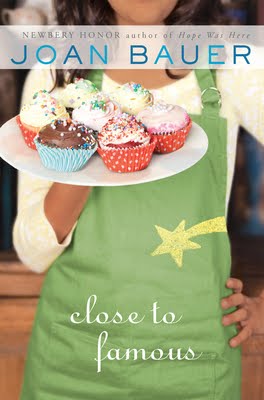
A Review of Close to Famous by Joan Bauer

You know how some authors are so reliably good that you simply buy their next book on auto-pilot, sight unseen? Joan Bauer is on that list for me. I especially liked Squash and Rules of the Road, but I've been pretty darn happy with all of her books. Now I've just finished her latest, Close to Famous, and while I wasn't quite as fond of it as I have been of some of her other titles, it nevertheless boasts Bauer's trademark strengths, including an appealing main character, colorful-yet-real secondary characters, and a small-town feeling of people pulling together to help each other. In my experience, this author's books are always feel-good reads, without being overly sentimental.

I was pleased to see that Close to Famous also features a main character who is half African American and whose mother is African American. This is inserted subtly, and once again (sigh) the jacket barely seems to indicate it. (Foster's hair is curlier in the book, for instance.) But it is there, I am happy to report.

When the story begins, Foster McFee and her mother are on the run from Mom's abusive boyfriend, an Elvis impersonator. They find shelter in a small town where someone kind gives them a tow, someone else kind gives Mrs. McFee a job, and the tow truck people then give them a place to stay. I would like to think that this would really happen. I'm sure it has, somewhere out there.

But I haven't even gotten to the good stuff, which is that Foster is incredibly talented as a self-taught young cook, especially when it comes to baking. At the same time, she is incredibly un-talented at reading. In short, she can't read, though she covers it up like a champion.

Now, as Foster spends the summer making connections with people like a young would-be documentary filmmaker and the actress who's hiding out from the pain of her all-too-public dumping by a big-time Hollywood flame, she finds that her secrets are coming out.

Plus she's worried about the location of a certain pillowcase that contains the few items she has remaining after her soldier father's death in Iraq.

Will this young cupcake maker be able to get in touch with her hero, TV chef Sonny Kroll? Will Miss Charleena ever come out of her house again? Will Foster's mom be recognized as having a star's voice, not a backup singer's? Will Macon ever make a documentary about the new prison down the road? Will Foster learn to read?

Quite probably!

Now for some quibbles... I have to say that I found the events of this book a little rushed. I wished for a slightly longer book to let things unfold more organically. Even so, I loved these characters and was hooked into their story.

The learning-to-read subplot felt didactic at times, yet it resonated with me overall, particularly because I have a dear friend who didn't learn to read till she was 18, faking it in all 11 of the schools her drug addict mother dumped her in for 10 years running. I am happy to report that my friend went on to get her GED and graduate from high school at the age of 32. (Like Foster, my friend has a learning disability. I'm guessing Close to Famous will be a Schneider Family Book Award nominee next year!)

One odd note: The author uses present tense for the first two chapters (the escape), then switches to past tense for the rest of the book. Plus there's a flashback in one of those chapters, which is of course in past tense. This back-and-forth with the verbs is distracting, but only for a few minutes, when you might find yourself, as I did, turning back pages and trying to figure out what's going on. It's smooth sailing after that.

In a Bauer book, however, strong characters, humor, and great dialogue far outweigh any minor concerns. For example, pay attention to the way Foster learned to cook in the first place—by falling hard for the art (initially with a friend) and working her butt off till she got it right, relying on listening and memory because she couldn't read the recipes. In an age when too many kids grow up scarcely lifting a finger to pick up their gym socks, it's great to see a kid who embraces a vocation and really puts in the required effort to make it happen. Eventually, Foster applies this same kind of effort to the far more daunting task of learning to read. Her determination and hard work are just a couple of the many nice things about this character. To begin to understand how endearing this kid is, watch Foster doing an episode of her so-far-imaginary cooking show:

I put on my shooting star apron, got out my baking pan, opened the refrigerator, and took out tortillas, tomato sauce, salami, and cheese.
"Today on Cooking with Foster we're going to make smiling pizzas for sad days." I put two tortillas down on the pan, spread red sauce over them, and sprinkled on mozzarella, garlic powder, and onion.
"Be careful the cheese doesn't go over the edge or it'll spill over on the pan and start smoking. That can make your whole kitchen stink. I'm going to turn the oven dial to four-fifty." I did that, smiling. "And now I'm getting my best knife"—I held it up—"and I'm slicing a thin round of salami into a smiley shape just like this. Don't make it too thick...."
Then Foster tells us about sad days and matter-of-factly relates that to losing her father in the war before she takes the mini-pizzas out of the oven.

Thank you, Joan Bauer, for giving us a girl to care about, as well as people to care about her.

Note for Worried Parents: This is listed on Amazon as a book for teens, though it reads as upper middle grade to me. Foster's mother is not extensively abused, but she does get hit by her boyfriend, who later stalks her and her daughter. That isn't the dominant story line, however; it's just one of many plot threads. I would be happy to share this book with middle school students and most fourth and fifth graders, as well.

Update: Peter D. Sieruta wrote about Close to Famous this week on his blog, Collecting Children's Books. He makes an interesting connection between an epic theatrical performance from his boyhood in Detroit and Foster's actress friend, Miss Charleena.

Friday, September 17, 2010

A Review of Dirt Road Home by Watt Key

I am a big fan of Watt Key's book, Alabama Moon, so I was happy to discover this sequel. But I will add a cautionary note, one that reflects my experience reading both books: Alabama Moon is middle grade fiction (ages 9-12), while Dirt Road Home is YA (Young Adult, ages 12 and up). Basically, we're talking PG vs. PG-13, mostly because of violence. To put it bluntly, Dirt Road Home has a kind of Lord of the Flies vibe.

That said, it's a good book because Watt Key is a terrific storyteller, and I do love finding out what happens to Moon's friend Hal. If you've read Alabama Moon, you may recall that Moon, a boy raised in the wilderness by a Vietnam vet father who distrusted everybody but especially the government, was placed in a boys' home after his father's death and managed to tame a bully named Hal. At the end of that book, Hal was sent to juvie to finish paying his so-called debt to society. Which is where Dirt Road Home picks up.

Hmm. Perhaps I should say this book is Heart of Darkness for fourteen-year-olds, or even One Flew Over the Cuckoo's Nest... Here Hal compares the state residence where he met Moon to Hellenweiler Boys' Home (emphasis on the "hell"):
You would never hear an adult call Hellenweiler a prison. It was always referred to as a "boys' home." But to look at the one-story cinder-block compound from the outside, there was no question what the place was modeled after. I had an idea what I'd find on the inside as well, and it wouldn't be pretty. I already had the feeling that Pinson had been a preschool compared to this place. This was a high-security jailhouse to lock down eighty bad boys.
Hal's first worry isn't how awful his new home will be; it's whether he'll be able to keep his temper and stay out of trouble so he won't be stuck in this place forever.

But soon he has other worries, because Superintendent Fraley has a dark, contemptuous approach to running Hellenweiler. He actually references Golding's classic in his orientation speech to Hal, then goes on to say:
You see, they tell me to educate the boys. To reform them. But this is just political talk to our fine citizens. Feel-good talk, if you will. In reality this place is a sort of human landfill that you hide on the outskirts of town. It's nothing more than a kennel for dogs that have no hope of being chained. This may sound harsh, but it is simply a reality that you must learn to face. The sooner, the better.
Hal finds out that Fraley has looked the other way, letting the boys form two gangs that brutalize newcomers into joining one or the other. The gangs battle for the Hellenweiler turf, having vicious fights on a regular basis. Hal is determined not to join either of the two gangs because he wants to keep his nose clean and get out fast, but avoiding trouble doesn't mean Fraley will support Hal's goals. In fact, Fraley doesn't want anyone contradicting his cynical convictions about the boys.

Hal is on his own, dealing with pressures and abuse from both gangs, though one more than the other. He sort of befriends one gang leader on the sly. And he wonders about the only other boy who's not in a gang, a huge, shell-shocked kid named Caboose. As the pressure ratchets up, Hal tries to lean on the knowledge that he has friends outside this prison, even an almost-girlfriend, Carla.

But he ends up getting sucked in more than he planned, and violence erupts again and again. Until Hal comes up with his own way of fighting back.

This is not a pretty story, it's a gritty story. It's also a psychological (and sociological) drama focusing on what happens when people live down to our expectations—or struggle to surpass them.

While you don't have to read Alabama Moon to appreciate Dirt Road Home, it does help, although, as mentioned above, the latter is a darker, bloodier tale. Even so, Dirt Road Home ends on a note of hope. As the title implies, Hal's determination not to give up is more powerful than anything someone like Mr. Fraley can throw at him. And, just as Moon rescued Hal from his worst self in the first book, here Hal rescues a couple of other boys from their downward trajectories.

Note for Worried Parents: This book might not be as dark as some of the YA out there, but it's dark enough—it's essentially a prison story for kids. There is gang warfare, including real and threatened violence. Plus just a lot of guy stuff. (I can't see many girls getting into this one!) Oddly, however, there's a sort of parable quality to Dirt Road Home, which may be why it's not quite as rough as it sounds.