Showing posts with label nature. Show all posts

Tuesday, March 26, 2013

A Review of Forest Has a Song by Amy Ludwig Vanderwater


Today is a happy day. It’s the release date of Amy Ludwig Vanderwater’s first poetry collection. If you haven’t heard of Amy, you should. I first “met” her in the poetry blog community last April, when I followed her poems through National Poetry Month, one for each letter of the alphabet and a few bonus poems. Amy has a very friendly and poem-filled blog, The Poem Farm. She actually lives on a farm in New York, where I suspect she takes walks
through the woods.

We can join her in Forest Has a Song, which takes us on a walk through the forest and the
seasons with a girl and her dog. The book is illustrated in light-filled watercolors by Robbin Gourley. We begin with rows of leaves on the endpapers, then a view of a house with a path leading to the woods on the title page. The oft-overlooked credits spread is especially pretty—a row of weedy grass stalks on a sky-implying background. Of course, our true journey begins with “Invitation,” a poem that starts with the girl’s words and ends with the words of the forest itself. Here is the entire poem:

Today
I heard
a pinecone fall.
I smell
a spicy breeze.
I see
Forest
wildly waving
rows of
friendly trees.

I’m here.
Come visit.
Please?

This is a good example of poet Vanderwater’s voice, clean and spare and true. Our walk continues with a “Dead Branch,” a haiku stick thrown to the girl’s dog. Then we meet “Chickadee,” who is afraid of the girl but is nevertheless attracted to the seeds she offers. As in the first poem, the poet gives us the girl’s voice followed by the bird’s. “Forest News” is next, in which the girl sees the tracks left by animals as the words in a newspaper. News about different animals is described in flowing lines. A couple of my favorites are “Young raccoons/Drink sips of creek” and “Here a possum/whiskery-wild/climbs a tree trunk/with her child.” The poem concludes:

Scribbled hints
in footprints
tell about the day.
I stop to read
the Forest News
before it’s worn away.

Our girl walks on, having encounters with unfurling “ferny frondy fiddleheads” and a “grandfather fossil,” a trilobite, before moving on to a tree frog and a lady’s slipper. There’s a sly bit of fairy tale humor in having those two poems on the same page since Vanderwater’s frog is courting and the lady’s slipper is the one dropped by “Forest Cinderella.” The frog poem, “Proposal,” begins rather desperately with:

Marry me.
Please marry me.

A tree frog calls
from tree to tree.
Hoping.
Hopping.
High above.
Crooning.
Plopping.
Finding love.

Notice the combination of romance and absurdity, as in “Crooning” followed by “Plopping.”

The girl is having a picnic with her family on the next spread, giving us “Spider” and the lullaby-like “Dusk.” Then the two night poems are especially nice. “Lichens” ends with a wise little twist and “First Flight” tells the story of a young owl’s first flight: “Mommy, I’m scared to be this high.” After that we see the girl and her dog back in the forest on their own, exploring moss and a sad little pile of bones: “I wonder/who will bury you?” We get a taste of “Wintergreen,” a moment of deer watching (and vice versa), “Home” in a rotten log, and the “Puff” of mushrooms ready to loose their spores. A “Warning” about poison ivy and the sound of “Woodpecker” finish off the summer: “In a red cap/he types poems/with his beak/upon a tree.”

The girl is waiting for the school bus as “Maples in October” decide to turn red. “Squirrel” has secrets, but can he remember them? Then we reach the poem that gave the book its name, “Song.” The girl tells us about the sounds of the forest, concluding:

Silence in Forest
never lasts long.
Melody
is everywhere
mixing in
with piney air.

Forest has a song.

A page turn. Snow has fallen, and snowflakes have voices. “Father cardinal” shows off: “Dramatically/he makes an entrance/through two birches/at stage right.” Finally, Forest bids us “Farewell,” again evoking the “spicy breeze” we smelled in the poem that began the collection, “Invitation.” The girl and her dog walk home.

Gourley’s illustrations are deliberately fair and spare, making a good match to Vanderwater’s poetic style. The girl appears with her brown Everydog on most of the spreads, leading us on a rambling tour of the forest. We get to see her parents and her little brother once or twice, as well. The subjects of the poems are called out in the artwork, but they support the poems rather than competing with them. The cover art is particularly lovely, as you can see.

Listen to the entire text of the title poem and take a look at more images from the book in the book trailer. Forest Has a Song is recommended by no less a luminary than J. Patrick Lewis, Children’s Poet Laureate of the Unite States: “With her first book of children’s poetry, Ms. VanDerwater has already arrived.”

I don’t know about you, but here where I live, Spring is starting to show her face. What better time to take a walk in the woods?

Note: Thanks to Clarion Books for providing me with a review copy of Forest Has a Song.

Sunday, December 9, 2012

Three Picture Books for the Thoughtful Child

Some picture books are wonderful because they sing out like a brass band, but others are just as marvelous because they murmur like a night wind. Here are three such books.

Unspoken: A Story from the Underground Railroad by Henry Cole

Making a picture book that’s wordless is usually more of a storytelling choice than a symbolic one, but here the wordlessness is both, as the title implies. This is a story about keeping quiet for all the right reasons, about keeping a secret to keep someone safe. It is also about not needing to speak to help someone out—which makes me think of quiet kindnesses in everyday life.


As our story begins, a young farm girl bringing the cow home from the pasture watches five men pass on horseback. The first one is carrying a Confederate flag, so we understand that this story takes place in the South during the Civil War era. The girl goes to feed the chickens, and then her mother sends her to fetch the eggs from a small barn. As she does so, she is frightened to realize that someone is hiding in a big stack of corn stalks laid in one corner of the barn, perhaps to dry for feed.

The girl runs back to the house, but even before she goes inside, she starts to calm down and think about what this means. She does not say anything to her family, but after dinner she goes out to the barn with some food for the fugitive. Perhaps my favorite part about this story is a spread showing different hands holding different food items on the same checked cloth—showing that each member of the family separately slips out to the barn to feed the runaway slave hiding there.

The next day two men come to the farm looking for a runaway slave, but the girl’s family sends them away. That night the runaway is gone, but she has left a simple gift behind for the girl, something she has made from the checked napkin and the corn husks.


A good picture book is like a poem. It is hard to tell a story well in just a few words or just a few pictures, but Cole succeeds beautifully. The entire book is done in charcoal pencil on cream-colored textured paper, giving it a sepia look like photos from the late 1800s as well as a subtle richness. The North Star, or rather the Little Dipper containing the North Star, is a motif used in a piece of art that appears on the book cover and inside the book; it is also shown on two other spreads, tying the story together.

Unlike a graphic novel, the picture book format does not allow for a lot of sequential storytelling, but Cole has chosen his moments well, and the narrative flows logically. I like the way he shows most scenes at a medium distance, but includes the occasional close-up. One of the best spreads in the book is simply all those corn stalks with their marvelous texture—and one eye of the hidden girl looking out.

Cole includes an author’s note that explains about the Civil War stories he heard as a boy growing up in Virginia, as well as more information about how slaves used the North Star to guide their escape to freedom.

Unspoken may require you to use a few words of introduction to give young readers historical context. But the sense of quiet urgency, the threat of discovery, the courage of the runaway, and one farm family’s kindness need no words, as Henry Cole so wisely shows us.


The Beetle Book by Steve Jenkins

I knew a guy in Los Angeles who created original artwork using photographs of beetles. They were really gorgeous, so it’s no surprise to me that the beetle art in Jenkins’ latest nature book is, too. The cover alone is worth the price of admission!


I will admit I was a little put off when I first opened the book and saw how small the font size is, but I quickly got used to it and realized that its size means the text doesn't compete with the illustrations. Beetle names are in boldface in the text, which is helpful. Another nice touch is that the author-illustrator gives us many of the beetles in black silhouette to show their actual sizes.

Jenkins lets the stark white backgrounds set off the beetles’ strong colors and shapes, taking full advantage of negative space and the beetles' symmetry to create graphic art-influenced illustrations. Many of the beetles are static, portrait-style, but some are shown in action, most notably two rhinoceros beetles dueling to win a mate. The illustrations are all the more breathtaking when you realize that they are done entirely using “torn- and cut-paper collage.” Jenkins has joined the rarified ranks of Eric Carle and Lois Ehlert in his use of the technique.

The science content may remind you a little of an Eyewitness book. The Beetle Book is filled with fun facts. For example, have you ever heard of the forest fire beetle? "[It] has special heat-sensing spots on its body. It can detect a fire from more than 20 miles (32 kilometers) away. These beetles fly to the site of the forest fire and lay their eggs in charred wood—wood that is now free of predators." I thought he was going to say the beetles sensed the fire and flew away from it, but instead the beetles fly to the fire!


Stinky beetles, shiny beetles, poisonous beetles (if you eat them!) and camouflaged beetles—Jenkins introduces readers to a colorful cast of characters. One of my favorites is an Australian beetle called Wallace’s longicorn, which has a body that’s not quite 4 inches long and antennae that can reach 15 inches or so in length. (Illustration above is a dung beetle.)

I’ll just end with one final fact, Jenkins’ opening sentence: “Line up every kind of plant and animal on Earth… and one of every four will be a beetle.” So yes, we’re outnumbered. But if you’ve got a budding scientist on your hands, get him or her The Beetle Book.

Here’s Chris Marley’s website if you want to see his beetle art and other pieces.

Also: See The Beetle Book cover art below at the end of last week's post.


The Moon Jumpers by Janice May Udry, illustrated by Maurice Sendak

This is a golden oldie, a Caldecott Honor Book back in 1960, predating Sendak’s 1964 Caldecott Medal for Where the Wild Things Are. I am happy to bring it up now because Harper Collins is reissuing the book in February. So just how well does The Moon Jumpers hold up?

It is retro in two obvious regards: it’s a quiet book, and the dad in the book smokes a pipe. The text of the story would be a real hard sell if Udry sent it out to Scholastic or any other publisher today. Fortunately, she sold it in a kinder, gentler day, and then Sendak’s illustrations made a slight story into something significantly more magical. Basically, four kids go outside and play around. Then their mom calls them in and they go to bed.

So what does Sendak do with this material? He adds a cat, for one thing. He shows how four kids can make a game out of anything, including a tree branch and the moon. And he gives the whole thing this really atmospheric feeling, reminding us that there is something mysterious and a little wild about the night and the moon. The four children—two girls and two boys—are a bit pretty, especially the girls, but we can happily forget that as they strike kid poses and flop around and goof off. (See Sendak’s brilliant work showing how kids move and the faces they make in Ruth Krauss’s A Hole Is to Dig.)

The spreads here are flatter and simpler than in some of Sendak’s later work, though you can see hints of Where the Wild Things Are in his trees and bushes. The shapes of the house, the trees, and the shadows make new meaning out of the night, as do the figures of the children. One spread I particularly like doesn’t show the children at all, just the house, the night, and the cat.

But I am not giving enough credit to Janice Udry for her own understanding of children. What do the children do, playing outside?

"We climb the tree just to be in a tree at night.
And we make a little camp and pretend we’re on an island for the night.
We make up songs. And poems. And we turn somersaults all over the grass.
We tell ghost stories. And holler “Boo!” under the window.
We jump and jump, over and over, and higher and higher. But nobody has ever touched the moon."

Today, even if you had four kids instead of two and weren’t afraid of them getting snatched from the yard and could get them out the door after dark, they would probably sit on the porch playing video game apps.

I hate to cite nostalgia, but it’s another good reason for liking this book. Most of all, though, I think I like it for the mood. People don’t necessarily talk a lot about that as a book illustration skill, but one reason Maurice Sendak is considered a master illustrator is because he could create a tone so distinct it was like a voice calling softly through the night.

The Moon Jumpers reminds me of that—and of catching fireflies when I was a child in my grandmother’s backyard. 

Sunday, November 4, 2012

Poems for an Autumn Day

Mind you, the poems aren’t fall-themed—but each of these books is worth curling up with on a gray day or even one of those blue-sky days blazing with leaves. Don’t forget the apple cider!


Outside Your Window: A First Book of Nature by Nicola Davies, illustrated by Mark Hearld (February 2012)

This book is a case of that old expression: the whole is greater than the sum of its parts. Though Outside Your Window is a collection of poems, it is also an introduction to nature. Many of the lines sound like a very pleasant science teacher explaining things such as birds, cows, and seasons. I was often reminded of prose poetry or simply well-stated prose. But then, some of the poems—and certainly some lines, are startlingly poetic. They are rendered all the more so by the poetry of Hearld’s illustrations, which wrap around Davies’ work like a quilt sewn by Mother Nature.
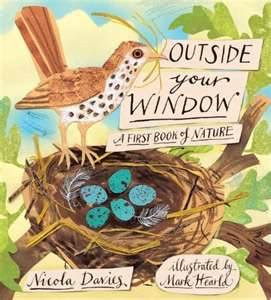


Be sure to take off the dust jacket. The look and design of the bare cover are wonderful in their own right. Hearld’s artwork manages to combine a look of 1950s children’s book illustration (e.g., Feodor Rojankovsky’s Caldecott winner, Frog Went A-Courtin’) with nonfiction nature illustration. The textured grandeur of his mixed-media style is made all the more intriguing by its often-small subjects. For example, a poem called “Night” is illustrated by a full spread that begins with yellow stalks of barley on the left, outlined by blues in a printerly way. A brown-and-blue mouse eating fallen grains of barley at the bottom of the page leads us across the gutter into a dark blue night holding the white-lettered poem. A moon, a star, and an owl overlook the right-hand page. What this description leaves out is that the whole thing sweeps and swirls as if brushed by a night wind. Hearld’s artwork makes the book into something positively spellbinding—and yet the poems are ultimately science-minded. The book is a strange and wonderful piece of art, poems and all.

I have questioned the poetic qualities of Davies’ work. We get, for example, lines such as these:

The frogs are croaking in the pond
and laying eggs like spotted jelly.
Next week the spots will be wiggly tadpoles.
Next month they’ll grow a pair of legs.
By summer they’ll be tiny frogs that leap off into the world.
And one night in another spring, when they’re big frogs, they’ll be back!

This particular poem’s best lines frame the ones I just gave you with frog calls: “Rrrruurrrp. Rrrrrruuurp. Rrrrrruuup.”

However, I should note that such descriptions take on a greater meaning because of Davies’s sharp eye for the details of nature. I had no idea that “Lambs’ tails wiggle when they’re happy…You’ll see it happen when a lamb is feeding….” Or that after dandelions bloom, “they fold up like furled umbrellas pointing at the sky./Then each rolled umbrella opens/into a puff of down.” The description of a gull’s flight is particularly fine. First the gull “runs into the wind, wings working hard for takeoff.” Then it “scoops the air with big, long strokes….” After soaring, the gull glides: “Now it bends [its wings] to make a W/and slides down the wind toward the sea.” Each of the four small stanzas is introduced with a flight sound or verb in a larger font.

Davies often uses repetition, cumulative refrains, and other devices to give her poems a more song-like quality. Her poem “Cherry Blossoms” ends each stanza with “blossoms”—the word is used once in the first stanza, twice in the second, and three times at the last. It’s a simple but true way to describe the drifts of pink that increasingly cover the ground.

I would have liked to see more metaphors, but when they appear they’re very good. “Plant [seeds] in some soil,/crumbly and moist as cake mix,” for instance. At the end of a poem called “Honey” that describes the work and sound of bees bringing nectar, we are told that their buzz and hum is “The sound of sweetness and the smell of flowers,/of sunny, sleepy summer—/the sound of honey.” That last line is just perfect.

Davies has another stupendous stanza at the end of “Tide,” but I’ll share the one at the end of “Night,” whose illustration I talked about above. Davies describes a night with its breeze, an owl, a star, a “moon [sailing] white and silver/in the dark sky.” Having led us into the night, she closes with:

Sometimes you can feel,
sometimes you can feel,
sometimes you can feel the world is turning.

So yes, at first I felt that many of the poems were a bit bland. But then I began to see this book in a different light. It really does give us eyes for looking at the world of nature that lies outside the window. And while its voice is often simple, it flashes powerful language every so often like streaks of lightning. Here’s another one, where Davies extends a cliché and makes it new. Speaking of a horse, she says:

…its dark eye is quiet,
and its nose is velvet,
softer than your own cheek.

I should mention that Davies gives us moments of humor, as in her poem “Five Reasons to Keep Chickens.” She also gives advice, mostly of the kind that will help children better care for the world. Sometimes it’s just nice; for instance, she tells us we should say thank you to worms. The book ends with instructions about how to save seeds and how to make winter cakes for birds.

Outside Your Window grew on me like a seed sprouting up into a plant. It’s a hodgepodge, yes, but in the best possible way—like compost (and there is a poem about compost). Even when Davies is just chatting about nature in that kindly teacher’s voice, there is something soothing and enlightening about her words. Other times she really sings, and Hearld sings with her. I recommend this book wholeheartedly.


National Geographic Book of Animal Poetry: 200 Poems with Photographs that Squeak, Soar, and Roar! edited by J. Patrick Lewis (September 2012)

Like Davies’ book, this one is chockfull of poems—a poetical bang for one’s buck, which I like very much. There have been a lot of books of animal poems over the years (e.g., Eric Carle’s collection, Animals Animals), but some genius finally came up with the idea of pairing photos from National Geographic’s vast collection with an anthology of poems, in this case one created by our current US Children’s Poet Laureate. Huzzah!

While many of the poems are from the past, by poets such as Emily Dickinson, Robert Frost, and Ogden Nash, more recent and current poets are also well represented. The poems are grouped in nicely parallel sections. After a brief set of introductory poems called “Welcome to the World,” sections proceed as follows: “The Big Ones,” “The Little Ones,” “The Winged Ones,” “The Water Ones,” “The Strange Ones,” “The Noisy Ones,” and “The Quiet Ones.” A section of four poems called “Final Thought” concludes the book. The fact that there are sections about noisy and quiet animals endeared the book to me even while I was still in the table of contents.

But really, how do we judge a collection like this? Probably by looking at the overall qualities of the poems and the ways in which they represent their subjects. Variety of styles, voices, and ideas is important. Another consideration is the fit between illustrations and text. These big picture criteria are difficult to wrangle on a poem-by-poem basis, which leads me to take the old-fashioned approach: going with my gut. So yes, this is a terrific collection! But I will provide you with some examples to back that up. As is required so often in life, let’s begin with the elephant.

The book offers four poems about elephants on a left-hand page with a really great photo of an elephant on the right—the photo, labeled “Asian elephant” in very tiny letters at the lower left, shows an elephant in a pond with green hills behind, tossing water onto his head with his trunk. The most well-known and oft-anthologized poem on the spread is “Eletelephony” by Laura E. Richards (“Once there was an elephant/Who tried to use the telephant—/No! No! I mean an elephone/Who tried to use the telephone…”). The other three poems are brief: an anonymous quatrain that has probably been around awhile comments on the “great big trunk” that “has no lock and has no key,” but is carried everywhere by the animal, along with two more modern poems, another quatrain and a haiku. These are the latter two:

Elephant

A threatening cloud, plumped fat and gray,
Snorts a thunder, rains a spray
And billows puffs of dust away—
A weather maker every day.

—Ann Whitford Paul


Anthology

So many stories
Locked inside the amber eye
Of one elephant

—Tracie Vaughn Zimmer


Of course, not every animal gets more than one poem. The variety of poems—and animals—is just right, however. I’ll list two subjects from each section to give you an idea: cow and orangutan, ladybug and lizard, bat and hummingbird, starfish and walrus, armadillo and blue-footed booby, pig and raccoon, Luna moth and sloth. As you can tell by the elephant examples, some of the poems are silly and others are serious. Here are excerpts from two other poems, one of each type:

from “Moray Eel”

Nighttime’s my bright time.
It’s head-out-and-bite time.
Give-shellfish-a-fright time.
Swim-quick-as-a-kite time.
Stay-out-of-my-sight time.
Or fins-up-and-fight time.
When I am the blight of the sea.

—Steven Withrow


from “Dog”

The sky is the belly of a large dog,
sleeping.
All day the small gray flag of his ear
is lowered and raised.
The dream he dreams has no beginning.

Here on earth we dream
a deep-eyed dog sleeps under our stairs
and will rise to meet us.
Dogs curl in dark places,
nests of rich leaves.

— Naomi Shihab Nye

The photo that accompanies the moray eel poem is a head-on shot of an orange-faced eel with teeth glaring and yellow eyes bulging off to the sides. The dog photo is a bright green field of grass with a small dog’s head sticking up out of it, mouth open in a grin and ears jutting like a bat’s.

The best poem in the book is arguably Lewis's own, a poem so comprehensive and gorgeous that it rightfully introduces the collection. Only you might miss it if you're not careful: it's printed on the front cover beneath the dust jacket. The poem is titled "Instructions Found After the Flood," and I'll give you just the first seven lines (of 19).

Let the red fox quicken the seasons.
Let the zebra buck and clatter in the cage of his skin.
Leave the glass lagoons to the blue heron, whose eye is steady.
Let jungles whisper jaguar, whose paw is velvet.
Let the worm explore the globe, his apple.
Let the spider embroider the air.
Let tongue and belly be called reptile.

You see what I mean? This poem, like the collection, is deeply satisfying. Not every anthology is as rich as National Geographic Book of Animal Poetry, but every public and school library and, I hope, personal library needs this book.