Saturday, October 1, 2011

A Review of Shelter by Harlan Coben

Yet another writer for adults crosses over into the lucrative YA market, this one an Edgar-award winning mystery/thriller author who's been writing books about Myron Bolitar, our new MC's uncle. In fact, Mickey Bolitar was apparently introduced in Coben's latest adult novel, Live Wire, but here the focus is on him—and we're clearly talking series starter. Coben doesn't pull any punches: he starts off with a white slavery/sex trade plot in his very first book. No middle grade fiction for him!

Mickey watched his father die in a car accident, and now his grieving mom is in rehab. He's not crazy about his new school, either, at least until he meets an odd but lovely classmate who becomes his girlfriend. Then Ashley disappears, and Mickey is determined to find her.

Along the way, he'll run into some seriously scary characters, as well as "Bat Lady," an old woman who gives him some clues about his father's secret life, things Mickey never knew before. The trail of his father's secrets extends back to other people's stories, events from the World War II era.

Meanwhile, Ashley is linked to a strip club owned by some real thugs. Mickey gets in and out once without any real damage, but he won't be so lucky twice.

At school, Mickey finds more clues about what happened to Ashley; he also has run-ins with a bully and a pretty girl who knows more than she should. But my favorite characters are goofy Spooner and sour Ema. Spooner is a bit of a clichĂ©, the over-talkative geek—still, he's rather appealing. Ema is sort of goth, a hostile fat girl who's bright and loyal and willing to break the rules for her friends. Though it seems obvious Ema could never be a romantic figure to Mickey, whether due to her weight or because she makes such a great friend, she is nevertheless a powerful character who really adds to the story. This is from the scene where Mickey meets Ema. He saves her from participating in an unpleasant school activity, but she's not exactly grateful:
"Is it mandatory?" I asked.

"Excuse me?"

"Is participating in this particular exercise mandatory?"

"Well, no, it's not manda—"

"Then I'm sitting out." I looked over at Ema/Emma. "Would you mind keeping me company?"

We walked away then. Behind me I could hear the world go silent. Then Ms. Owens blew a whistle, stopping the exercise and calling for lunch.

When we were a few more feet away, Ema/Emma said, "Wow."

"What?"

She looked me straight in the eye. "You saved the fat girl. I bet you're really proud of yourself."

Then she shook her head and walked away.

One amusing plot component is that Mickey doesn't trust Uncle Myron, though many readers will come to the book thinking Myron is a pretty great guy thanks to the author's adult series. Mickey sneaks around quite a bit trying to solve the mystery of Ashley and of his father's death, rarely turning to his uncle for help.

Neither Coben's prose nor his storytelling is extraordinary in this book, but it's not a bad series start. Shelter is a pretty solid adventure which should appeal to fans of Alex Rider and the like. Of course, while the Ashley story wraps up, the author leaves the door open for a sequel that will continue to pursue the mystery of Mickey's father.

There's definite reluctant reader appeal here, with an easy style, plenty of action and suspense, and a likable main character. I suspect Book 2 will take hold even more successfully. And I look forward to seeing more of Ema and Spooner!

Note for Worried Parents: This is a book for teens, with some peril and violence, as well as a mature plot about the sex trade—though it is handled fairly tastefully and the good guys win. Also: Take a look at Harlan Coben's website, where you can find a book trailer for Shelter.

A Review of The Pearl Wars by Nick James

This debut novel enters the growing ranks of YA sci-fi with strong boy appeal; it's also another dystopian offering. In James's future U.S., most of the population is divided between a corrupt government on the Surface and a group of Skyship dwellers who are political dissidents. Both groups compete to capture the Pearls: small spheres that fall from space and contain vast quantities of energy that can be used to keep the machines of civilization running.

Of course, there's a third faction here, though it's not well organized—those who live between the ruins of post-apocalyptic cities outside the protected areas run by the government. The worst of these are called Fringers because they live in Fringe Town and are the equivalent of roving street gangs. But others eke out an existence in quietly pathetic little communities.

Jesse Fisher lives on a Skyship. He encounters ruthless Cassius Stevenson from the Surface agency when both are in pursuit of a fallen Pearl. As they clash, the boys nearly die; then, as the two of them dangle from the rooftop of an abandoned building, they feel a strange flash of energy flowing between them. Just what connection could two such different people possibly have?

Back in their respective realms, Jesse and Cassius discover that the adults they trust are keeping secrets from them. When they meet again, is it to kidnap, kill, or help each other? Each boy seeks for answers, but the politics of Skyship and Surface conspire to keep them from learning what they need to know.

James deliberately makes Cassius less likable than Jesse, who seems more like the main character. But the two subplots do intertwine, and you may feel a bit of sympathy for cold-hearted Cassius before all's said and done.

Jesse has friends on the Skyship, but it's hard for him to know who to trust. Why does Captain Alkine take an unusual interest in him? Then there's an older girl named Eva. She seems to keep an eye on him, but why? Is Skandar really that good of a friend? And what about Avery, a girl who might be attracted to Jesse?

Then Jesse starts having strange interactions with the falling Pearls. Who is he really?

As for Cassius, he begins to question the intentions of Madame, leader of the Surface government and the closest thing he has to a mother. Does she care about him at all? As his body reacts bizarrely in the aftermath of his meeting with Jesse, he becomes determined to find the Skyship boy and see if he can make things normal again.

But neither boy is exactly normal. Eventually both of them are on the run, running from each other and after each other, fleeing from larger forces as they head for the ruins of Seattle, where they believe they will find the truth.

Here's a sample of the action:
Just as the guy's about to crack my skull open, an explosion rattles the street.

All three Fringers release me and spin around. I crumple to the ground, face on fire.

Framed by their tense, ready-to-pounce bodies, I see the silhouette of Eva Rodriguez. A trail of sandy smoke winds up into the air beside her like a serpent. It came from a detonator, the spherical shell of which lies on the cracked pavement in front of her right foot.

She looks older than her fifteen years, and far more intimidating than me with her cropped hair and well-practiced battle scowl. A bulky burlap pouch hangs over her shoulder, barely containing a radiant green glow. Resting inside is the Pearl we were sent down to retrieve...

"I've got more where that came from." Her dark eyes lock onto each of them as she moves the barrel of the pistol from one to another. "Leave. Now."

You'll find more action than character development in The Pearl Wars, but Jesse is a nicely dimensional character, while Cassius is sufficiently dark and complex to create a good contrast to his Skyship counterpart.

Nick James's vision of the future is an intriguing one, and his storytelling is suspenseful and fast paced—obviously influenced by TV, movies, and comic books. Watch for some great plot twists as you give this first volume of his new Skyship Academy series a try!

Note for Worried Parents: Like many YA dystopian novels, this book has a grim, dreary world marked by violence and betrayal. There's a little boy-girl attraction, but not much more than you'd expect from a teenage boy protagonist.

Also: The jacket art is great, but I think it looks a bit steampunk, and this is not a steampunk book.

Don't know how long it will last, but here's Nick James explaining his blog tour contest, and then you can check out his his very cool website, where you'll find more info about the blog tour and Nick, his book, etc.

A Review of The Project by Brian Falkner

This YA adventure/suspense book reads more like middle grade fiction a lot of the time; in fact, I was surprised when I realized that Luke and his buddy Tommy are in their mid-teens instead of middle school. But let's just agree that Luke and Tommy are pretty immature and move on...

Luke believes that the book assigned by his English teacher, Ms. Sheck, is the most boring book in the world, but he is wrong. Of course, he doesn't know that: when he argues with Mr. Kerr, the vice principal gives Luke and Tommy just a few days to prove what they say about James Fenimore Cooper's classic. He and Tommy have been caught bungling an elaborate prank on school property; now they will have to do some research to save themselves from being suspended.

Luke goes home and googles "the most boring book in the world." According to the online encyclopedia, that honor goes to a tome called Leonardo's River by a man named Darcy Benfer—an English inventor. It was so boring it even put its writer to sleep, and only one copy was ever printed. But a millionaire book collector named James Mullins would love to get his hands on it. He's willing to pay a lot of money for that single copy.

Luke forgets all about the book, caught up in the relative excitement of having to sandbag his town because the river is rising. But while he and Tommy are helping bring books upstairs from the university library's basement to the upper floors, Luke catches a glimpse of a book he is pretty sure is Benfer's sleep-inducing masterpiece. That night, he gets Tommy to sneak across the river with him and look for the book.

Only the river is flooded and the library is beginning to flood, too. Luke and Tommy manage to get by the security on the bridge, then discover they aren't the only ones looking for the book. Rather, they are the ones without guns.

The twosome makes it out, but Ms. Sheck disappears. And the menacing people from the library are soon on the trail of Luke and Tommy.

This suspenseful story heats up with a plot that involves Nazis and Leonardo da Vinci and even [spoiler!] time travel.

The whole thing is even more tricky because everyone thinks of Luke and Tommy as troublemakers, which means that no one takes them seriously when they try to get help from the authorities.

About the only thing they've got going for them is Luke's photographic memory. That and an unquenchable spirit of curiosity and adventure.

Here is an excerpt from the prologue:
This is not the most boring book in the world.

This is a book about the most boring book in the world, which is a different book altogether.

This book is really interesting and exciting, and parts of it are quite funny...

You might think that your history textbook is the most boring book in the world. But you are wrong. Or you might think that your auntie's book about dried flowers is the most boring book in the world, but that's like an action-packed adventure story compared to the real most boring book in the world.

The prose in this non-boring tale does its job handily, and Luke and Tommy are a cheerful, if slightly bumbling, duo.

Falkner, the Australian author of books like Tomorrow Code and Brain Jack, specializes in action/suspense stories. The Project is a light-hearted ride, despite the peril and the threat of world domination from the bad guys. It's salted with guy humor (at least one fart joke that I can recall) and stars a couple of goof-offs playing Hardy Boys. But it is a fun read, and your son might get a kick out of it.

Note for Worried Parents: Though this book is being marketed as YA and has teen protagonists, it reads like upper MG fiction. There is definitely peril, but little actual violence.

Visit Brian Falkner's website to learn more about
The Project and other books.

Also: I like the Australian cover (gold) a lot more than the U.S. cover (red); what about you?

Saturday, September 24, 2011

Ribbit, Ribbit: A Trio of Frog Books

If you've ever visited my author's website, you will know that I am a real fan of frogs, which I like to think of as nature's clowns. (Frog princes are featured prominently in my book, The Runaway Princess!) Today let's take a look at three frog-themed picture books, two fiction and one nonfiction, two new and one old.


Too Many Frogs! by Ann and John Hassett

Not to be confused with Sandy Asher's book, which lacks the explanation mark in the title, this new picture book takes a look at what Nana Quimby does about a frog invasion in her basement. (The plot may remind you a tiny bit of that beginning reader classic, The King, the Mice and the Cheese, by Nancy and Eric Gurney, or better still, Helen Palmer and P.D. Eastman's A Fish Out of Water.)

Nana Quimby is baking a cake when she discovers that her basement has flooded. A helpful paper boy suggests she call a plumber. Soon the water is gone, but a frog appears in her kitchen. Ten frogs, in fact. "'Put the frogs in a goldfish bowl,' said a girl jumping up and down. So she did."

Twenty more frogs appear, and "a boy running fast" suggests she put the new frogs in cups of water.

"So she did."

You can see where this is going, right?

John Hassett's acrylic illustrations give us a marvelous Nana Quimby. For example, on one page we watch her white eyebrows rise in dismay as she stares down at the frog in the cup of water she's holding, with nineteen other frog-filled cups and mugs sitting around the kitchen. There's a parrot in a cage, and out the window we discover a cat chasing a mouse. Perhaps my favorite detail is that Nana, in a lavender polka-dotted dress and white apron, wears blue tennis shoes. Note also her hair, coifed in a goofy way that faintly resembles a chef's hat.

Thirty frogs, forty frogs, fifty frogs—the neighborhood children continue to make suggestions, but eventually Nana Quimby comes up with her own solution, and the reader comes full circle to the richly imagined smell of a freshly baked cake.

Kids will appreciate both Nana's burgeoning quandary and the way passing children give her possible solutions—they may even have their own suggestions.

Apparently this husband-and-wife team has done two previous books featuring Nana Quimby, along with a couple of other picture books.

If the other books are anything like this one, with its soberly escalating absurdity, I'm in!

Note: Visit the Hassetts' website to learn more about their books and Nana Quimby's frog conservation efforts.


999 Tadpoles by Ken Kimura, illustrated by Yasunari Murakami

This book was originally printed in 2003 in Japan, but just became available in English this year. And I'm glad it did.

Consider that age-old parental dilemma: it's all very well to have 999 darling tadpoles, but when your tadpoles turn into young frogs and outgrow their pond, what do you do?
Now the pond was too small for them.

"We can't move!" one called.

"We can't breathe!" called another.

"Don't push!" called a third.

"We have a situation here," said Father.

"We'll have to move," said Mother.

So follows a froggy exodus, including a scary/funny encounter with a snake and an even more wild-and-crazy encounter with a hawk.

To say the theme is "Safety in numbers" is not enough; a better way of putting it is "Family is there for you." The message is delivered in a wry, dry style that I thoroughly enjoyed.

Murakami's illustrations are simple, but her green-and-yellow frogs really pop on the stark white backgrounds. One of the funniest spreads shows Father Frog demonstrating to his children what a snake looks like. Parts of the artwork seem deliberately designed to look like a child's drawings—note the trees and the clouds, for example. Other components are slightly more sophisticated, such as the illustrator's adorable birds.

999 Tadpoles is a clever take on the quest story, made simple enough for the youngest readers, but with a subtle humor that will appeal to parents. And of course, children ages 4 to 7 will like the idea of growing bigger and moving out into a world filled with adventure.

Note: Want to see a whole bunch of frogs in one spot? Try this brief YouTube video.


Nic Bishop Frogs

If you haven't heard of Nic Bishop—well, I just can't imagine that, actually. This photographer has created numerous award-winning nonfiction books for children. Frogs came out in 2008, which means it should be readily available at your local library (assuming budget cuts haven't shut the place down).

Bishop combines marvelous photography with his clearly delineated factual text. Here's a sample:
A frog's life is all about eating.

Frogs eat almost anything that moves and can fit inside their mouths. Once, an African bullfrog ate seventeen young cobras, one after another.

Some frogs seek out their food. A toad hops around after dark, snapping up moths, beetles, and crickets. It may eat more than 5,000 insects during a single summer. Other frogs ambush their prey. A horned frog hides among leaves on the rain forest floor in South America. It stays absolutely still, day after day. When an animal comes by, the frog watches attentively, waiting until it moves closer. Then it seizes the prey with a loud snap of it hug mouth. The horned frog is not a fussy eater. It gulps down cockroaches, lizards, mice, and even other horned frogs.

The accompanying photo shows a horned frog with a mouse tail hanging out of its mouth. The caption reads: "It is easy to see why some people say that a frog is like a stomach with legs, eyes, and a very big mouth. This horned frog has just swallowed a mouse."

The next page begins: "Frogs are prey, too." And discusses frog camouflage, with two more terrific photos to illustrate the point.

I was pleased to come across the last spread, which shows Nic Bishop in a canoe on a pond and explains how he trained one particular frog to be comfortable with the camera so he could get a photo of it catching its prey, among other frog encounters like adopting some gliding frogs.

Remember the days when nonfiction books were in black and white and were mostly text? Well, I've said it before and I'll say it again—the past 20 years have seen a Renaissance or even a first birth in beautiful children's nonfiction. DK's Eyewitness books may have led the charge, but Nic Bishop is the reigning king of photo-illustrated nonfiction for children. (Okay, better give a nod to Seymour Simon! He can be prime minister.)

You really should visit Nic Bishop's fascinating website. Take a look at the awards his frog book has won, as well as a list of his other books. Find out more about how he does the research for his books, including traveling the world to take the photographs. And then there's his life story, briefly yet tantalizingly summarized here.

Turns out Nic Bishop grew up in Bangledesh, the Sudan, and New Guinea. He started taking photographs at age nine. At ages sixteen and seventeen, he traveled the highlands of New Guinea on foot or in a dugout canoe, taking pictures and interviewing villagers with his tape recorder. I'd love to see a book-length biography of this guy!

In the meantime, I can heartily and happily recommend his Frogs to you.

Note: Watch this Scholastic book trailer for Nic Bishop Spiders to see Bishop catching spiders in the woods and taking them home to his studio to photograph.

Saturday, September 17, 2011

A Review of Liesl & Po by Lauren Oliver

I've heard a lot of talk about this book lately, so I was eager to read it and see for myself. The author has already written a couple of well-regarded books for teens: Before I Fall and Delirium. Sometimes authors for older readers who switch to writing for younger children have a little trouble with the transition, but Oliver plunges into the MG genre skillfully.

Of course, I am a sucker for great metaphors, and Oliver has a real talent for them. Here's how the book begins:
On the third night after the day her father died, Liesl saw the ghost.

She was lying in bed in the uniform gray darkness of her small attic room when in one corner the shadows seemed to crimp, or flex, and suddenly standing next to her wobbly desk and three-legged chair was a person about her height. It was as though the darkness was a sheet of raw cookie dough, and someone had just taken a cookie cutter and made a child-sized shape out of it.

Liesl sat up, alarmed.

"What are you?" she whispered into the darkness, even though she knew it was a ghost. Normal people do not appear out of darkness, nor seem to be made out of liquid shadow. Besides, she had read about ghosts. She read a lot in her little attic room. There was not much else to do.

The plot feels a bit like Charles Dickens meets Cinderella. And what a terrific cast of characters!

We've got Liesl, whose awful stepmother has locked her in the attic and has no plans whatsoever to let her out. (Augusta is too busy spending Liesl's inheritance.)

Then there's Will, the boy who stands down in the street watching Liesl's window in between running midnight errands for his heartless master, an alchemist.

Another character I like very much is a simple guardsman named Mo who carries a cat.

The sun never shines in Liesl's land, so the story takes place in a great deal of gloom and chill. Steam trains and factories add to the atmospheric mood of the book.

Liesl and Po has the feel of a fable. It's shaped like a folktale or perhaps a theater piece for children, a Christmas pantomime. The characters are deliberate types: the Wicked Stepmother, the Simpleton, the Oppressed Good Daughter, the Evil Alchemist, the Kindly Boy, the Greedy Duchess, the Thief. This is a good thing: the stylized feel of the book really works with the story Oliver is telling. So does the sweetly whimsical tone, shining forth in spite of the gloom and the various villains.

The book's magic, which is carried around in a box and changes hands comically (as in one of Shakespeare's plays about mistaken identity), is defined rather vaguely. It becomes a Symbol, not the tool you have seen in other fantasies.

Of course, let's not forget that this book is in part a meditation on death, loss, and the afterlife. Oliver herself says as much in the Introduction:
I wrote Liesl & Po during a concentrated two-month period at the end of 2009...

At the time, I was dealing with the sudden death of my best friend. The lasting impact of this loss reverberated through the months, and it made my world gray and murky, much like the world Liesl inhabits at the start of the story....

Only in retrospect did I realize that I was writing about myself—that Liesl's journey was my own.

The author goes on to define the book, not as an escape, but as "the opposite of an escape; it is a way back in...."

And so we return to that little ghost, Po, who becomes Liesl's best friend, despite the space (and philosophy) that separates them. Here is a moment when Liesl asks Po for a favor:
"And you must help me," Liesl finished.

Po was unprepared for this. "Me?" it said unhappily. "Why me?"

"Because you are my friend," Liesl said.

"Friend," Po repeated. The word was unfamiliar by this point. Something tugged at the edges of Po's memory, the faintest of faint recollections of a bark of laughter, and the smell of thick wool, and the sting of something wet against its cheek. Snowball fight, Po thought suddenly, without knowing where the words came from: words he had not thought of in ages and ages, in so long that millions of stars had collapsed and been born in that time.

"All right," Po said. It had never occurred to Po that it would ever have a friend again, in all of eternity. "I'll help you."

There are chases and villains and peril and a rich setting in this story. But most of all, there is a wistfulness. Having read Lauren Oliver's introduction (after reading the book, I'm happy to report!), now I know why.

Children will probably like Liesl & Po for the adventure and the appealing characters, but grown-ups might read it and get a bit teary, the way they feel after reading Antoine de Saint Exupéry's The Little Prince.

Note for Worried Parents: Oliver's portrayal of the afterlife may be of concern to religious families. A discussion of your beliefs vs. the book's take on things would be useful.

Also: I requested a copy of this book from Amazon Vine.
Liesl & Po will be available in bookstores on October 4.

A Review of The Inquisitor's Apprentice by Chris Moriarty

Picture Sherlock Holmes and the Baker Street Irregulars... Now plop them into New York City, make the Irregulars into a rich girl and a poor Jewish boy, and add a generous dose of magic. Nope, still not a good enough analogy. But it leads you in the right direction, where you'll find Sacha Kessler, a boy from an alternate version of New York's Lower East Side in the days of Thomas Edison, who is a key character in the story. (Hmm. Perhaps this author's last name inspired me to think of Sherlock.)

Chapter One is titled with precision: "The Boy Who Could See Witches." When Sacha blurts out that he can actually see the magic created by Mrs. Lasscha in her bakery, he is caught by a New York Police Department Inquisitor, who proceeds to recruit him. Not that he has much choice! Sacha has to take an IQ (Inquisitorial Quotient) test, which confirms his magical ability. Sacha finds himself apprenticed to an odd, colorful detective named Maximillian Wolf. Here's the detective:
In a city like New York, charm was cheap. Any shopgirl or salesman could buy a little glamour to help win the next sale or just get that extra edge it took to get ahead, and most did. It wasn't exactly legal, but it worked. And New Yorkers were too ambitious to turn down anything that worked.

But Inquisitor Wolf didn't seem to think he needed that kind of help. In fact, he seemed to go to great lengths to be as unglamorous and unmagical as possible. His long, lanky legs were encased in baggy trousers that had never seen the inside of a tailor's shop, let alone a fitting spell. His jacket hung off his bony shoulder like a scarecrow's sack. His hair looked like it hadn't been brushed for weeks. His spectacles were covered with smudges and fingerprints. And his dishwater-gray eyes wore a sleepy, absentminded look that seemed to say Wolf was still waiting for the day to bring him something worth waking up for.

As far as Sacha could tell, the only remotely interesting thing about Maximillian Wolf was the extraordinary collection of food stains on his tie.

Moriarty's premise and world building are utterly delightful. The first few chapters give us a wonderful Jewish neighborhood in late nineteenth-century New York. For example, there's Sacha's uncle the anarchist and the neighbors who share a flat with Sacha's family: Mrs. Lehrer spends years sewing her savings into the lining of a coat. The baker, Mrs. Lassky, makes mildly bespelled pastries such as "Deliciously Efficacious Knishes...guaranteed to get any girl married within the year." The Wobblies are the Industrial Witches of the World, and the villain of the tale is a scarcely disguised Robber Baron, J.P. Morgaunt, while Sacha's fellow apprentice is gutsy Lily Astral (nice play on the name Aster!).

Then there's the shadowy figure who seems to be following Sacha... what does he want?

Sacha's family is proud of him for getting such a good job, and Sacha tries to focus on learning everything he can from the surprising Inquisitor Wolf. He also begins to tolerate and then appreciate Lily, who is tougher than she looks.

The mystery the team is trying to solve has to do with an attempt on Thomas Edison's life, but that winds up being only a small part of a much more complex and devious plan. Moriarty's plot takes a couple of surprising turns as the story progresses, working its way up to a highly dramatic climax involving Houdini.

The Rag and Bone Man, Hexers, and dybbuks mix it up with other strange magical influences and famous figures (slightly revised) in this well-written, satisfying historical fantasy. (Be sure and watch for an appearance by Teddy Roosevelt.) Although the plot wraps up nicely, we are left with a dark glimpse of the next book. I can't wait to read the sequel!

Note: I requested a copy of this book from Amazon Vine. The Inquisitor's Apprentice will be out on October 4.

Update, 9-29-11: Check out Kate Milford's interview with author Chris Moriarty at the Enchanted Inkpot.

A Review of Mistress of the Storm by M.L. Welsh

Note to self: If someone knocks on the door and says she's your step-grandmother that you've never heard of before, RUN! At least, that's what Verity Gallant should have done...

Welsh's first book is about bullying, smugglers, friendship, really great nautical engineering, and a sort of wind goddess, not necessarily in that order. There are some key arrivals and departures here: an old woman named Alice who is Verity's friend departs, a mysterious ship arrives, Verity's grandfather departs (it's history, but she didn't know about it before), a new girl named Martha arrives, the peace and tranquility in Verity's home departs because her evil grandmother arrives, causing her father's sanity to depart... Oh, and a Preventative Man arrives. He's supposed to be catching smugglers, but he has his own secrets and hopes.

If you are anything like me, you will be incensed by how badly the kids at school treat Verity and even more incensed by how horribly her step-grandmother treats her. (One thing they tease her about is her weight, since she's a little chunky.)

Meanwhile, everyone wonders what that ship is doing in the harbor, and Verity learns a great deal about smugglers—especially her missing grandfather—even as her friendship with Henry and her ability to sail grow stronger.

It becomes clear that Grandmother wants to hurt Verity Gallant and maybe the rest of her family, too. M.L. Welsh is a dab hand at foreshadowing, and the tension in this book builds in a satisfying way.

One interesting aspect of Mistress of the Storm is that Verity gets her hands on a secret book which contains such true stories that they must be retold, or rather reenacted, in real life. Verity appears to be at the center of such a story—or is she? Can the plot be changed?

The author is especially good with names, although the names, along with the smuggling being in the recent past, may cause you to reassess the time frame of this story. It seems contemporary because of the schoolchildren, but later feels more historical. The setting is very British, yet the author almost immediately identifies the land as Albion, a variation sometimes used by writers of alternative history. My favorite character name in the book is Villainous Usage; I also like Jasper Cutgrass, Charlotte Chiverton, Isaac Tempest, and Henry Twogood.

Here is one of Verity's unpleasant moments with Grandmother:
Astonishingly the little ornament suddenly leaped from Grandmother's fingers and dashed itself on the hearth. It smashed noisily on the marble. Verity stared in amazement and horror.

"Really, Verity," scolded Grandmother in a loud, clear voice. "Isn't that one of your mother's particular favourites?"

Mrs. Gallant hurried into the room. "What's all the commotion—? Oh." She knelt down to examine the shattered pieces.

"I did warn Verity to be careful. But of course she rarely listens to her elders and betters," soothed Grandmother.

Verity stared at her in outrage. "That's a complete lie—" she started.

"Verity, really." Mother was holding the broken shards with evident sadness. "How dare you cheek your grandmother. To your room now."

While Mistress of the Storm is a nice read in many ways, the bits and pieces of the book don't always seem to hang together. And I wasn't sure how I felt about Verity's role in the climactic confrontation with her archenemy. However, she is part of a loving and loyal group of friends, something Welsh emphasizes in relation to the book of true stories and the way Verity's adventures wrap up.

It's no surprise to learn from the flap copy that this author "spent her formative years in the sailing town of Cowes, on the Isle of Wight." Next to Verity's friendship with Henry, the sailing scenes and descriptions of the sea are probably the best thing about this book.

If you have the slightest longing to go to sea, or if you have ever been bullied, especially by a truly awful grandmother, give Mistress of the Storm a try!

Tuesday, September 13, 2011

"WIP It!" at the Inkpot

Just to let you know, I put up a post at the Enchanted Inkpot which tells about the manuscripts a dozen or so MG/YA fantasy writers are working on right now (including me!). It's an enticing look at what you'll be reading in 1-2 years...

WIP stands for Work in Progress, but I couldn't help thinking of Devo's most famous song (from 1980).

Friday, September 9, 2011

A Review of Wisdom's Kiss by Catherine Gilbert Murdock

Fun fact about this writer: her sister Elizabeth Gilbert is the author of Eat, Pray, Love. And with Murdock's new book, we learn that she really likes playing with form as well as genre, something only hinted at in her previous take on the princess tale, Princess Ben.

Princess Ben even makes an appearance in this book as the grandmother of one of the main characters. In Wisdom's Kiss, Murdock creates an epistolary novel utilizing more than one format. And so our story is told in chapters that are more or less alternately written in letter form, diary form, memoir, encyclopedia entries, and even small plays. All of which allows our story to shift point of views (at least 7, by my count) and thus voices regularly as it moves forward. As an introductory quote states: "Truth requires many voices, for it is a relentless foe but a most unobliging mistress."

Wisdom's Kiss: A Thrilling and Romantic Adventure, Incorporating Magic, Villainy, and a Cat begins with an orphaned tavern maid named Trudy (short for Fortitude) who happens to have second sight. Trudy's best friend is the handsome miller's son, Tips, so when he leaves with the Master Swordsman, Felis el Gato, ostensibly to become a soldier, she misses him terribly. (If you're paying attention, you'll notice mild allusions to a well-known fairy tale in this book.)

Six years have passed as the next chapter begins in the form of a play that introduces Queen Temperance and her sister, Princess Wisdom. We also encounter a rather fickle suitor, Duke Roger of Farina, who is supposed to propose to Temperance, but proposes to Wisdom instead. We learn in Wilhelmina, Duchess of Farina's notebook (diary) that she is Not Happy with her son Roger's actions. She had specifically assigned him to court the queen because she wants to take over the kingdom of Montagne. Yes, Wilhelmina is the villain of this piece!

On we go, eventually reading Princess Wisdom's (Dizzy's) diary as she travels to Farina with her grandmother and falls madly in love with someone completely unexpected. (You'll find that Dizzy is a daring soul.) Meanwhile, young Queen Temperance is left to deal with another suitor, and our girl Trudy sets off to find out what happened to her dear friend, Tips.

As you can imagine, the plot thickens, and thickens again, with so many voices and adventures. Yet beneath it all, what we have is a rather mannered, orderly story, and eventually the puzzle pieces come together.

I wouldn't recommend the book to a reluctant reader, but a reader who delights in fantasy of every sort will no doubt enjoy Wisdom's Kiss. I tracked down the book because I loved Murdock's Dairy Queen trilogy, but this is quite a different story. The Dairy Queen books are contemporary YA, set on a farm, and their heroine is a high school athlete. What the two books do have in common is an emphasis on character, which might explain the different forms used in Wisdom's Kiss, actually. Murdock is clearly fascinated by individual characters, with their varying points of view and motivations. I'll give you an example, but keep in mind that this excerpt represents Princess Dizzy's voice, not the whole book:
Yes that inn had mattresses older than Nonna Ben but I could see the river from my room & hear the boatmen—who know more curses than I shall ever be able to remember! One man in particular had a true gift—wouldn't it be wonderful if I could rattle off blasphemies so! He was a veritable poet—I could have stayed awake until dawn just to hear him! In fact I was wholly primed to smuggle myself down to the dockside bustle that I might better attend when Escoffier [the cat] appeared quite glaringly on the windowsill relaying with every black whisker of his being that if I so much as stepped from my chamber I should be in Very Great Trouble.

While the plot of Wisdom's Kiss may seem rollicking and complicated at first glance, the book is ultimately about its characters. And no, Murdock doesn't go in for conventional happy endings—at least not the one you might have expected.

My only hesitation in recommending this book is that, because it does jump around, it tends to feel a little disconnected, and no one character gets enough page time for the depth of development you might like to see. Still, Wisdom's Kiss is a lively read. With its unique perspective on court intrigue and a generous dollop of magic, the book is a fun pick for capable young readers looking for a break from the recent onslaught of school assignments.

Besides which, there's a circus!

Note for Worried Parents: Wisdom's Kiss is categorized as Young Adult. It doesn't really have any worrisome content and could easily be read by 10- to 12-year-olds as well as teens. However, its characters are older teens and adults, so its tone is relatively grown-up.

Also: I requested a copy of this book from Amazon Vine. It will be available in bookstores on September 13.

A Review of The Near Witch by Victoria Schwab

You could batch Schwab's first novel in with the latest crop of paranormal romances, but it's really something more than that. It's a sort of horror fairy tale, complete with ghosts and small children who dance in a circle, singing an ancient song, before they begin disappearing one by one, night after night.

And then there's Shane. No, I mean there's a stranger in town, a strange stranger who almost immediately gets blamed for the disappearing children. Only Lexi doesn't believe the rumors: she is sure the boy has troubles of his own. She names him Cole, and she asks the town witches—who are wisely, even cynically, gearing up to be the possible subjects of a witch hunt—to help her.

Turns out the town of Near has been keeping secrets about its past. Now Lexi must investigate, although her scowling uncle and a bossy suitor try to stop her, telling her it's not lady-like.

Lexi is a strong main character, determined to put on her dead father's old boots and go searching for answers, no matter who might try to stand in her way. Lexi's powerful personality and sense of justice make her admirable, but they also make her a target.

Schwab is interested in themes of small town loyalty, as well as small-mindedness and a suspicion of anyone who doesn't fit in. The events of the Salem Witch Hunt inevitably spring to mind. (See Rosalyn Schanzer's new book, Witches: The Absolutely True Tale of Disaster in Salem. Check out Betsy Bird's review here.) In The Near Witch, a tragedy from the past will not stay buried; it reverberates into the future, Lexi's present.

The author has a lovely storytelling voice. Here is Lexi thinking about her father and the present-day witches of Near:
My father taught me a lot about witches.

Witches can call down rain or summon stones. They can make fire leap and dance. They can move the earth. They can control an element. The way Magda and Dreska Throne can. I asked them once what they were, and they said old. Old as rocks. But that's not the whole of it. The Thorne sisters are witches, through and through. And witches are not so welcome here.

The Near Witch is almost a fable, but it is saved from being pedantic by Lexi's appealingly fierce character and her efforts to help, not only Cole, but the entire town.

Cole's story is also moving, and his interactions with Lexi are more heroic than romantic. The romance is quiet and tender, taking a backseat to the pair's efforts to find the missing children.

Other characters may be a tad more predictable, but the parts they play in the unfolding drama contribute nicely to the whole in Schwab's new book. I especially like the Thorne sisters.

Perhaps the best thing about The Near Witch is how atmospheric it is. Even though no one runs around a Victorian mansion in a white nightgown, you get a wonderfully eerie feeling of a town that is haunted, of ghosts drifting silently across the empty moors. I'll end with one more excerpt, as Lexi looks out the window one night:
Our house sits at the northern edge of the village of Near, and beyond the weathered glass the moor rolls away like a spool of fabric: hill after hill of wild grass, dotted by rocks, and a rare river or two. There is no end in sight, and the world seems painted in black and white, crisp and still. A few trees jut out of the earth amid the rocks and weeds, but even in this wind it is all strangely static. But I'd swear I saw—

Again something moves.

This time my eyes are keen enough to catch it. ...

I squint, pressing my hands against the cool glass. The shape is a body, but drawn too thin, like the wind is pulling at it, tugging slivers away. The moonlight cuts across the front of the form, over fabric and skin, a throat, a jaw, a cheekbone.

There are no strangers in the town of Near. I have seen every face a thousand times. But not this one.

Note for Worried Parents: You'll find a scary witch in this book, as well as some teen attraction and a few kisses. We also hear about a cruel murder. The Near Witch is a book for teens, but 11- and 12-year-olds who like dark fantasy, historical fiction, horror, and paranormal romance will be interested, too.

Two YA Fantasy Mini-Reviews

Across the Great Barrier by Patricia Wrede

In 2009, I reviewed Book 1 in Wrede's Frontier Magic series, Thirteenth Child. I thought it was very good, especially the idea of adding magic to the settling of the West. But the book's strengths were sometimes overlooked because of a controversy: Wrede did not include Native Americans in her alternate history, and she caught a lot of grief for it. (We can assume, however, that she would have caught a whole different batch of grief for her portrayal of them had she left them in.) I read one of the later interviews with this author during the book promotion period, and she was so fed up with the whole thing that when she was asked if she wanted to talk about it, she replied tersely, "No."

Anyhoo, here's Book 2! Across the Great Barrier doesn't have quite the same sense of emotional tension that characterized the first book, but it is nevertheless a good story. As the book begins, Eff is no longer being persecuted for being a thirteenth child; in fact, she has become something of a hero, which is surprisingly hard on her golden boy twin brother, Lan.

Perhaps that explains why he does something at school that causes all kinds of trouble. Lan also fails to understand why his sister is more interested in studying Aphrikan magic than Avrupan (British/European) magic. As for Eff, she is focused on why she has so much difficulty mastering simple, useful spells. But it is only when Eff goes across the Great Barrier into the wilderness with a research team that she discovers true danger and learns how to handle herself in unexpected situations.

The odd thing about this series is that it has no human villain to contend with—instead, Eff and her friends and family must deal with the strange magical creatures and other, more ordinary threats that lie in the untamed lands of the West. For this reason, I suspect the Frontier Magic books will have more appeal to serious fantasy fans than to those who like their good and evil served up in the form of fluffy unicorns and black-cloaked villains.


Texas Gothic by Rosemary Clement-Moore

A few years ago, I reviewed Book 3 in the Maggie Quinn: Girl vs. Evil series, Highway to Hell. Clement-Moore gives us a new character in this series starter, Texas Gothic. Amy Goodnight is a member of a family of witches, but she tries really hard to be normal. However, when her aunt leaves her in charge of her aunt's ranch, together with her witchy mad scientist sister, Phin, Amy gets a lot more magic than she bargained for. It seems the ranch is haunted, and not by Casper the Friendly Ghost, either.

On top of everything else, a teenage cowboy from the ranch next door is exasperatingly cute and inclined to pick a fight. He doesn't like the fact that Amy's aunt won't give his family an easement in order to build a much-needed bridge. Then there's the archaeological dig happening over on Ben's father's ranch. Of course, you would expect some girl-clashes-with-boy trouble after this little meet cute: Ben's cow attacks Amy's car, and Amy comes running out in her underwear to rescue it. Naturally, they quarrel, whereupon Ben dubs her Underwear Girl. But Ben and Amy will have to get past their initial hostility if they want to combat evils ancient and modern...

The nice thing about this author's books is that they have the kind of lighthearted verve you would expect from a Meg Cabot, yet they have a flair of their own and some clever paranormal plotting that's a decent four or five steps up from the Scooby Doo mysteries. Furthermore, how can you not like a ghost-hunting girl who drives a Mini Cooper and nicknames it Stella?

Note for Worried Parents: Texas Gothic is a book for teens. Yet other than the abovementioned underwear encounter and a little kissing much later in the book, there's nothing of major concern. Oh, there are ghosts and some peril. We've definitely got peril!

Saturday, September 3, 2011

The Stars Shine All Day Long

At the SCBWI Conference in August, I was on a budget, so I only bought one book (a first for me!). It's about stars. Which leads me to think about the end of the space shuttle missions... People have all kinds of opinions about what our government should spend money on, and I do understand about belt-tightening, but still; it's a little sad.

And yet the stars shine on, all night and—blotted out by our own star—all day. So let's talk about star books, or rather night books, two new and two old. I'll begin with the book I just bought, available as a kind of sneak preview at the conference, but actually due out on October 4.


Stars by Mary Lyn Ray, illustrated by Marla Frazee

I'm somewhat spoiled by having heard illustrator Marla Frazee and editor extraordinaire Allyn Johnston talk about the making of this book. But their experience won't be completely different from your experience as a reader—both of them fell in love with the poetic text by Mary Lyn Ray, and then Marla set about illustrating it.

Stars is unabashedly a concept book. It acknowledges the "behavior" of actual stars just a bit, then speaks of other stars: the gold (and other colored) stars we are given as children for good work, stars in pockets, stars on buttons... Here's a sample, the book's first few pages:
A star is how you know it's almost night.
As soon as you see one, there's another, and another.
And the dark that comes doesn't feel so dark.

The book is basically a riff on stars. But somehow, it's also a riff on comfort, and on hope.

Marla Frazee's inspired illustrations are simple, using her signature children (reminiscent of the slightly more realistic style of All the World rather than the mildly cartoonish look of A Couple of Boys Have the Best Week Ever). I can see why Frazee is Johnston's go-to illustrator.

Little kids are so cute that it's easy to make them overly adorable, but Frazee's children are appealing without being schmaltzy in that Bambi eyes, paintings-on-velvet way. This illustrator is also good at creating a multicultural cast of characters without being obvious about it.

There's a lot of white space here—or gray space, or blue space, as the case may be. Thus we are constantly, subtly reminded of how small people are compared to space and stars. I'm not sure that's specifically Frazee's purpose, but it works.

I will restrain myself from sharing more of Mary Lyn Ray's astonishingly lovely metaphors and uses for stars, but suffice it to say that her writing, like the art, is rich while seeming simple. Truly beautiful stuff.

This is the kind of book you immediately want to nominate for a Golden Kite Award for Picture Book Text, not to mention the Caldecott. Note that two other recent books edited by Allyn Johnston and illustrated by Marla Frazee, A Couple of Boys Have the Best Week Ever and Liz Garton Scanlon's All the World, both won Caldecott honor awards. Maybe this one will take the Caldecott itself.

Whether it does or not, Stars puts all those random books about night and getting sleepy to shame. It leaves you with this nice little "ahhh" feeling that only certain books can impart. I don't mind saying it: Stars is a perfect picture book.


A Full Moon Is Rising by Marilyn Singer, illustrated by Julia Cairns

I got this book, which came out in May, because Marilyn Singer is such a good poet. And sure enough, A Full Moon Is Rising delivers.

The book has an unusual concept: it celebrates the full moon with children all around the world. This gives the author an opportunity to write about the full moon and also about different cultures. Be sure to look at the endpapers, which show a map of the world with the countries spotlighted in the book indicated by different bright colors. The countries are Australia, Canada, China/Hong Kong, Colombia, Curaçao (or rather, the ocean next to it), India, Israel, Mali, Mexico, Morocco, South Africa, Turkey, and the U.S. Plus a spot in space!

Thanks to Singer and Cairns, we get to visit a camel fair in India, a dreaming boy in the Sahara, a wheat field in Iowa, a sukkah in Israel, coral spawning in the Caribbean Sea, wolves howling at the moon in Canada, the ruins of a temple to Artemis in Turkey, a lunar eclipse in Mali, and the moon festival in Hong Kong. We also learn about high tide in the Bay of Fundy, a famous Colombian astronomer, and Mars's unusually shaped moon, Phobos.

The Phobos poem is one of my favorites: the address of the poem is the International Space Station, and the point of view is that of an astronaut.

Throughout the book, Singer quietly changes tone and sometimes poetry forms. But her work is consistently pleasing and informal, mostly free verse with the occasional rhyme thrown in. Singer begins and ends the book with a "Broadway Moon" making its entrance and exit in New York City. The first poem starts out:
It waits behind skyscrapers,
a brilliant actor in the wings,
ready for its monthly debut...

A very helpful one-page author's note not only introduces the poems, it shows and names the phases of the moon, as well. Then at the end of the book, a note about each poem gives further scientific and cultural information in a brief, clear paragraph. Don't skip the notes—they're terrific! For example, we learn that Phobos is scheduled for demolition one of these millenia and that flamingos migrate by night.

Julia Cairns' illustrations are in watercolor, but they are strong enough that they almost look like acrylic used with water. Her work is deliberately a bit rough-edged and casual in style, with a loose look that carries us easily from page to page. The art helps unify a book that is purposefully all over the place, covering social science, science, poetry, and bedtime in one fell swoop as it visits more than a dozen countries!


DK's Guide to Space by Peter Bond (newer edition simply titled Space)

My copy is the 1999 edition, but I'm happy to inform you that there's an updated 2006 edition, no doubt corrected for the exclusion of Pluto from the planetary roster. (Apparently the slew of lay-offs over the past decade extends to planets.) I have no doubt that the new edition is just as good, if not better, than the one I'm describing. (See cover of new edition, right.)

As a teacher, I've seen a lot of space books, so why does this one stand out? Partly because of the following passage, which I'll excerpt for you. It's about picturing yourself riding in a space shuttle away from Earth (see illustration below from the "Universe" spread).
--Planet Earth: "Forty hours after launch, the whole Earth and Moon come into view."
--The Solar System: "After 27 years, you reach the edge of the solar system."
--Stars: "It takes about 500 years to reach the nearest star to our Sun."
--The Milky Way: "The Sun is one of 200 billion stars that make up our home galaxy, the Milky Way. ... Continue traveling for another billion years and the shuttle reaches the Milky Way's neighboring galaxy, Andromeda."
--The Universe: "The Milky Way is just one of hundreds of billions of galaxies in the universe. ... Your shuttle could never reach the furthest galaxies because they are racing away faster than you can travel. You would need a time machine to catch up with them."

Yes indeed. That still gives me the shivers! Keep in mind that the average speed of a space shuttle is 17,500 mph, just a tad faster than the family car. Most of us, children and adults alike, truly don't understand the vast distances involved within our solar system, let alone farther out, so I appreciate this author's straightforward, riveting explanation.

There's a lot more great stuff in this oversize book, which devotes a glorious spread to each planet, as well as to the moon and things like "Star Birth," "Star Death," "Space Stations," "Satellites," "Comets and Asteroids," and "Is Anyone Out There?"

The illustrations are photos, particularly the masterpieces from the Hubble Telescope collection. You'll appreciate the size of this book when you see that it's all done on a black backdrop, with the text in white and the photos given the space they deserve. (No pun intended!)

Guide to Space is one of the most gorgeous books, DK has ever made, and it's chock full of useful, clear information, too.


A Pocketful of Stars: Poems about the Night, compiled by Nikki Siegen-Smith, illustrated by Emma Shaw-Smith

Another 1999 offering, the two Smith hyphenates give us a well-rounded collection of poetry about the more mysterious half of our 24-hour cycle. The publisher is Barefoot Books, known for world folktale retellings and collections; their work is deliberately and delightfully multicultural.

In her introduction, Siegen-Smith speaks of the mysteries and fears of the night:
Children have mixed feelings about darkness, even when the stars are shining—noises are scary and strange creatures stalk the night. Darkness is at once fascinating and frightening. ... Poetry has a great way of making fears manageable.

There are three famous poems here: the nursery rhyme "Girls and Boys Come Out to Play," "Windy Nights" by Robert Louis Stevenson, and "Silver" by Walter de la Mare. But even these are rendered new by Shaw-Smith's illustrations, and the rest of the poems are likely to be unfamiliar to many readers. You may have heard of the poets, however: Ogden Nash, Arnold Adoff, Jane Yolen, Carl Sandburg, Nikki Giovanni, and Jack Prelutsky, for example.

Here is part of John Agard's poem, "Cat in the Dark":
Look at that!
Look at that!

But when you look
there's no cat.

Without a purr
just a flash of fur
and gone
like a ghost.

Now turn the pages. "Bats" by Prelutsky, "Sleeping Outdoors" from Marchette Chute, and "Nightmare" from Siv Widerberg. Here's a bit of Widerberg's poem:
I never say his name aloud
and I don't tell anybody
I always close all the drawers
and look behind the door before I go to bed
I cross my toes and count to eight
and turn the pillow over three times
Still he comes sometimes

Or Ann Bonner's poem for Divali, "Dipa," which begins:
Light the lamp now:
Make bright
the falling night
wrapped in the leaves
of autumn.

Emma Shaw-Smith's illustrations are strong and vibrant, a fitting accompaniment to the poems. In some books, the artwork competes with poems, but these spreads are satisfying, singing companions to the words. I especially like the way different spreads are different colors, each well contained, spiraling into or framing focal points, managing to draw the reader in without being static. Shaw-Smith's children and families radiate love, and they come in a rich array of colors, too.

Stars, trouble falling asleep, ghost stories, and fireflies—for a collection of 21 poems, this book manages to cover a lot of ground. A beautiful bedtime read for the 5-to-8 crowd.

Tuesday, August 30, 2011

Hunger Games Teaser Trailer

It's out, the first trailer for the upcoming Hunger Games movie! Take a look, courtesy of Rotten Tomatoes.com. At a glance, I'd say Jennifer Lawrence makes a pretty good Katniss. And I like the way they have the fire and her arrow transitioning to the mockingjay pin. (You will have to skip the first ad and sit through another quick one... maybe YouTube has a cleaner copy.)

Update: Thanks to Amy of Amy's Library of Rock for referring us to Jezebel, who provides an ad-free copy of the trailer. Plus the girl's blog post has the alluring title, "Watch the Hunger Games Teaser Trailer and Do the Pee-Pee Dance!"

Can't argue with that.

Saturday, August 27, 2011

Back to School with New Middle Grade Fantasy

Take a look at some great new fantasy reads! We've got one July book, three August books, and a September. (Though one of the August books is more of a December, actually—wink, wink, nudge, nudge.)

The Wizard of Dark Street by Shawn Thomas Odyssey

In a departure from tradition, first I have to talk about Shawn Thomas Odyssey. This author, who is not the tiniest bit shy, has done a rap about his book. I mean, the guy can moonwalk!

Next STO "performs the prologue" to the book. And it is indeed a performance, with sepia tones, a great hat from the late 1800s, and a very fun British accent which I think STO is enjoying at least as much as viewers will.

And, finally, we can experience "Welcome All to Dark Street/Calling Oona," another musical number (or two) by STO about the book, in yet another style.

Then there's the man's website, which has a blog, trading cards, the aforementioned videos, quizzes, and a whole lot more.

I haven't seen this kind of stuff since James Kennedy hit the scene! So perhaps it won't surprise you to learn that Odyssey worked in a theater as an actor and stagehand for several years, then as a composer for video games, TV shows, and films. To top it all off, he is an author.

And—on to the book. Twelve-year-old Oona lives with her uncle, the Wizard of Dark Street, in a magical slice of land between Fairy and old New York. (The year is 1876, to be precise.) The gate to New York opens briefly every night at midnight; the gate to Fairy is never open, and opening it would invite an invasion.

Now everything is shaken up because Oona, even after years of training, refuses to become her uncle's apprentice. She has her reasons, sad ones, but she also simply has other plans. Oona wants to become a detective.

She gets her chance all too soon when a motley crew of potential apprentices arrives and her uncle disappears right before her eyes. Oona races to recover her uncle, finger the culprit, and keep her highly magical home from being stolen by an ambitious resort builder.

Odyssey, besides having the world's coolest last name, has written a rollicking combination of of detective story (a classic locked-room mystery, no less) and fantasy (just a whiff of Potter) that will appeal to a lot of readers. His world building is a kick, from Oona's pompous encyclopedia in the shape of a crow to the lawyers with tattooed faces and the witches living under the hill. His characters in particular stand out: the blind actor with the magically powerful sense of smell, the mean girl who is the daughter of a famous designer of magical clothing, and the eerie servant who is a fairy in exile, for example. The whole thing has a theatrical feel, and now I know why! Here's an excerpt, about one of the rooms in Pendulum House:
The windows were all shaped into round ship's portholes, and on the wall hung various charting tools and spyglasses and a spoked steering wheel nearly twice Oona's size. But it was not the room's decor that made it so peculiar. The smell of salt water clung to the dampened air, while the floor rocked beneath their feet like a ship adrift on calm waters. After Oona's baby sister, Flora, had been born, her mother would often visit the Captain's Cabin, and the rocking motion would lull the baby to sleep.

You don't have to watch all of Odyssey's video fare, but you might want to read this book!

Oh, and take a look at this print interview with STO by T. Lynne Tolles at Paranormal Romance Everything. Which reminds me, there's even a hint of romance for our girl Oona in The Wizard of Dark Street.


The Ogre of Oglefort by Eva Ibbotson

Ms. Ibbotson passed away last fall, and she will be missed. Fortunately, we get another dose of her wry, funny, even giddy take on middle grade fantasy in this new book. Once again, Ibbotson turns fantasy tropes upside down in delightfully silly ways.

The story begins in London, where a little group of magical creatures have been teamed up for a sort of annual service project, the Holiday Task. Yep. You know how kids are assigned summer homework packets or summer reading? It seems magical beings are given summer quests! Everyone else is getting easy stuff like ridding a carnival of a plague of mice...

Then the three fates (Norns), who are grouchy old ladies wheeled around in a large hospital bed, give our little group their assignment:
"It is the Princess Mirella," said the First Norn in her sing-song voice.

"She must be rescued," said the Second Norn.

"Saved," said the Third.

"And the ogre must be slain," said Norn Number One.

"Killed," said the Second Norn.

"Pulverized. Absolutely," said the Third.

If the team does not get the job done, the Norns will punish them with horrible ghosts from the depths of the British train tunnels. And the Norns are not interested in excuses.
"You are the Chosen Ones," said the First Norn.

"You are the monster-slayers," quavered the Second.

"The rescuers," said the Third.

"But—" began the Hag.

She had infuriated the ancient creatures.

"There is no BUT," screeched the First Norn.

"No BUT whatsoever," yelled the Second.

"Not anywhere is there a BUT," cackled the Third.

The bed shook with their rage.

Our heroes consist of a Hag in a "long Dribble-colored dress" whose familiar has gone on strike, a wizard whose banshee mother bullies him (Dr. Brian Brainsweller, AKA Bri-Bri), a troll named Ulf who has been displaced from his ancestral home by loggers, and a small boy named Ivo.

The vengeful ghosts are eventually unleashed, and a terrible crew they are (okay, and really, really funny)! Read more about them in my post memorializing the author last fall, "Lessons from Eva Ibbotson."

Because the thing is, while it's true that the hideous ogre has been transforming people into animals, he turns out to be a hypochondriac with giant problems. And the princess has troubles of her own—she may remind you a bit of Cimorene in Dealing with Dragons by Patricia C. Wrede.

Ibbotson's little team of magical beings (and one boy) must use their dubious talents, not to mention their kindness, loyalty, and persistence, to solve any number of complications, including those ghosts.

If there's a message in this book, it's "Don't judge by appearances." And maybe, "You don't have to be wildly talented to help; just do your best." But these themes are delivered in the midst of plenty of action and magic and humor, so no didacticism here.

So many children's fantasy books today seem dark and grim that I find it refreshing to read Ibbotson again, with her sad sack-yet successful, off-the-wall characters and her cheerful tongue-in-cheek tone. (In fact, some of Ibbotson's characters have a wistful hopefulness reminiscent of Stan Laurel or Charlie Chaplin's Tramp.) The Ogre of Oglefort is a delightful farewell offering from one of the most gleefully outrageous fantasy writers of the past half century. Thank you, Eva!

Note: Check out this transcript of Just One More Book's podcast interview with Eva Ibbotson.

Also: The cover shown is the British one. I ordered my copy early from the UK!


The Dragon's Tooth by N.D. Wilson

I fell hard for N.D. Wilson's 100 Cupboards trilogy a year or so ago, and then I read Leepike Ridge, which was, perhaps, even better. So I was eager to get my hands on the first book in his new series.

If Rick Riordan's series were as dark as the later Harry Potter books, they would be something like N.D. Wilson's books, especially this series launch. In other words, boys who are into action movies and video games will like this stuff. However, the books aren't just for reluctant readers: they're for any major fantasy fan, and probably for you dystopian fans, too. The Dragon's Tooth is Harry Potter meets film noir—a little edgy, kind of gritty. And fast paced, to boot!
The Lady is an archer, pale and posing twenty feet in the air above a potholed parking lot. Her frozen bow is drawn with an arrow ready to fly, and her long, muscular legs glint in the late-afternoon sun. Behind her, dark clouds jostle on the horizon, and she quivers slightly in the warm breeze pushed ahead of the coming storm. She has been hanging in the air with her bow drawn since the summer of 1962, when the parking lot was black and fresh, and the Archer Motel had guests....

To a traveler's eyes, the motel is dead and useless, a roadside tragedy, like the remains of some unfortunate animal in a ditch—glimpsed, mourned, and forgotten before the next bend in the road. But to the lean boy with the dark skin and the black hair struggling in the thick brush behind the pool, the motel is alive, and it is home.

Soon Cyrus Smith has an encounter with a strange old man named William Skelton, or Billy Bones, who lights up the long-dark archer, nearly zapping the boy as he apparently calls down lightning. The one-and-only guest in the hotel, Mrs. Eldredge, pitches a fit when the Smiths let the old man stay—and Skelton insists on staying in Cyrus's very own room. After the visitor passes along a couple of his secrets to Cyrus and his sister Antigone everything really goes haywire, leaving Skelton dead, the Smiths' older brother Daniel missing, and an uber-creepy guy named Maxi determined to take the treasure Billy Skelton left in Cyrus's keeping.

Following a strange meeting with Skelton's lawyer and a car chase in a limo, bullets flying, Cyrus and Antigone end up at Hogwarts.

Just kidding: the place they land is called Ashtown. It's a training academy and headquarters for a group of mysterious guardians, but most of them are decidedly unfriendly to the Smith siblings. In a politically charged meeting of the Order, Cyrus and Antigone are denied proper entrance. Then they are given into the keeping of a strange young-old man who lives among the poisonous spiders in the deepest dripping-pipe basements. Not quite the dorm room they expected!

Now the games begin—Cyrus and Antigone must try to pass a set of outdated entrance requirements while figuring out which members of the Order are traitors. And all the while, Maxi is after Cyrus and the secret he carries....

You can practically feel the spider venom in this great new series starter from N.D. Wilson!

Note for Worried Parents: The Dragon's Tooth has a fairly high level of violence and suspense. I recommend it for kids (especially boys) 10 and up, or younger kids who are comfortable with teen-level video and movie violence.

By the way, this is another book where the publisher tries not to show the main character on the cover with skin as dark as it should be. The book trailer also depicts the Smith sibling as white. But they aren't!


Wildwood by Colin Meloy

And you thought Shawn Thomas Odyssey was intriguing! This book was written by the lead singer and songwriter of the indie folk rock band, the Decemberists, with illustrations by the author's wife, Carson Ellis.

To get you in the mood, I'll just quote Ellis, who comments of her and Meloy's childhoods: "We had such overactive imaginations that the normal world did not suffice."

This becomes readily apparent when you enter the I.W. (Impassable Wilderness), a vast off-limits and magical forest realm in the middle of Portland, Oregon. Of course, the residents of Portland don't realize there's a spell set to keep them out, or that anything unusual exists within the region.

So why, after her baby brother is abducted by a murder of crows, is Prue McKeel able to enter the forest, known to insiders as the Wildwood? And why can she take her not-exactly-friend Curtis with her?

The first shock for Prue and Curtis is the talking animals, but there's more to follow as they find themselves smack in the middle of a buildup to war between the acting authorities and a witch in exile—with her coyote army.

Unlike most fantasy villains, this one has sympathetic motives, yet her ultimate goals are still horribly ruthless.

Various parties gradually come together to join the fray: in addition to the townspeople and the witch, we get a group of bandits, the Avian Principality (birds), and a peaceful farming community of animals. Meloy creates the characters from each faction with a fine hand, among them the regal owl who leads the Avians, coyote soldiers with varying degrees of cowardice and loyalty, a sort of nature priestess who is supposed to be a pacifist, the powerful leader of the bandits, and a postal carrier who agrees to carry more than just the mail.

As for the villainous Dowager Governess, she has a bit of a White Witch thing going, though it doesn't take Turkish Delight to entrance Curtis, just some flattery. I am reminded that it's a lot harder to tell who the good guys are when you're down in the trenches of a story rather than reading it.

Prue is a bit prickly, but then, she has to be if she's going to save her baby brother. (Shades of Maurice Sendak's Outside Over There!) Curtis starts out as a pleasant wimp, manipulated by the bad guys, but shows unexpected strength and cleverness before the book is over.

The author surprises us with a couple of plot twists along the way. His tale wraps up the major conflict with a bang, though it does leave a few questions unanswered about political machinations in the South Wood and the Governor-Regent's mansion.

One of the nicest things about this book is that Meloy's voice is so beautifully ordinary that he makes the story feel very real. Here's an excerpt, from a scene where Prue is trying to get past a large and noisy crowd of supplicants to speak to the Governor-Regent:
Prue looked down and saw a field mouse, calmly chewing on a split filbert. He appeared to be on his lunch break. He was sitting against the base of one of the room's columns, and a kerchief laid out in front of him displayed a tidy selection of foods: a chunk of carrot, a tiny wedge of cheese, and a thimble of beer. He washed down a mouthful of the filbert with a swig of beer, cleared his throat, and said, "Are you on the list?"

"List?" asked Prue, nonplussed. "What list?"

Ellis's artwork is fresh and unique, a great complement to the story.

All I can say is: How soon till the sequel comes out?

Note for Worried Parents: There is some scary violence and peril here, most of it associated with war. In one scene, the witch gets a child drunk in order to discover his secrets. And Prue's parents are weak, if not negligent.

For
a sample of the Decemberists' music, try this YouTube link. Or you can watch the book trailer, featuring some of Carson Ellis's artwork. Or take in this lovely interview with Colin and Carson. And don't miss Colin Meloy's Wildwood playlist: scroll down the Amazon book page to find it.
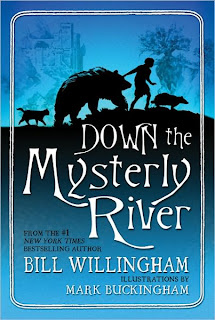

Down the Mysterly River by Bill Willingham

Try not to be too put off by the main character's voice, okay? It helps to compare Max (the Wolf) to Jasper Dash from M.T. Anderson's Pals in Peril books; he's a tad pompous and old-fashioned. But his amnesia-based adventure in a strange forest won't be at all what you're expecting, and I think you just might like it.

After Max finds himself in the forest, he draws on his Boy Scout skills to get his bearings, but he's further mystified to run into a talking badger named Banderbrock, then a monster of a barnyard cat named McTavish who talks quite a lot, and finally a talking bear named Walden. Max thinks maybe he's dreaming, but Banderbrock, who also has no memory of how he got there, wonders if perhaps he is dead.

And there's more to this forest than talking animals. Max and Banderbrock are sitting peacefully around their campfire when McTavish first appears, bringing a hunter and his dogs down on their heads. You would think that the human hunter wouldn't go after Max, but he does—why?

It turns out he is no ordinary hunter, but one of a group called the Cutters, wielding his Blue Sword to transform the creatures he is tracking down.

Max and his new friends must go on the run, avoiding the Cutters while trying to find some answers.

Keep in mind that Bill Willingham is best known for his Fables, a series of adult (PG-13 and occasionally R-rated) graphic novels about fairy tale characters.

In terms of pacing and action, Willingham's new story for children works, but there are certain aspects of the world building that seem a little less child-like in tone. The bad guys in this book are motivated, ultimately, by rather grown-up concerns (with tongue-in-cheek connotations for the publishing world), and I'm not sure the creation myths are convincing, either. We also get an occasional "adorable" moment; um, no.

But if you simply take Down the Mysterly River as storytelling—which is what young readers will do, after all—Max's adventures are compelling, and the plot twists are surprising.

I will mention that most of the humor has to do with McTavish as an over-the-top, vain and brutal king-of-the-world type; you will no doubt find Walden's food obsession and Barney Fife backstory amusing, as well. You mustn't mock Banderbrock, though: he's a warrior!

In addition to following our small band of heroes, Willingham gives us the Cutters' point of view every so often, which adds dimension to his narrative and makes the Cutters seem slightly more human.

I'm not sure how I feel about the ending—it's a little like the way the Wizard of Oz movie finishes off.

This book still has a lot to recommend it, however. Take a look and see what you think!

Note: There's not much out there in the way of video material, but you can watch the author auctioning off a copy of the book in support of the Comic Book Legal Defense Fund Auction.