Saturday, June 30, 2012

Blog Vacation

I am taking a much-needed blog vacation this week. Enjoy your 4th (if you're in the U.S.)!

Look for a post next week on a couple of new picture books and a poetry collection. Unless I come up with something completely different. It happens.

Meanwhile, may you have fireworks, watermelon, and maybe even a trip to the beach in your life...

Things that make you go BOOM!

Saturday, June 23, 2012

A Review of Hapenny Magick by Jennifer Carson

Awhile back I taught children's book writing classes for Online University for two summers in a row. The first year, I tried covering everything from picture book to YA, but the second year I narrowed it down to middle grade fiction. Jennifer Carson was one of my students that year, so I was pleased to hear from her when she wrote asking me to review her second book, Hapenny Magick. (Her first book was To Find a Wonder.)

Jennifer is creative in more than one way. She also happens to be a dragon charmer. Here's her bio from Amazon:
Jennifer Carson lives in New Hampshire with her husband, four sons and three four legged friends. She grew up on a steady diet of Muppet movies and renaissance faires and would occasionally be caught reading under the blankets with a flashlight. Besides telling tales, and being an editor for Faerie Magazine, Jennifer likes to create fantasy creatures and characters and publishes her own sewing patterns. Her artwork and patterns can be seen online at thedragoncharmer.com. Hapenny Magick is her second published work of fiction.

Jennifer's work has been featured in national magazines like Faerie Magazine, Soft Dolls and Animals, Teddy Bear and Friends and Dolls United. In the spring of 2008, Jennifer was featured on the ABC affiliate, WMUR tv show, New Hampshire Chronicle. Her sewing patterns have recently been translated in Dutch and in April 2009, she received the NE-SCBWI Ruth Landers Glass Scholarship for her writing.

Jennifer's fabric fantasy creatures are stories in and of themselves, so it's easy to see the roots of a book like Hapenny Magick. I'll confess that I'm not usually into cute, but wow—Jennifer's creations are cute! Her book is also cute, despite the troll peril. I think 2nd through 4th grade would be about the right reading age for this story about a Hapenny girl named Maewyn who lives with a mean slob named Gelbane after her mother goes away on a journey. Soon Maewyn meets up with a talking pig and a wizard and discovers she has magical powers of her own. And she begins to wonder—is her village really safe from the Hapenny-eating trolls, after all? The magic on the bridge pillars may not be working quite the way it should...

Maewyn's magic and her determination to help Hapenny friends like Leif, who has gone missing, assist her with her mission, as do new friends like a giant named River Weed Starr. The tale ends with an epic battle and a new future for Maewyn. Here's a sample from the book that shows Mae playing her flute as she rounds up some runaway pigs:
Skipping to the tune she played, Mae made her way to the edge of the hayfield. One by one the piglets came, trotting in a line like a gaggle of newly hatched goslings. A sow at the rear kept the piglets in rank. The boar took the lead. Mae's skirt swayed against her knees as she led the swine parade. They trotted around the hill the barn was built into, through the damp and dewy grass, and to the pigpen. Kicking the gate open, Mae danced into the sty.

All the pigs were safe once more—except the one still nipping the heads off the flowers. Her head nodded to the beat; she even let out a happy oink, but she didn't join the march through the farmyard. That pig was always hard to catch. Sometimes she would even go missing for weeks and then show up one morning like she'd never been gone.
Jennifer Carson's book is full of whimsy and a gentle humor, but it also includes peril and a satisfying adventure. Hapenny Magick is a fitting tribute to the world Carson first created in cloth. (See fabric Maewyn, right.)

Thursday, June 21, 2012

Join the Audio/Video Club

After the first two came along, I thought I'd share and add a few more clips and picks...

Someone singing to one of my poems in a bookstore. No, really!

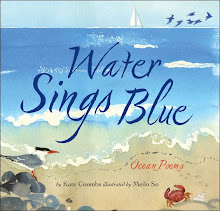
Here's her soundcloud melody and arrangement in case you have my book and want to sing along. Looks like her name is Emily Leatha Everson Gleichenhaus. Arrangement by Paul Raiman. Kind of pretty, huh? Apparently this is a thing she does. (See her blog here and the specific entry for Water Sings Blue here.) Thanks, Emily!


"More Than a Number," lyrics by Poem Farm poet Amy Ludwig VanDerwater with music and performance by Barry Lane. Great thoughts about real kids vs. standardized test subjects.


Everybody Dies book trailer by Ken Tanaka. A strangely compelling book trailer. Though the art struggles in comparison to the illustrations in, say, Everybody Poops.


—Not like iPad needs any help from me, but I am about to buy a Mac and this is a great little parody (also out in actual picture book form): Goodnight iPad. Nice reference to Angry Birds, too.


How to Write a Children's Book—Not. Two so-so ideas plus eight things I completely disagree with, e.g., the suggestion to add a message of some kind. (Yikes!) Plus the whole formulaic approach in general. But the artwork is kind of cute!


—And last but not least, John Green's Crash Course World History #17. After all those teasers about "The Mongols: The Exception," we finally get an entire crash course (11 minutes plus) about the Mongols! Called, naturally, "Wait for It... The Mongols." (Warning: Starts with an ad. When I watched, it was a Duracell ad in Spanish. Random.) Watch the entire series if you like your history mixed with John Green's brand of humor.

Sunday, June 17, 2012

YA Beach Reads

In which I give you the bikini-clad skinny about four sequels as well as three brand-spanking-new books. Let the waves wash in, let the sunscreen shimmer, let sand get between the pages and your toes!

Note: If you haven't read the previous books for the ones that are sequels, watch out for spoilers below.


Underworld by Meg Cabot

Paranormal romance, continued. Underworld is one of those Hades-Persephone variations. At this point, in Book 2, Pierce Oliviera has already been to hell, and hunky, brooding John Hayden—AKA Death—wants her to stay there. But her malevolent nemesis is after her hapless cousin now, and she really wants to help him. John reluctantly takes her back on an inter-dimensional road trip to her hometown of Isla Huesos, with a few of his colorful shipmate dead buddies as backup. Everyone in Isla Huesos thinks Pierce is dead, plus she is unclear on the whole "Don't eat the food in hell" concept. Then again, she is clearly pretty happy to be in John's clutches, though he worries what she will think of his scarred past (from his human days). It's kind of like the Scooby Gang, only their home base is the underworld and everyone wears black or gray. Whatever Cabot writes, even death-based paranormal, there's a cheeriness and good humor that I find rather charming. Read Abandon first, though.

First line: "Pierce keeps having the most terrible nightmares." My mom used to say this to all the doctors we saw right after the accident.


The Calling by Kelley Armstrong

In The Gathering, Book 1 of the Darkness Rising trilogy, Maya Delaney found out the meaning of her paw-print birthmark: she's a skin-walker. And she's just one of several unusual teens who's been raised deliberately in the same small town under the auspices of a mysterious corporation. After a forest fire, they are evacuated, but it soon becomes clear they're being kidnapped. They manage to escape, and then the book is all about them being chased through the forest while finding out each other's secrets. Oh, and of course we need to know who the mole is. There's nothing particularly amazing here, but Armstrong knows her stuff, and The Gathering is a well-told tale. These books, like Armstrong's previous YA trilogy, Darkest Powers, are loosely linked to Armstrong's paranormal series for adults. And by the way, I like this line from the book jacket bio about Kelley's childhood writing: "If asked for a story about girls and dolls, hers would invariably feature undead girls and evil dolls, much to her teachers' dismay." Oh, and we do have the requisite bad boy love interest, just in case you were wondering!

First line: I don't know who was more anxious—Daniel or Kenjii—but they weren't making this emergency helicopter evacuation any easier.


Flora's Fury by Ysabeau S. Wilce

Ysabeau Wilce is one of the finest world builders working in YA fantasy fiction today. I was intrigued by Book 1, Flora Segunda, which felt pretty MG to me and was just off the wall in a lot of great ways. I liked Book 2, Flora's Dare, though I realized at that point that Wilce is actually writing YA. Now Book 3 introduces a new journey companion and sort of love interest for our girl Flora: a werebear named Tharyn. Meanwhile, childhood friend and previous sort of love interest, Udo, is in the doghouse as far as Flora is concerned. So is Buck, especially when Flora figures out the other secret she's been keeping from her adopted daughter/stepdaughter. But then, Flora is on a quest to find her birthmother, Tiny Doom, who may not be dead, after all. And always Flora must be on the lookout for treachery from the Birdies, whose cute nickname doesn't even to begin to touch on how scary these Aztec conquerors are with their death magic. I mentioned love interests, but there's only a touch of romance in the book, and it turns out to be based on false premises for reasons too complicated to explain here. Mostly, this is just weird-cool, darkly swashbuckling fantasy adventure. I recommend you read all three books and catch up with Flora Fyrdraaca. Flora is occasionally irritating (pig-headed and selfish!), but she's also such a fresh character compared to the same old same old in children's fantasy that I think you'll enjoy these books very much.

First line: [Statement of Intent; Magickal Working No. 9] Dear Mamma/Butcher/Brakespeare/Azota/Tiny Doom: Everyone thinks the Birdies killed you, sacrificed you to one of their gods, whose priests ate your body while he ate your soul. [Ed. note: Not sure how to do cross-outs, which is what is really in the address line above.]


Invisible Sun by David MacInnis Gill

Young mercenary Durango survived some pretty wild stuff in Book 1, Black Hole Sun. Now he's going to learn some hard life lessons when he counts on his youthful invincibility to save him and his kinda girlfriend/loyal lieutenant Vienne from a whole new kind of enemy: humans. Corrupt, warlord/mafioso-type humans, naturally. Sure, Durango has his AI, Mimi, to help him, and Vienne is the ultimate warrior, but even that might not be enough in the decaying Mars colonies. Durango does get taken home to meet the equivalent of Vienne's family (think Buddhist shrine with martial arts), saves some refugees, and tries to find out the truth about his late father's experiments. But everything blows up in his face (often literally), and Durango mishandles things right and left. I really like Gill's ruthless take on Book 2. It reminds me a little of what Megan Whalen Turner puts supposedly invincible thief Gen through in her own Book 2. Not very many writers have the guts to go this far in making life hard for their heroes, frankly.

Like Black Hole Sun, Invisible Sun has a lot of violence. It's pretty dark stuff with high guy appeal. Durango's adventures make Mad Max look like a Sunday drive through the Australian desert. if you want gut-wrenching sci-fi dystopian with a real dose of testosterone, read both these books and join me in waiting breathlessly for Book 3.

First line: Vienne points the gun, squeezes the trigger, and fires a live round square into my chest.


Second Chance Summer by Morgan Matson

Go back to the lake again after all these years? It would have been hard for Taylor Edwards because of the friends she left behind even if it weren't for the real reason she's going now: her father is dying of cancer, and he wants to spend one last summer with his family in the place he was happiest. Some people might see Taylor's angst about her previous relationships with a best girlfriend and best boy friend as shallow compared to what's going on with her dad, but even her father makes it clear that he doesn't want his kids to just sit around the lake house staring tragically at him all summer. He wants to see them, sure, but he also wants them to have fun, get jobs, take tennis lessons, have sleepovers—ordinary things. Which would be fine if Taylor weren't trying so hard to avoid Henry and Lucy. The truth about what she did to them, when it comes out, isn't as bad as readers might expect. Kid stuff. But it feels that bad to all three of them, which is what it's like when things go wrong at age 12 or 13. No magic here, just good character development a la Sarah Dessen. The beachiest beach read of this batch, with an actual beach included! (Well, a lake beach, which I'm pretty sure counts.)

First line: I eased open my bedroom door to check that the hallway was empty.... It was nine a.m., we were leaving for the lake house in three hours, and I was running away.


Every Other Day by Jennifer Lynn Barnes

High concept with a capital H-C: Kali D'Angelo has superpowers, but she only has them every other day. Which means, of course, that if she makes enemies on her strong, demon and monster hunting days, they're likely to catch up with her on her wimpy, all-too-human days. This makes things worse when she learns that a girl at school has been targeted. She also happens to be a mean girl who has been out to get Kali. But Kali doesn't care. She has a mission to fulfill. If that means putting her own life on the line, whatever. When Kali is in power mode, she is ruthless and determined, fierce and risk taking to the point of foolhardiness. She's also significantly less human and practically indestructible. But now there's a conspiracy afoot, and Kali has leaped right into the middle of it. Protecting Bethany is only the beginning. We're definitely talking mad scientists and supernatural beings here. But we're also talking a nice little crew of Kali and her new friends, Skylar, Elliott, and (kind of) Bethany. Not to mention Zev, the voice that's now in Kali's head. Oh, and Kali's mother may not be dead after all. Which isn't nearly as nice as it sounds. I thought this book was quite good—it stood out from the paranormal pack because of its unusual premise, solid execution, a dimensional heroine, and nice little plot twists. If you're a fan of paranormal fiction with a hint of romance, try Every Other Day.

First line: The decision to make hellhounds an endangered species was beyond asinine, but I expected nothing less from a government that had bankrolled not one, but two, endowed chairs in preternatural biology (one of them my father's) at the University That Shall Not Be Named.


Cat Girl's Day Off by Kimberly Pauley

WHAT a fun book! Thanks to Charlotte of Charlotte's Library for recommending this one. I thoroughly enjoyed it. Cat (Natalie) lives in an ordinary world like ours except that some people are Talented, which means they have special powers. Her older sisters and parents have cool, important powers, but Cat's gift of talking to cats is so pointless she hides it from everyone at school, except her best friends Melly and Oscar. The three of them are pretty excited because a movie is going to be filmed at their school and they're signing up to be extras. Victoria Welling and Ty McKenzie are starring in the film, which has all three drooling. Well, Cat's less into this than the other two, but she goes along for the ride. Then she finds out from a video clip that something's wrong when a celebrity blogger's cat begs for help, accusing Easton West of being an imposter. The book gets increasingly madcap after this funky inciting incident: Cat and her two friends go after the blogger's cat so they can find out what's really going on. Other cats get involved. Easton West says she's going to eat a hot dog—and she's a vegetarian. Then there's Cat's crush on a boy named Ian. Slapstick and cat scratches abound in this goofy, adventurous, and thoroughly satisfying read. It's the kind of book that you want to see as a movie, but you're just so afraid Disney will get their hands on the rights and ruin things by making the cat voices sound stupid. By the way, this one's from Tu Books, so not only is Cat half Chinese, but the cover actually shows that. If you're only going to track down one of these YA reads, I'd say pick this one!

First line: [Easton West's Blog] Wednesday, September 2, 6:02 A.M.: La, la! You read that right, little poppets! Six frickin' o'clock in the morning!

Sunday, June 10, 2012

A Review of Horten's Miraculous Mechanisms by Lissa Evans

Quest books based on puzzles and clues really only work if you get caught up in the main character's desire to find the answers. Fortunately, that's what happens in Horten's Miraculous Mechanisms: Magic, Myster & a Very Strange Adventure. In this book originally published in Great Britain, Stuart's parents move him to Beeton, the town his father's family is from. Stuart's initial dismay and boredom are not relieved by the girls next door, triplets who spy on him and publish his activities in a neighborhood newspaper. They are, however, relieved by the discovery of a mystery involving Stuart's great-uncle Tony.

Tony was a magician and, being short (like Stuart), his stage name was Teeny-Tiny Tony Horten. The magician disappeared unexpectedly after being accused of being responsible for his fiance's death in a fire. He left his nephew, Tony's father, a message hidden in a puzzle box along with eight threepenny bits.
I have to go away, and I may not be able to get back. If I don't return, then my workshop and all it contains is yours if you can find it—and if you can find it, then you're the right sort of boy to have it.

Affectionately, Your uncle Tony

P.S. Start in the telephone booth on Main Street.

As it turns out, Stuart's father didn't even find the message because he was not the right sort of boy to have it. But Stuart is. He finds the message and begins following a treasure trail of old mechanisms, inserting a threepenny bit in each one when he can and getting further clues. Then April, one of the girls next door, starts following him, as does a greedy woman connected with his uncle's magician past. Stuart also meets a kindly elderly woman with another sort of connection to Teeny-Tiny Tony.

The other piece of Stuart's heritage is that there used to be a factory where the Hortens made mechanisms. Some of the machines are kept in the Beeton city museum, but Stuart runs into trouble when he tries to get at them. Oh, and Uncle Tony's house, which contains clues and possibly the missing workshop, is about to be demolished. It all comes to a head during Beeton's summer festival. Meet Stuart and April in the park by the bandstand and see what happens...

Stuart is your basic nice Everykid, while the secondary characters are a good bunch. About the only flat character is the villainess, and since you'll find yourself wanting to flatten her with a cartoon steamroller, that's not too terrible, after all.

At first this book seems to be about mechanisms, not magic, but as Stuart learns, there is magic associated with the mechanisms, the threepenny bits, and the long-ago disappearance of the magician. (The combination of magic and mechanicals is what I wish we'd seen a bit more of in Hugo Cabret, actually.) This is a small book, even in trim size, but it's a perfectly satisfying read even as it opens the door to a sequel. The codes and puzzles Stuart must solve may appeal to a different sort of reader than the usual fantasy fan, giving the story a broader, more unusual appeal. Touches of steampunk, Oz, and Edward Eager: I think you'll like this one!

Note: If you enjoy Horten's Miraculous Mechanisms, try The Inventions of Hugo Cabret, Chitty Chitty Bang Bang Flies Again, and R.L. LaFevers' Theodosia series.

A Review of Look into My Eyes (Ruby Redfort) by Lauren Child

I'll warn you that Ruby Redfort might get on your last nerve. I wasn't sure I liked her at first, but I kind of got over it. Put it this way: the kind of stylized characters and dialogue you've seen in Child's Clarice Bean picture books is a little harder to swallow in a full-length MG novel.

Ruby Redfort actually started out as Clarice Bean's favorite schoolgirl detective, a modern Nancy Drew. Ruby is a cross between Harriet the Spy and maybe Artemis Fowl. Without the evil, though Ruby is a little ruthless and doesn't seem particularly fond of her parents. (No fairies, either. Sorry.) Throw in some Alex Rider and a bit of Sherlock Holmes and you're there. Ruby was born to be a spy, or a P.I at the very least. She would have solved her first case as a two-year-old if she could have talked a bit better. Here young Ruby has just watched what appears to be a dognapping take place out the front window.
The little girl attempted to grab her parents' attention, but since her use of language was still limited she could not get them to understand. She watched as the woman pushed her feet back into her black shoes, walked to the rear of the truck, and disappeared out of view.... The girl jumped up and down, pointing at the window. Her parents, sensing she might be eager for a walk, went to put on their coats.

The child drew a truck on her chalkboard.

Her father smiled and patted her on the head.

Meanwhile, the driver folded his map, thanked Mr. Pinkerton, and returned to his vehicle, waving to him as he drove off.... The woman, now minus the picnic basket, walked on by. She had a fresh scarlet scratch on her left cheek.

The child spelled out the truck's license plate with her alphabet blocks.

Her mother put them away and dressed her in a red woolen pom-pom hat and matching mittens.

When Ruby is a little older, she keeps her findings in a series of notebooks hidden in her room. She also becomes a talented code breaker. This attracts the attention of a CIA-like group that recruits her—which sounds like a lot more fun than it is. Oh, and her house is robbed. Everything disappears except Ruby's stash of notebooks. Even the housekeeper is missing. Then a new butler shows up a little too quickly and takes things in hand.

A shipment of gold is coming to the city bank, and a legendary Buddha statue is coming to the city museum. Ruby's parents are on the board of directors. The secret association, Spectrum, is sure the gold is going to be stolen. They want Ruby to decipher the notes of the agent who last worked on the case, a woman who died in an avalanche while mountain climbing in Europe. Ruby meets a bevy of other agents—the helpful Hitch, the sourpuss she nicknames Frogface, donut-supplying Blacker, and boss woman LB. None of them seem very respectful or appreciative of Ruby, who just happens to swipe a few gadgets from the agency's hidden lair. Oh, and they swear her to secrecy, which puts her friendship with best buddy Clancy on the rocks.

I wish Ruby's t-shirt sayings were more off the wall, but her adventures really grew on me. The spy action has a solid Saturday-morning cartoon vibe. The moments of humor are especially nice—like the way Mrs. Digby handles being kidnapped or the various villains' monikers and looks. Not sure how I feel about Ruby's overly vacuous, inept parents, though. Still, there's an energy to Child's storytelling that I like very much, and Hitch and Clancy make good secondary characters. I think I'll stick around to see what happens in Book 2.

Note: If you like Ruby Redfort, try Harriet the Spy, the Artemis Fowl series, and Georgia Byng's Molly Moon books.

A Review of Spy School by Stuart Gibbs

A geeky boy goes to spy school, thinking his dreams are coming true, only to find out he got in for all the wrong reasons. And his insta-crush? Well, picture James Bond having a daughter who's just as kick-butt as he is, or more. In this case, James Bond is Alexander Hale, who recruits 12-year-old Ben Ripley to go to spy school, basically sweeping him off his feet with weapons and swashbuckliness.

Then Ben gets to the Academy of Espionage and is stunned to find himself in the middle of an attack. An older girl named Erica helps him make his way into the building and upstairs, with Ben fumbling every step of the way. Turns out this was all a test, and he didn't do so well.
Which meant I was now flanked by six heavily armed me in total darkness.

So I did the only other thing I could think of: I prepared to surrender.

I raised my hands over my head and backed against the principal's door, accidentally bumping the handle.

It lowered with a click.

Apparently, I'd unlocked it.

All six flashlight beams swung toward the sound.

I slipped into the darkened office, slammed the door shut, and promptly ran right into a coffee table. It cut me off at the knees, and I face-planted on the carpet.

The lights snapped on again.

I reflexively tucked myself into a ball and yelled, "Please don't kill me! I don't know anything! I just started here today!"

"Begging for mercy?" said a disappointed voice. "That's D-quality performance for sure."

There were murmurs of assent.

I slowly lifted my eyes from the deep-pile carpet. Instead of a horde of assassins facing me, I found myself facing a conference table.

Ben continues to bumble his way through being a student at the academy, where everyone else seems to be equal parts super-athlete and genius. So why is he the target of a real assassin? Why does his file say he has mad skills and is working on a special project?

To Ben's surprise, Erica continues to help him out, as does his new friend, the cynical Murray Hill. Erica is the best spy student in the school. Her attention to Ben makes the other kids believe he must be secretly superior, which leads to some funny assumptions and situations. The humor really makes this book a kick to read—particularly the satire about fictional spies and extra-special, gifted students in books like this one.

Ben is a pleasantly flawed and determined main character. As he plays detective with Erica's assistance, he starts catching glimpses of what might really be going on. Ben may not have the makings of a cinematic superspy, but he's a pretty smart kid, especially when it comes to math.

I do wish Gibbs had found a few more ways of using Ben's math abilities, although I understand Ben is simply trying to survive for most of the book. But eventually the pieces of the puzzle start coming together. Ben is both disillusioned and heartened to find out the truth about spy school, his own role there, and the villainous plot he's determined to stop. A cool summer read for upper middle grade and middle schoolers with both boy and girl appeal. Also—I'm guessing—the start of a very fun new series.

Note: If you like Spy School, try Chris Rylander's The Fourth Stall, Trenton Lee Stuart's Mysterious Benedict Society series, and Pseudonymous Bosch's Secret series.

Sunday, June 3, 2012

Remembering Leo Dillon

I fell in love with the art of Leo and Diane Dillon many years ago and have been reading and collecting their books ever since. After the heyday of Martin and Alice Provensen, the Dillons have been the husband-and-wife team that dominated, not only children's book art, but the world of sci-fi fantasy, particularly book jackets. They are also the only illustrators to ever receive back-to-back Caldecott awards—in 1976 for Why Mosquitoes Buzz in People's Ears (Verna Aardema) and in 1977 for From Ashanti to Zulu: African Traditions (Margaret Musgrove). They have since won at least three lifetime achievement awards for their body of work, along with many other honors.

It was a shock for me to learn that Leo Dillon died of lung cancer last week, and so soon after the death of Maurice Sendak.

The Dillons staked their claim with those two Caldecott awards years ago, and they continued to work in the field of children's books, most recently illustrating Marjorie Kinnan Rawlings' The Secret River last January and Patricia McKissack's Never Forgotten in October. They are also well known for their book jackets, especially for Harlan Ellison's work. They have done cover art for some famous children's series, too, such as The Chronicles of Narnia, A Wrinkle in Time and sequels, and the Earthsea books. Their son Lee is a sculptor and art jeweler who has sometimes collaborated with his parents.

Leo and Diane first met as rivals at the Parsons School of Design in New York City. According to Margalit Fox of The New York Times (May 30, 2012):
Viewing an exhibition of student work there one day, Mr. Dillon was captivated by a still life of an Eames chair.

“I knew it had to be by a new student because nobody in our class at the time could paint like that,” he told The Horn Book, a magazine about children’s literature. “This artist was a whole lot better than I. I figured I’d better find out who he was.”

“He” turned out to be Diane Claire Sorber, and a crackling competition ensued. “If one got a better place in a show, we wouldn’t speak for three weeks,” Ms. Dillon told The Seattle Post-Intelligencer in 1990.

In the end, the only thing for it was marriage, which, she said, “was a survival mechanism to keep us from killing each other.”

As Fox and others note, the Dillons describe their work together as a third artist, sometimes referred to as "It." In Deborah Kovacs and James Preller's book, Meet the Authors and Illustrators, we read Leo's explanations of the process:
Together we are able to create art we would not be able to do individually.

...Each illustration is passed back and forth between us several times before it is completed, and since we both work on every piece of art, the finished painting looks as if one artist has done it.

...After years and years of collaboration we have reached a point where our work is done by an agent we call the third artist.

The couple originally shared a studio, but later set up studios on separate floors—partly because Leo liked playing the music louder than Diane did.

Leo and Diane Dillon's distinctive style has an airbrushed look, with clean lines and stylized figures. However, they have been known to adapt their style depending on the project. One of the most beautiful books they've ever created is To Every Thing There Is a Season, in which they use art styles from different cultures and time periods for each couplet from the famous passage in Ecclesiastes.

Other books I amespecially fond of are Wind Child (story by Shirley Rousseau Murphy)—which includes sculptures by Lee Dillon, The People Could Fly: American Black Folktales (Virginia Hamilton), Pish Posh Said Hieronymus Bosch (Nancy Willard) and Switch on the Night (Ray Bradbury). There are many more, of course. The artists have done some particularly beautiful books based on black culture and folktales. In addition to books already mentioned, they illustrated Leontyne Price's Aida, Mansa Musa: The Lion of Mali (Khephra Burns), Many Thousand Gone: African Americans from Slavery to Freedom (also by Virginia Hamilton), and their own Jazz on a Saturday Night as well as Rap a Tap Tap: Here's Bojangles—Think of That! The Dillons' Mother Goose Numbers on the Loose and The Goblin and the Empty Chair by Mem Fox are two more books I like very much.

Alice Provensen created books on her own after losing her husband Martin, and I expect that Diane Dillon will do likewise. But without Leo, it won't be the same. The second artist is gone, and with him the third artist. Even so, because of the rich legacy of his book illustration and the personal legacy he has left his friends and family, Leo Dillon, as his book title from last fall puts it, will be Never Forgotten.

Saturday, May 26, 2012

A Review of Ordinary Magic by Caitlen Rubino-Bradway

Rubino-Bradway flips the Hogwarts scenario on its head by creating a society a lot like ours in which almost everyone has magical powers. The handful of people who don't are hated, mistrusted, and exploited. When Abigail Hale, daughter of an elite magical family, is tested on her twelfth birthday and learns she is an ord (for ordinary), her life is thrown into chaos. The students and teachers at school shun her and she is thrown out. Two hardnosed adventurers, Barbarian Mike and his partner Trixie, try to buy Abby. Fortunately, Abby's family stands by her, unlike the families of many other ords.

Rubino-Bradway is a creative world builder, especially when it comes to the ords. In this world, an ord can cancel out magic, walking through magical security systems and wards, for example. That means an ord can cause a lot of trouble, even becoming a successful thief or, less independently, a carnival attraction. Of course, adventurers in search of magically guarded treasures like to send an ord in first—even if the ord ends up dead because of other, more physical obstacles. In this society, ords are considered to be subhuman, pariahs, and possessions.

But Abby's oldest sister, Alexa, who is one of the most powerful magic makers in the kingdom and works for the king, knows what to do. Abby must go to a special school for ords so she will be safe. There she will learn self defense, among other useful tricks for surviving in a world that treats ords very badly. Which is a really good idea, especially considering Barbarian Mike and Trixie are still trying to get their hands on an ord, whether Abby or one of the other students.

The writing is brisk and reader friendly, and the characters are a group worthy of Hogwarts. I particularly like the self-defense teacher, Becky, and an often-surly fellow student named Peter ("Peter has two modes: annoyed and golem."). Abby winds up in the clutches of the school cook, who seems determined to bring our wealthy heroine down a peg or two—as if being an ord isn't bad enough! We learn that the school is guarded by minotaurs as well as spells on the outer walls. But ultimately, it won't be enough to keep some horrific intruders out.

In Abby's world, magical creatures are just part of the scenery. Here Abby meets the minotaur who is the school's security chief:
Suddenly there was a mountain next to us, one with horns.

Mr. Dimitrios was a minotaur. A real minotaur; the hoofs, the horns, the tail, the nose ring, even the spear, it was all there. His horns were short, just peeking out of his floppy hair, which made him look young—well, youngish. Minotaurs don't really like people knowing things like how they age and how old they get. I had never seen a minotaur before except on those shows where they interview movie stars; huge and hulking in the background are the minotaur bodyguards. Which is probably why Mom and Dad were smiling so much as they shook Mr. Dimitrios's hand. If this school had hired a minotaur, even a young one, they were serious about security.

You'll find action, menace, and social struggle in this well-thought-out book from newcomer Caitlen Rubino-Bradway. Ordinary Magic promises to be the start of an intriguing new fantasy series for middle grade readers. (Ages 8 and up)

A Review of Enchanted by Alethea Kontis

Most fairy tale retellings are built around just one story, occasionally two. Enchanted gives us the Woodcutter family, whose children—most named after days of the week—appear to be the stars of a bunch of well-known fairy tales: The Princess and the Frog, Rumpelstiltskin, Cinderella, The Princess and the Pea, and Jack and the Beanstalk, to name just a few.

Sunday is the main focus of the book. She befriends an enchanted frog, visiting and talking with him more than once and really enjoying their conversations. When she agrees to kiss him, nothing happens. What she doesn't know is that the kiss works, only a little later. All she knows is that her friend disappears and she misses him.

Meanwhile, the frog prince, Grumble-now-Rumbold, has returned to his palace, where not everyone is glad to have him back. The Woodcutter family knows Rumbold as the prince who was responsible for their son and brother Jack disappearing. Rumbold's father, a suspiciously youthful king, appears to be tangled up in some kind of dark magic. When the king throws three balls, ostensibly in honor of his son, and begins to woo Sunday's sister Wednesday himself, Sunday is very worried. Her aunt, a fairy named Joy, begins teaching Sunday magic, but what of the fairy named Sorrow, who lives in the palace? It's all very complicated.

Take a look at the beanstalk, its seeds planted, not by Jack, but by Sunday's fey adopted brother, Trix. The stalks are growing up around a huge old tree.
Magic and monsters, all before breakfast. Sunday wouldn't have it any other way. She bravely cupped a hand around a budding leaf; its new velvet skin tickled her palm as it unfurled and continued to stretch its way heavenward. The monster stalk's leaves yawned above the tree's top into the breaking light of dawn. The vines plaited themselves into a mass as thick as the trunk of the tree at its base. Sunday's feet itched, remembering her own waltz as she watched the vines dance.

There is magic around every corner in this book, and sometimes it seems a bit cobbled together, even frenetic: How many fairy tales, tropes, and even nursery rhymes can we jam into one book? Each of the Woodcutter siblings should be an entire book, and maybe that's where Kontis is going with this. It's as if, magically speaking, you had a family in which one sibling was Sandra Day O'Connor, another was Yo Yo Ma, another was Kobe Bryant, and so on. All of it is fascinating, but there's just so much going on. I would also say that the plot feels middle grade, but the romance and character interactions come across as YA (the book's apparent market).

Of course, Enchanted cries out to be read without too much analysis—the thing to do is just enjoy the ride and cheer for the good guys, waiting for Sunday and Rumbold to defeat the villain and share a happily-ever-after kiss. I suspect that Kontis can only get better—she has a wonderful imagination. (12 and up)

Note for Worried Parents: The villains' scheme is creepy and there's some violence and peril, but I would say the book is just fine for upper middle grade and tween readers.

Also: I requested a copy of this book from the Amazon Vine program.

A Review of Once Upon a Toad by Heather Vogel Frederick

Cat Starr is horrified to learn that when her astronaut mother goes on a months-long mission, she will have to stay with her father. Oh, his wife is nice, and Cat's toddler half-brother is cute, but her stepsister Olivia is the very definition of "mean girl." Olivia sets out to make Cat's life miserable, especially at school. Things get worse and worse, till finally Olivia has the entire school calling Cat an awful nickname. Cat begs her mother for help, and what she gets is Great-Aunt Abyssinia, a highly colorful personality who travels in a mobile home. Abyssinia is not much help, in Cat's opinion. Pretty soon she's on her way again.

But when Cat opens her mouth to talk at breakfast the next morning, toads come out with each word. Since only her little brother sees this, Cat immediately declares herself to have laryngitis. She also finds out that Olivia has been struck, too—although when Olivia speaks, jewels fall out of her mouth. So unfair!

Naturally, the information that Olivia is spitting out jewels spreads fast. People start calling her Diamond Girl. The government shows up, and so do some criminals. Pretty soon Cat and Olivia hit the road, bonding the tiniest bit as they try to find Great-Aunt Abyssinia to see if she can help. Because Geoffrey's been kidnapped, and Olivia herself is supposed to be the ransom.

As in her well-known Mother-Daughter Book Club series, Frederick shows that she's a dab hand at creating middle school girls. Cat and Olivia seem all too real, especially when they're quarreling. Frederick's contemporary retelling of the fairy tale doesn't stick too closely to the original, but then, it doesn't need to: the basic premise takes this story a long way. And though Aunt Aby's intention of bringing the girls closer together with a spell seems pretty obvious, the storytelling is so rollicking that readers are unlikely to get hung up on the book's message. We also get some nice secondary characters, though they are much less interesting than Cat and Olivia. Here's a sample of what it's like for Cat to live with dear, sweet Olivia:
If I went upstairs to our room, Olivia would inevitably be there talking about me on the phone to Piper, or worse, sitting there with Piper in person, the two of them making loud snarky remarks about my clothes (what was wrong with jeans and a T-shirt?), my hair (why should I have to brush it more than once a day?), my lack of makeup (who wanted to smear that goop all over their face?), and everything else they could think of. Oh, and forget practicing my bassoon. I had to barricade myself in my dad's office if I wanted to do that, otherwise Olivia would moan about it hurting her ears.

Just the right summer read for 10- to 13-year-old girls who like their fantasy mixed with sisters and school, not to mention gemstones, toads, road trips, and kidnapping plots. (10 and up)

A Review of Deadly Pink by Vivian Vande Velde

In this slightly futuristic sci-fi/fantasy mix, Grace has a real superstar of an older sister. Emily is a genius, also pretty and popular. So Grace is startled to learn that Emily, who works for the Rasmussem video game company, has apparently disappeared into one of the artificial reality games and won't come out. Or can't come out—really, it's not clear exactly what went wrong. But Grace is drafted to go into the game and bring her sister back.

To her surprise, the game is not very cooperative. Neither, when she does find her, is her sister. Grace must deal with increasingly difficult scenarios and hostile characters, of which Emily is one of the most hostile. Grace begins to suspect that the game is not the problem: Emily is. But why?

On the one hand, we have Grace trying to figure out how to play a virtual reality video game in which the rules have been changed. On the other hand—well, actually, the same thing applies to her sister. Emily is not acting like herself.

The game itself starts out as a sweetsy pink world of charming Venetian-style gondoliers and pastel fairies, but it turns into a place that would just as soon burn players to a crisp using dragons. Eventually Grace and Emily must team up to escape being killed in a game that winds up being a fantasy world with its own denizens and desires. A place where they might just stay dead.

Deadly Pink has a definite theme: Don't cheat. Grace finds out that she must make up for the ways she has tried to cheat at the video game she's been trapped in, and Emily has her own troubles to deal with. I'm not crazy about "the moral of the story is" when I'd rather just read for character and plot, but the story itself has a good premise, and I liked watching how Grace deals with her sister, let alone angry sprites.
"Two more," she said. Either she'd helped design the maze or she'd navigated it quite a few times, for she seemed entirely familiar with its twistings and turnings. We came to another pot, this one holding hollyhocks. I thought I was doing a good job with hiding how impatient I was getting, but maybe not, because she said, "You can save us some time." She pointed the way we'd been walking. "Around that corner"—it was a right-hand turn—" then take the second left, and there's a vase holding a gerbera daisy. If you can get that for me while I pick these, then we can go back and drink some lemonade on the porch and discuss things.

"Okay," I said.

It only worked as far as "take the second left." There was no vase.

And when I retraced my steps to the pot of hollyhocks—which were all still there, by the way—there was no Emily, either.

The author has written two earlier books about the Rasmussem Corporation: Heir Apparent and User Unfriendly. I'm actually more fond of some of her fantasy, such as Dragon's Bait and Witch Dreams, but Deadly Pink is a fun and clever summer read. (10 and up; due out on July 10th)

Note: I requested a copy of this book from the Amazon Vine program.

Sunday, May 20, 2012

A Review of Giants Beware! by Jorge Aguirre and Rafael Rosado

Medieval kid Claudette is just a tad bloodthirsty, so it's no surprise she ends up going on a quest to kill a giant in this graphic novel. Of course, she gets the idea when an old man tells the village children the terrible story of "The Baby-Feet-Eating Giant." Claudette is incensed by the story's ending—or lack thereof:
Pascal: Pierre XXXII and his men valiantly chased the giant...
all the way up the tallest mountain in the territory. And he never bothered our village ever again.

Claudette: AND THEN WHAT?
Well?
So, how did the marquis kill the giant?

Gaston (Claudette's little brother): I don't want to know.

Claudette: Burnt him at the stake?

Pascal: No.

Claudette: Stabbed through the heart?

Pascal: No.

Claudette: Choked him?

Pascal: No.

Claudette: Poisoned?

Pascal: No.

Claudette: Oh, wait, I got it...
THEY TOLD THE EVIL GIANT A POINTLESS STORY, AND HE DIED OF BOREDOM!

Pascal: ...

Claudette: Is that it?!
Aw, get to the bloody part, already!

Naturally, Claudette concludes that since the "irresponsible" long-ago marquis never killed the giant, the evil creature is still up on the mountain, needing to be killed. By her. Of course, she takes two buddies along: her fearful little brother, who wants to be a chef and a master sword maker, and her friend Marie, the current marquis' daughter who wants to be a princess. (We also learn that Claudette's blacksmith father is missing both legs and one arm because he used to be a monster slayer and eventually lost.)

Often, in such stories, the hero or heroine is a valiant teen, but a lot of the humor here stems from Claudette being seven or eight years old, nine or ten at the most. I'm going with seven or eight because of her simplistic, determined world view. This means Claudette doesn't reason very far ahead. It also might explain why Gaston brings pots and pans on the trek, but no actual food. And why, as they tromp through the village to set out on their quest, all of the adults who hear where they're going think it's just a cute game the kids are playing. These three really are babes in the woods. Make that the Forest of Death, which is one of their first stops.

In true quest fashion, the three heroes have three encounters with monsters or other threats along the way. Then their fellowship is splintered by Claudette's hubris (and some lies she told, inspired by the current marquis' philosophy) before they truly join forces and achieve their goal. Or rather, arrive at their goal and reassess the situation. Meanwhile, Claudette's blacksmith father and his mysterious companion are hot on their heels, as is a less capable group of villagers who are being paid for their efforts.

Illustrator Rafael Rosado gives us a relatively bright palette dominated by Claudette's carrot-top. He outlines characters and key setting components with strong, contoured ink lines. I got a kick out of noticing that Claudette's outfit resembles Robin Hood's at first glance, but also evokes the Girl Scouts. Rosado is a dab hand with action scenes, especially in the forest and at a river that must be crossed.

The real strength of the storytelling lies more in the characters than in the plot. Claudette is ox-like in her determination, as much foolhardy as courageous. Her pride and eagerness as she wields her wooden sword are so very young that they are cute rather than irritating. Gaston starts out seeming like a stereotype—the sweet boy whose ultra-tough father doesn't understand his interest in creating fine cuisine. But Gaston really does long to make swords as well as pastries, and his knowledge of food has surprising benefits. As for Marie, at first she is just every other girl who wants to be a princess. But humor adds to the effect. Her efforts to test the pea-under-the-mattress premise are very funny, for example. And ultimately, we discover that Marie is a lot smarter than previously suspected. Each of the quest companions winds up solving one of the problems they encounter in a great display of teamwork.

I was a little less sold on the secrets of the giant, but still had a lot of fun following the twists and turns of the plot.

There is a certain nuance to another aspect of the story, which is that the villagers have been cowering inside the high walls the long-ago marquis built for at least a couple of hundred years. Led by the three children to venture out of their fortified village, the villagers learn that they can overcome their fears. The world broadens, and not just for Claudette and her friends.

A combination of adventure, humor, and heart, Giants Beware! is the perfect graphic novel for readers ages 6 through 10. And really, we have television to thank for this and many of the other graphic novels hitting the children's book market: the writer and illustrator come from the animation and children's TV industry.

A Review of Explorer: The Mystery Boxes, edited by Kazu Kibuishi

You may have heard the name Kazu Kibuishi before. Kibuishi is the creator of the Amulet series. (See my review of Book 1 here.) Now Kibuishi has put together an intriguing graphic anthology. Apparently he asked each graphic artist to start with the idea of a mysterious box and go from there. Here's a look at what they came up with:


"Under the Floorboards" by Emily Carroll

A girl finds a little wax doll in a box under the floorboards. At first the doll helps her with her chores, but then it starts causing trouble for her—and growing bigger. How will she stop the doll before it ruins and maybe even takes over her life?


"Spring Cleaning" by Dave Roman and Raina Telgemeier

When Oliver's dad tells him to clean out his closet, he finds an odd puzzle box that he tries to sell online. Instantly wizards start showing up at the house, trying to buy the box. He runs to his friend's house, where further online research shows the probable origin of the box. Now they just have to figure out what to do with it.


"The Keeper's Treasure" by Jason Caffoe

A young treasure seeker braves dangers to find a secret maze and the monstrous man who guards it. But is he really our hero? The keeper of the treasure seems to value imagination over the gleam of gold. The treasure seeker leaves, satisfied, but none the wiser, while readers might find some real wisdom in the treasure keeper's approach to life.


"The Butter Thief" by Rad Sechrist

A young Japanese girl's grandmother captures the little spirit who's been stealing butter from the family kitchen in a box and buries it out in the backyard. The girl goes out that night to dig up the box and see what's inside, but the angry spirit turns her into a being as small as he is. Only the promise of more butter from the kitchen might entice him to turn her back...


"The Soldier's Daughter" by Stuart Livingston

When Clara and her brother get the awful letter telling them their soldier father has been killed in the war, Clara is determined to kill her father's killer in revenge. Her brother questions her choice, so she calls him a coward. But instead of revenge, Clara finds a mysterious man with an even more mysterious box—and one more chance to talk to her father.


"Whatzit" by Johane Matte

Deet's grandpa is going to give him a special job in his intergalactic factory, checking off inventory before the product ships. But some of the more senior employees aren't too thrilled about Deet's promotion, and Deet finds an odd box that's not on his list. When he opens it, the creatures inside escape in a Pandora's pandemonium of knocking over still more boxes. Wait till you find out what the product is, let alone how Deet manages to solve his problem.


"The Escape Option" by Kazu Kibuishi

Kibuishi concludes the collection with a short fable about a boy who is offered the chance to escape the destruction of Earth. Only the destruction isn't a question of alien attack, it's a matter of environmental disaster. James makes an unpredictable choice, which is just as well. Turns out the alien who found him wasn't telling him everything he knows.


Half the fun of reading this book is seeing the styles of the different illustrators. We get more realistic approaches like Caffoe's and Kibuishi's, along with more cartoonish work from artists such as Matte and Roman and Telgemeier. Since all of the other illustrators use ink outlines, it's nice to see what Sechrist does without them. Matte's work has a bright, Loony Tunes vibe, while Carroll's and Caffoe's are hauntingly atmospheric. All of the artists are highly accomplished, and a look at the thumbnail bios on the last page explains why. It looks like most of them work together in animation at places like Dreamworks, and I'm sure you've heard of Raina Telgemeier's award-winning graphic novel, Smile.

In terms of storytelling, Caffoe's, Livingston's, and Kibuishi's segments are the most didactic, but the stories are still worth reading and hold together well—especially Caffoe's with its delicate humor. You'll have seen the basic plot of "Under the Floorboards" before, but Carroll's artwork and the final solution are satisfyingly fresh. For fun and entertainment, nothing beats the plot and dialogue of "Spring Cleaning," though "Whatzit" comes close. And "The Butter Thief" offers us a nice new take on both the character of the pesky house elf and what happens when a child magically shrinks.

This book could obviously be used as a set of story prompts for students to write and illustrate their own tales about a magic box. The very different takes on the premise in Explorer will show students that they, too, can come up with an all-new approach to the magic box story. The book could also be used to discuss concepts like tone and theme, which are sometimes difficult for students to grasp.

But you don't have to be a teacher to appreciate the artistry of Explorer: The Mystery Boxes. Just a fan of good graphic art and storytelling.

Note: Illustration above left is from "The Keeper's Treasure" by Jason Caffoe.

A Review of The War at Ellsmere by Faith Erin Hicks

I liked Friends with Boys so much that I looked online to see what else the author of that graphic novel had done. Zombies Calling is funny, but it seems to be aimed at the college crowd. The War at Ellsmere is more clearly a story for tweens and maybe teens, featuring one of those boarding school battles between the scholarship girl and the rich mean girl.

Hicks does interesting things with this much-used premise. Juniper is the new student, while Cassie is her roommate and wanna-be friend. Juniper accidentally snubs sweet, naive Cassie during their first encounter, but ends up coming to her rescue when she is insulted by mean girl Emily while waiting for assembly to begin. Emily responds with a typical put-down. Watch how Juniper handles the situation:
Emily: Hey, look, it's Bishop's latest scholarship project. Did you have a comment, project, or just a chunk of McDonald's stuck in your throat?

Juniper: McDonald's. No, really... that's great.

I mean, you totally got me there. I'm the charity case.

By all means, continue to make fun of my thrift store clothes, my ten dollar haircut, my single working mom... Wow, it's like all of my deep, unconscious fears are begin laid bare before me—

And y'know, I'm with you. Poor people suck, and I sure do wish I had your spending ability. But you know what I'm glad I don't have?

Emily: Um... no. what?

Whereupon Juniper nails Emily for her probably crappy parents and her insecurities. Emily leaves the assembly in a huff—and the war is on.

At first, Juniper wins, mostly because Emily doesn't know her weakness, which has to do with her dead father. When Juniper does finally snap, she is put on probation. Emily even suggests it, but only because she is planning something much worse for Juniper, something that will destroy her entire future.

I will just mention that I found it very satisfying that Juniper and Cassie laugh at most of Emily's insults. This is just part of the storytelling, but it makes a good model for so many kids who take hurtful remarks to heart. The power of Juniper and Cassie's friendship is another strength of the book.

Now, you may not be thinking that The War at Ellsmere is a fantasy, but it is. Cassie tells Juniper stories about the mythical creatures who live in the woods, and Juniper is startled to find out that the stories may be true. What exactly happened to Lord Ellsmere's sons when the school was still an aristocrat's estate? Trust me when I say that no one has ever before used unicorns the way Hicks does in this book. Good will triumph in the end, and Juniper will learn that while being smart isn't always quite enough to defeat someone like Emily, she can still hold her own with the help of Cassie and of the universe.

Like Friends with Boys, The War at Ellsmere is well illustrated, but just as important (or more so), it is well thought out. The dialogue is especially sharp, and I'm very fond of Hicks' humor. I'll leave you with just one more example:
Cassie: You were talking to yourself.

Juniper: Noooo. I was narrating. There's a difference.

Note: I'm not sure what grade these girls are in—maybe middle school? Booklist says it's for grades 5-8.

Sunday, May 13, 2012

More Sorcery and Cecilia

Last week, I shared the first letter of the Sorcery and Cecilia trilogy as it appeared in the Letter Game, before Patricia C Wrede and Caroline Stevermer decided to turn the letters into a novel called Sorcery and Cecilia, Or The Enchanted Chocolate Pot. This week, check out Kate's reply, written by Stevermer.

10 April 1817
11 Berkeley Square

Dear Cecy,

If you've been forced to listen to Reverend Fitzwilliam on the subject of the emptiness of worldly pleasures for hours together, I feel I ought to write something bracing to cheer you up. (As for the Vanities of Society, it would take a confirmed cricketer to fully understand them -- and I trust once the weather turns fair our good reverend will spend his afternoons out on the pitch where he longs to be instead of indoors boring the earrings off harmless young ladies.) But after three days of a London Season I find it hard to come to the defense of frivolity with any spirit. Perhaps it will make Rushton seem more amusing to you if I complain vigorously. (Don't worry, I haven't said a word to anyone else, not even Georgina.)

First, there was our arrival in Berkeley Square, a very welcome event after a day spent in the coach with Aunt Charlotte complaining of her migraine and Georgina exclaiming, "Only look, a sedan chair!" at every opportunity. It was very late and we were very tired and soiled with our travels, too weary to feel the proper emotions on entering such a grand house for the first time. (Horace Walpole is by no means Aunt Charlotte's favorite author, but the opportunity to hire his London town house for the Season has given her a new appreciation for him and his works.)

Make no mistake, it is very grand. On the outside it is a high, narrow, polite looking house built of brick. On the inside there is a high-ceilinged entrance hall with a marble staircase winding up two flights. On either side of the hall are reception rooms. The one on the right is called the blue saloon. It is very comfortable with a bow window overlooking the Square. On the left side of the hall is the drawing room, much grander than the blue saloon, furnished with lyre-back chairs, delicate sofas and a spinet. There are velvet drapes in the windows and a highly polished marble floor, upon which I slipped and sat down hard as we were being shown about the house. This was my first piece of clumsiness in London, but I suspect it will not be my last. The general effect of the marble floor and ivory drapes is almost arctic. Only touches of primrose and black relieve the whiteness. At the top of the two flights of stairs are the bedrooms. Georgina's looks out over the Square and mine faces back into the lane behind the house. If I crane my neck I can see down into the kitchen garden -- but there is nothing much to look at. Nothing to compare with the gardens at Rushton.

It seemed like a dream to me, following Georgina up and up the stairs -- she like a kind of angel climbing to her proper place, her golden hair bright in the light from the lamps -- me like a ramshackle shadow lurking after her, shedding hairpins and stumbling over the hem of my skirts.

The bedrooms are lovely, but that night they seemed grand and cold and I was a little dismayed to find myself in my own room all alone -- can you credit it, after I schemed for years to get a room to myself? So I slipped in to Georgina to say good night and get my top buttons undone. Georgina was sitting at her window, trying to guess from the darkened glass what direction she was facing so she could say her prayers toward home. I turned her around and didn't tease her, even when I saw the lock of hair she had clenched in her moist little palm --Oliver's, tied up in a bit of pink ribbon. Can you believe it?

Well, as I say, I got her pointed in the right direction and she got me unbuttoned and told me that I had a smut rubbed clear across my forehead and a spot coming on my chin. (As if I hadn't been driven half mad feeling it coming out all day long in the coach . . .) So we parted, she to her prayers and I to my bed, the highest, hardest, narrowest, dampest bed on four lion's paws (London would be grander still if they knew how to air their sheets.)

Our first day in London was spent shopping, which means I kicked my heels while Aunt Charlotte and the modiste went into raptures over Georgina. The second day we were taken to see the Elgin Marbles, which was interesting, and to listen to other people see the Elgin Marbles, which would make the eyes roll right back in your head with boredom. The third day we went back to shopping and I was able to get gloves. Please find enclosed a pair which I think will suit your pomona-green crape to perfection. I bought a pair for myself and have spilt coffee on them already. So you see London hasn't changed me yet.

I feel quite envious about Lady Tarleton's dance. Aunt Charlotte has spoken of Almack's but never yet without looking at me and giving a little shudder of apprehension. She intends to call on Lady Jersey tomorrow. If their acquaintance has been exaggerated (and you know that sometimes people do not care quite as much for Aunt Charlotte as she thinks they do) I don't know how we will obtain vouchers. It is plain, however, that without vouchers for Almack's Assembly, Georgy will never truly shine in society, no matter how lovely she is. For my own sake, I hope I get to go too. It would be a shame to have trodden Robert Penwood's feet black and blue learning to dance and then never to get a chance to put it to the test.

Do you think a wizard's installation would be a lady-like thing to attend? We passed the Royal College on the way to the Museum and I'm sure I could find my way.

Do tell me all about the dance and mention Oliver a little so Georgina doesn't sigh herself away entirely.

Love,
Kate

I reread the other two books in the trilogy this week and will give you a quick preview of each one...

THE GRAND TOUR starts out with our two couples going on a sort of shared honeymoon trip through Europe—with Thomas' mother along, no less (at least for the first part of the journey)! The letters have turned into Kate's daybook and Cecy's depositions for a magical inquiry after the adventures are over. Because of course these two get into further scrapes, and James and Thomas do their part, as well. This time, the party briefly gets their hands on a vial of oil used to christen monarchs. Soon it becomes apparent that someone is collecting royal regalia, possibly in hopes of setting up a new emperor over Europe. Bit by bit, the foursome tracks down clues and makes magic, trying to stop the thieves, who begin to threaten our heroes' lives once they realize they are being hunted.

Because the romances are already in place, this book is a little less dimensional than Book 1; however, it's still a lot of fun following the quartet all over Europe. Kate and Cecy in particular are as charming and intrepid as ever. It's especially nice to see Cecilia learning and using more magic. As before, any attempts by James and Thomas to keep their wives safe is doomed to failure. Kate and Cecy are adventurous souls, thankfully for readers.

THE MISLAID MAGICIAN takes place, as the subtitle suggests, "Ten Years After," when each of our couples has a brood of children. In the comments of last week's post, we talked about wanting to see books starring the kids. Here we get a glimpse of that, though we read about the adventures of Cecy's nine-year-old twins and Kate's Edward in their parents' letters, which creates a bit of a remove. (There are younger children, but we hear the most about these three.) I was pleased to see that in Book 3 James and Thomas write letters, too. Their voices are just as they should be and a delightful addition to the mix.

Cecilia and James leave their children with Kate and Thomas and set off to the north to hunt down a missing surveyor-magician. They wind up staying with a pair of ill-bred siblings who seem to be keeping secrets. This book gets a little bogged down in talk of ley lines and the new steam trains, but then the effect of some ancient stone circles kicks the story into high gear. Edward's inadvertent kidnapping is also a romp for readers, if not for his mother. Georgina, Aunt Charlotte, Aunt Elizabeth, and Mr. Wexton make an appearance in the book, some more obnoxiously than others, as befitting their personalities. Cecy and James practically have to rescue the bad guys from Aunt Charlotte!

Overall, the adventures in the trilogy are a little staid, yet they seem appropriate for the Regency era, with a certain British formality. Fortunately, the characters' personalities are engaging and lively enough to make up for the sometimes sedate plot points. There's a droll, witty style to the letters and interactions that makes for a very happy read. (Think Jane Austen.)

I would like to see some books about Kate and Thomas' and Cecy and James' children as teens or young adults. Perhaps losing the epistolary format would allow for faster-paced storytelling, though.

In the meantime, I do recommend the trilogy, particularly because of the setting and the thoroughly appealing characters. You'll find yourself wanting to go on an adventure with Cecy and Kate.

One last thing: Caroline Stevermer wrote a related book with appearances by Thomas and Kate. Magic Below Stairs is a short novel about a boy named Frederick who becomes part of Thomas Schofield's household and ends up saving the day with the help of a brownie named Billy Bly. Also a lot of fun!

The two book jackets up top are the print versions of the books, while the set below are the new ebook reissues we're celebrating with a blog tour. The gentleman at the upper right would be George IV while Prince Regent by Sir Thomas Lawrence.

Note: I am working on getting a link to the edited version of Cecy's first letter. Will keep you posted.