Tuesday, March 26, 2013

A Review of Forest Has a Song by Amy Ludwig Vanderwater


Today is a happy day. It’s the release date of Amy Ludwig Vanderwater’s first poetry collection. If you haven’t heard of Amy, you should. I first “met” her in the poetry blog community last April, when I followed her poems through National Poetry Month, one for each letter of the alphabet and a few bonus poems. Amy has a very friendly and poem-filled blog, The Poem Farm. She actually lives on a farm in New York, where I suspect she takes walks
through the woods.

We can join her in Forest Has a Song, which takes us on a walk through the forest and the
seasons with a girl and her dog. The book is illustrated in light-filled watercolors by Robbin Gourley. We begin with rows of leaves on the endpapers, then a view of a house with a path leading to the woods on the title page. The oft-overlooked credits spread is especially pretty—a row of weedy grass stalks on a sky-implying background. Of course, our true journey begins with “Invitation,” a poem that starts with the girl’s words and ends with the words of the forest itself. Here is the entire poem:

Today
I heard
a pinecone fall.
I smell
a spicy breeze.
I see
Forest
wildly waving
rows of
friendly trees.

I’m here.
Come visit.
Please?

This is a good example of poet Vanderwater’s voice, clean and spare and true. Our walk continues with a “Dead Branch,” a haiku stick thrown to the girl’s dog. Then we meet “Chickadee,” who is afraid of the girl but is nevertheless attracted to the seeds she offers. As in the first poem, the poet gives us the girl’s voice followed by the bird’s. “Forest News” is next, in which the girl sees the tracks left by animals as the words in a newspaper. News about different animals is described in flowing lines. A couple of my favorites are “Young raccoons/Drink sips of creek” and “Here a possum/whiskery-wild/climbs a tree trunk/with her child.” The poem concludes:

Scribbled hints
in footprints
tell about the day.
I stop to read
the Forest News
before it’s worn away.

Our girl walks on, having encounters with unfurling “ferny frondy fiddleheads” and a “grandfather fossil,” a trilobite, before moving on to a tree frog and a lady’s slipper. There’s a sly bit of fairy tale humor in having those two poems on the same page since Vanderwater’s frog is courting and the lady’s slipper is the one dropped by “Forest Cinderella.” The frog poem, “Proposal,” begins rather desperately with:

Marry me.
Please marry me.

A tree frog calls
from tree to tree.
Hoping.
Hopping.
High above.
Crooning.
Plopping.
Finding love.

Notice the combination of romance and absurdity, as in “Crooning” followed by “Plopping.”

The girl is having a picnic with her family on the next spread, giving us “Spider” and the lullaby-like “Dusk.” Then the two night poems are especially nice. “Lichens” ends with a wise little twist and “First Flight” tells the story of a young owl’s first flight: “Mommy, I’m scared to be this high.” After that we see the girl and her dog back in the forest on their own, exploring moss and a sad little pile of bones: “I wonder/who will bury you?” We get a taste of “Wintergreen,” a moment of deer watching (and vice versa), “Home” in a rotten log, and the “Puff” of mushrooms ready to loose their spores. A “Warning” about poison ivy and the sound of “Woodpecker” finish off the summer: “In a red cap/he types poems/with his beak/upon a tree.”

The girl is waiting for the school bus as “Maples in October” decide to turn red. “Squirrel” has secrets, but can he remember them? Then we reach the poem that gave the book its name, “Song.” The girl tells us about the sounds of the forest, concluding:

Silence in Forest
never lasts long.
Melody
is everywhere
mixing in
with piney air.

Forest has a song.

A page turn. Snow has fallen, and snowflakes have voices. “Father cardinal” shows off: “Dramatically/he makes an entrance/through two birches/at stage right.” Finally, Forest bids us “Farewell,” again evoking the “spicy breeze” we smelled in the poem that began the collection, “Invitation.” The girl and her dog walk home.

Gourley’s illustrations are deliberately fair and spare, making a good match to Vanderwater’s poetic style. The girl appears with her brown Everydog on most of the spreads, leading us on a rambling tour of the forest. We get to see her parents and her little brother once or twice, as well. The subjects of the poems are called out in the artwork, but they support the poems rather than competing with them. The cover art is particularly lovely, as you can see.

Listen to the entire text of the title poem and take a look at more images from the book in the book trailer. Forest Has a Song is recommended by no less a luminary than J. Patrick Lewis, Children’s Poet Laureate of the Unite States: “With her first book of children’s poetry, Ms. VanDerwater has already arrived.”

I don’t know about you, but here where I live, Spring is starting to show her face. What better time to take a walk in the woods?

Note: Thanks to Clarion Books for providing me with a review copy of Forest Has a Song.

Saturday, March 16, 2013

Middle Grade March

March is here and spring is springing, at least in my town, where the three feet of snow in the front yard has finally melted and the sun is shining. It's time for kites and daffodils and some good middle grade books!

Garden Princess by Kristin Kladstrup

Princess Adela is a girl after my own heart. Well, she’s more enthusiastic about weeding than I am, but she loves gardening, as I do. Actually, Adela lives and breathes gardening, which worries her well-meaning stepmother. How will the princess ever find a husband with all that dirt under her fingernails? Then Garth the handsome gardener’s boy gets an invitation to a garden party from the mysterious Lady Hortensia, and he asks Adela to come with him so that she can help him follow proper etiquette. Adela’s pretty stepsister Marguerite gets an invitation, too. Adela can’t wait to see Lady Hortensia’s famous gardens.

Then we see Lady Hortensia in her garden, accompanied by a talking magpie named Krazo. It won’t take long for readers to realize that the lady is up to no good. Her plans for her party guests threaten to be self-serving, and she seems to know some magic, besides.

Sure enough, when Adela gets to the party, she finds out that Lady Hortensia is an evil enchantress (think Circe). Now everyone but Adela is under a spell, and she sneaks around trying to figure out what to do. But her friends are gone or have turned against her, and she can’t hide out forever.

The book is not very long, and the prose is clear and friendly. Here is Adela’s description of part of Lady Hortensia’s garden before the princess figures out that something is very wrong. At this point, Adela is wondering how the woman can have spring, summer, and fall flowers at the same time.
How different Hortensia’s garden was from the gardens at home! The palace gardens had wide-open lawns and terraces—broad bands of colors and texture. But this garden felt closed in and secret, with surprises at every turn. The roses were astonishing. They were all different from one another: damasks, centifolias, china roses, tea roses, musk roses, and ramblers and scramblers that threw themselves up and over the walls. The roses can’t have been moved from a greenhouse, Adela decided. Hortensia must have been cultivating them in the ground for years.

Garden Princess is a fun story that reads like an adventurous fairy tale. And there is a rather sweet romance. Adela is a kind and determined heroine, with Krazo—not Garth—playing the role of sidekick. I found the first three fourths to be a bit better than the last fourth, but all in all the book is a cheery, fast-paced read, with a beautiful if ominously enchanted garden that seems just right for spring.


A Tangle of Knots by Lisa Graff

The world Graff creates is a lot like ours, except that many people have Talents—some great and some small. Cady has such a powerful gift for baking the perfect cake that she’s won the Sunshine Bakeoff every year since she was five. Cady lives in Miss Malory’s Home for Lost Girls, which is often practically empty because kindly Miss Malory has a Talent for finding orphans just the right homes. Miss Malory hasn’t been able to find the right home for Cady, but when a man named Toby shows up, it seems that will change.

Meanwhile, the Owner of the Lost Luggage Emporium is doing something uncanny to each of his customers and evidencing an unusual interest in a certain kind of powder blue suitcase. This will remind readers of the prologue, but what’s the connection?

At the same time, a girl named Marigold Asher tries and tries to find her Talent. She’s even jealous of her brother Zane, whose Talent is for spitting. We also encounter an old woman who has lost her memory and then the nurse who cares for her. We meet Marigold and Asher’s small brother Will, who apparently has a Talent for getting lost. Then there’s the man in the gray suit, who is more than a little magical and seems to be manipulating events.

All of these stories will touch each other. We learn at the end of Chapter 2 that six of the eight rooms above the Lost Luggage Emporium are for rent.
The Owner didn’t know it then, but in just one short week, all eight rooms would be filled. Some would be occupied by people with great Talents, others would not. One would house a thief, a person in possession of an object worth millions of dollars. Several would be inhabited by liars. But every last person would have something in common.
 In just one short week, every last one of them would have lost the thing they treasured most in the world.
Which, you've got to admit, is a pretty enticing statement! 

While the magical elements are well delineated, A Tangle of Knots reads more like magical realism than fantasy to me, that and a touch of Ray Bradbury. I am curious about the title. Certainly it speaks to the interconnectedness of people, especially the people in the book. But I’m not sure Graff wants to untangle the tangles or unknot the knots. I suspect she doesn’t even think that’s possible. Because don’t the knots hold people together even if life is often tangly? Graff’s book shows us that human kindness and connections are more important than talents or Talents. Her cast is fairly large, but she manages to imbue her characters with individual importance and nuance. A Tangle of Knots is a thoughtful new book for the magically minded middle grade reader.


The Girl from Felony Bay by J.E. Thompson (5/13)

Abbey Force used to live on a beautiful old plantation in South Carolina, but her father has been injured and is in a coma. He is also accused of being a thief and has lost everything. Now Abbey lives with her Uncle Charlie and his wife. They’re an awful pair, and Charlie seems to have betrayed Abbey’s father in some way.

Determined to clear her father’s name, Abbey finds an unexpected ally in a girl who moves into Abbey’s old home, Reward Plantation. Here the author makes an interesting choice: newcomer Bee is also a Force, and she is African American. It is possible that Bee’s ancestors used to be slaves to Abbey’s ancestors. And now Bee lives in the manor house while Abbey lives in a little old broken-down place. Bee has been badly injured in a car accident and now walks with a cane.

Other players in this tale are a bully named Jimmy Simmons and his father, a pugnacious sheriff’s deputy, and a black boy named Skoogie who lives with his grandmother and is often a target for Jimmy’s bullying. We also meet some lawyers who were partners with Abbey's father at his law firm. Will they help Abbey with her quest?

As Abbey tries to find out more about what happened to her father, she stirs up trouble and uncovers mysterious doings in a part of the plantation named Felony Bay. But—the land isn’t part of Reward Plantation anymore. Why not? As Abbey and her friends get closer to the truth, they find themselves in serious danger. Let’s just say alligators are involved. But eventually the mystery is solved and Abbey finds her answers.

The sections about Abbey’s father are poignant, but Thompson is wise enough to handle them matter-of-factly. Here Abbey is visiting her father, talking to him in hopes that he will hear her and wake up.
I really did get straight As, but I hadn’t told Daddy that I was no longer going to Miss Walker’s School for Girls, I also hadn’t told him that Reward Plantation had been sold or that Timmy [her pony] had been sold or that I was living with Uncle Charlie and Ruth and pretty much hated every minute of it. Daddy had always raised me to tell the truth, but there was no way I could tell him the truth about my life. I was afraid if I told him what it was really like, he might never want to wake up.
 I made up some happy stories about things I had done and places I had gone with old friends from Miss Walker’s, and when I couldn’t think of any more good lies to tell, I took out A Tale of Two Cities by Charles Dickens and went to my bookmark and started to read from where I had stopped the last time.

The Girl from Felony Bay is a well-written adventure story, a nice blend of friendships, mysterious goings-on, and peril in the swamps, not to mention treasure hunting and treachery. A satisfying read for the middle grade crowd.

Note: Thanks to Walden Pond Press for a review copy of this book.

Monday, March 11, 2013

Reader Blues


I’m trying to figure out the differences between being in a reading slump, going through a genre phase, and evolving as a reader. Plus some other stuff. So far, here’s what I’ve got:

Reading Slump
Me? Not feel like reading? Right, and the sun didn’t rise yesterday, either. Maybe it’s a mid-life crisis, which is sort of like teen angst. Only I’m a little past the mid-life point, so that’s a stretch. I pace the floor, look at my TBR pile (A-list) and my other TBR (B-list). Even the C-list. None of the books appeal to me. I consider reading something from my standby pile ‘o comfort, beloved books I’ve already read two or three times, if not ten or twelve. Is the sun out yet? Still winter? Is spring hinting? I feel restless. I pick a really appealing book from the A-list pile and read the first two pages. Meh. I flatter myself it’s because I’m so discerning after having read thousands of books, but I know I’m making excuses. I pick up another book, reread the jacket copy, and put it down.


Genre Phase
I’m just not in the mood for middle grade fantasy. Sort of in the mood for YA, but not for another love triangle, or hate triangle, as the case may be (e.g., evil 400-year-old witch posing as cute young thing is using the kind-hearted boy who really loves the good young witch). What am I in the mood for? Adult sci fi, apparently. For three weeks straight. And then? I got nothing.


Evolving as a Reader
This is obviously about personal growth. Who am I as a reader? And what is the meaning of life, by the way? The pages, they are like the sky. And I reach for a new sky. Where is that sky, O World?


Lack of Vitamin Ch
It’s not even about books. I just need some chocolate.


As Yet Undiscovered Syndrome
Uh, I don’t know. Just because?


What about you? Have you ever had the reader blues? Tell us about it in the comments. Or better yet, suggest the marvelous new book that will break through my weltschmerz. The one that will please everybody else hanging out in the children’s book corner of the blogosphere, while we’re at it.

Saturday, March 2, 2013

Goldilocks and Those Three Bears


When I was young my sister and I learned a camp song that goes like this:

Once upon a time in a
wee little village
there were three bears—cha, cha.
One was a papa bear and
one was a mama bear and
one was a wee bear—cha, cha.

One day they were walkin’
in the deep woods a-talkin’
when along, along,
along came a little girl
with golden curls
and upon the door she knocked…


Timeless, right? There are other fairy tales about thieves, but the only one that even comes close to getting this much page time is Jack and the Beanstalk, and Jack still can’t compete. So what’s the charm of this tale? Is it that inconsistent porridge? The bears and their chairs? Or simply the idea of getting away with something? Not to mention the repetition and cumulative effect of three trios of bowls, chairs, and beds, or the suspense when the bears come home and go up the stairs. I present to you some of the best renditions of this much-loved story, including several revisionist versions.


Perfect for Preschoolers


The Three Bears by Byron Barton
Barton’s style—both in words and in pictures—is very, very simple. This gives it strong appeal for 3- and 4-year-olds who might otherwise be confused. No surprise that this one is also available as a board book.


Catch the Classics


The Three Bears, illustrated by Feodor Rojankovsky (1948)
This Little Golden Book is what many parents and grandparents grew up with. Rojankovsky's illustrations easily stand the test of time. His Goldilocks looks like trouble, while his bears manage to look sweet and wild-eyed at the same time. The artwork is simple, surrounded by white backgrounds on most pages, but the strong textures and curves of the lines of furniture, stove, and bears are striking.


Goldilocks and the Three Bears by Paul Galdone (1972)
The late Paul Galdone and James Marshall are the dynamic duo of folktale illustration. In this book, Galdone’s text is particularly well done and reader-friendly. For example, he incorporates his introduction of each bear into the artwork, and he uses a different font size for each one: small, medium, and large, of course. When he tells us “They each had a chair to sit in,” there’s a wonderful illustration that shows the three bears sitting in a row on rustic chairs made of tree limbs, each one reading a book.


Goldilocks and the Three Bears by James Marshall (1988)
James Marshall is good. Very, very good. He starts off: “Once there was a little girl called Goldilocks. ‘What a sweet child,’ said someone new in town. ‘That’s what you think,’ said a neighbor.” Later we get Goldilocks exploring the house in the wood and noticing “a lot of coarse brown fur everywhere. ‘They must have kitties,’ she said.” The illustrations are just as funny. Note that this book won a Caldecott Honor in 1989.


Illustration Den


Goldie and the Three Bears by Diane Stanley
This Goldie “knew exactly what she liked.” We see her sitting in a restaurant holding a menu and saying, “I want plain pasta with just butter and no green things, please.” In a wholly fresh choice, Stanley’s baby bear is a girl. The porridge is sandwiches, the bears’ clothes look more 60’s than 1600’s, and a sleeping Goldie “dreams” the bears’ return before waking up completely.


Goldilocks and the Three Bears by Jan Brett
You’re probably familiar with this illustrator’s intricate style—often, as here, inspired by Scandinavian culture. Brett is particularly well known for her borders. This is the traditional story, beautifully illustrated. (Today’s factoid: Did you know Brett co-founded Reading Rainbow?)


Goldilocks and the Three Bears by Caralyn Buehner, illustrated by Mark Buehner
The text is on the lengthy side and has a rhyming element that doesn’t quite work, but the book is a nice enough retelling. I like how Goldilocks carries a jump rope that makes it possible for her to wreak far more havoc.


Goldilocks and the Three Bears by Emma Chichester Clark
A cheery British version which begins like this: “Once upon a time, there was a family of bears: Mummy Bear, Daddy Bear, and Baby Bear. One morning, Mummy Bear said, “Bother! This porridge is much too hot!” The story has more dialogue than some of the others and the playful pastel illustrations are fresh—especially when Goldie’s (long) hair stands on end in the final pages.


Goldilocks and the Three Bears by Gennady Spirin
Sometimes it amazes me that this Russian illustrator’s lavish, Renaissance Russia-style artwork succeeds in children’s books, but it does. The lushness of the bears’ costumes and furniture is set off by stark white backgrounds, and Spirin’s text is nicely concise.


Goldilocks and the Three Bears, retold by Jim Aylesworth, illustrated by Barbara McClintock
McClintock gives Brett a run for her money when it comes to intricacy. And then there’s this illustrator’s preferred nineteenth-century setting. We’re told Goldilocks “sometimes forgot to do things that her mother told her to do,” and this point is raised here and there as the story progresses, concluding as a moral. McClintock’s bears and their young intruder have near-theatrical facial expressions. I especially like the spread that shows the bears tiptoeing up the stairs with obvious trepidation—even big Papa Bear looks anxious.


Goldilocks and the Three Bears by Valeri Gorbachev
Can I just say I love this book? As our story begins, Father Bear is playing the violin, Mother Bear is reading a book, and Baby Bear is sneaking cookies. These illustrations are homey and appealing, and the text is simple and clear enough to work just fine with the 3-to-5 crowd.


The 3 Bears and Goldilocks by Margaret Willey, illustrated by Heather M. Solomon
Willey and Solomon do interesting things with the story, positing a bears’ house that is closer to what real bears would have in the wild. Instead of being one of those cottages you usually see, this is a rough, dome-shaped home with piles of leaves inside and beetles and grubs in the porridge. Unfortunately for the unsuspecting bears, Goldilocks is a dab hand at sweeping up.


Goldilocks and the Three Bears by Gerda Muller
European retro is the look in this lovely version by Dutch illustrator Gerda Muller. Apparently Goldilocks lives in a circus caravan and is curious about actual houses. All of the backgrounds in the book are a light brown color, giving it a cozy feel. Many different things in the book come in threes, each set having a big, medium, and small size. Muller also color-codes the bowls, chairs, and beds. Yet these touches do not distract from the story.


Revisionist Goldie


Dusty Locks and the Three Bears by Susan Lowell, illustrated by Randy Cecil
I was a little dubious about this one, but turns out it’s a real hoedown of a book. Young Dusty Locks is a dirty, cowboy boot-wearing child living “Once upon a time, way out West” (think Pigpen from Peanuts). And here’s how Lowell describes her bears: “One was a little bitty bear cub, just knee-high to a bumblebee. One was a mild-mannered middle-size mama. And one was a great big humpbacked grizzly, nine feet tall and cross as two sticks.” You’ll find beans in the bowls instead of porridge.


Goldilocks and Just One Bear by Leigh Hodgkinson
A bear gets lost in the big city and takes refuge in Snooty Towers, where he makes himself at home in a fancy apartment and proceeds to follow the Three Bears script. Watch for the visual humor: as the bear tastes the three “bowls of porridge,” we see that the first one is a fishbowl, the second is the food in a dog dish, and the third is toast on a plate. The bear finds the porridge soggy, crunchy, and dry for some reason. The chairs are even better, and wait till you see who lives in this snazzy place.


Goldilocks Returns by Lisa Campbell Ernst
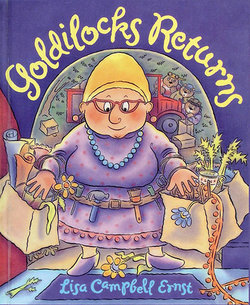
Goldilocks is all grown up and running a lock and home security shop in Ernst’s sequel. Still feeling bad about the bears, Goldi decides to go back and make things right—by installing new locks and redecorating a bit, for example. Still clueless after all these years! There’s a nice twist at the end of the book.


Goldilocks and the Three Bears: A Tale Moderne by Steven Guarnaccia
The author of The Three Little Pigs: An Architectural Tale gives us modern design furniture in this very hip tale. The house is a split-level and Daddy Bear looks like a beat poet. This kind of book seems to be more for grown-ups than children, but how very cool it is. The furniture in the illustrations is identified by designer on the endpapers. I should mention that the storytelling is traditional; it’s the art that gives it a twist.


Goldilocks and the Three Bears and the 33 Bears and the Bliim and the Furniture OR The Goldilocks Variations: Who’s Been Snopperink in My Woodootog? by Allan Ahlberg, illustrated by Jessica Ahlberg
We’re talking nutty, over-the-top British humor. This one’s for 5- to 7-year-olds because it’s fairly complicated and wordy. Also funny, funny, funny. There are seven versions of the story here, including one that’s a play, one in which the furniture talks, and one with space aliens. The book also has moving parts. (Note: This Goldilocks inspired today’s post.)


Goldilocks and the Three Dinosaurs by Mo Willems
A nice new spoof of the story. I especially like the way the dinosaurs are being ever so sneaky. It could have used a better last line, I think, but this one’s still a keeper. See my review here (scroll down).


Tackylocks and the Three Bears by Helen Lester, illustrated by Lynn Munsinger
Tacky the penguin is a unique character, weird and inclined not to get what’s going on, but nevertheless likable. This is partly because he’s pleasant and cheerful, but also because, unlike the rest of us, he’s utterly lacking in self-consciousness and self-doubt. In this story he draws the Goldilocks role out of the casting bowl, which is funny in and of itself. But goofy as Tacky looks in his costume, I was more amused by the way his buddies look in their bear hoods, which have ears on top, of course. A rowdy audience and Tacky’s approach to playing the part—or snoozing, as the case may be—make this deliberately ditzy book an icy delight.


The Three Snow Bears by Jan Brett
Brett told the story in traditional style in 1992, but she reimagined it with polar bears in 2007. This time a little Inuit girl named Aloo-ki loses her sled dogs and finds an igloo. All of the characters are arctic animals except Aloo-ki, all dressed in heavy sweaters. You don’t often see an author tell the same story again (Robin McKinley aside), but this version really is fresh and worthwhile.


I could go on… Ruth Sanderson has a version, Jump at the Sun did an African-American version illustrated by John Kurtz, and Lauren Child did a version with dolls. There’s even one told in Signed English (Harry Bornstein) and a special needs version in which Baby Bear “uses a wheelchair, goes to physical therapy, and ultimately makes friends with Goldilocks” (Rolling Along with Goldilocks and the Three Bears). If you look up the story title on Amazon, you will find 110 pages! I kid you not. There’s just something about the tale of a little blonde housebreaker and three put-upon bears that calls out to storytellers—and to 4- to 6-year-olds, who will want to hear it over and over again.


So how do you decide which one to read to your child? You can’t go wrong with the classics—James Marshall’s and Paul Galdone’s books are both marvelous, though I think Marshall’s bears may be less intimidating for very young readers.  My own new favorite for how the bears are depicted is Valeri Gorbachev’s version. For comedy, look to Lowell’s regional retelling, Hodgkinson’s high-rise rendering, Willems’ conniving crew of dinosaurs, James Marshall’s sly take on the tale, and Helen Lester’s penguin theatrics. Of course, if you like complicated British humor, Allan Ahlberg’s your guy.

Challenged to pick just three of these books, I’d go with Marshall’s, Gorbachev’s, and Ahlberg’s versions. But you have so many great choices!


Note: The illustration at the top of the post is by Emma Chichester Clark and the one at the bottom is by Gerda Muller.