Showing posts with label Adam Rex. Show all posts

Sunday, September 23, 2012

Pandas, Dragons, and Dinosaurs

It’s Tongue-in-Cheek Week here at Book Aunt as we talk about three picture books I think parents will like because the humor works for them as well as (in a somewhat different way) for young readers. Do try to keep a straight face.


Chu’s Day by Neil Gaiman, illustrated by Adam Rex

This is an extremely simple story that—Neil Gaiman hype or no Neil Gaiman hype—needs just the right illustrations to work. Fortunately, Adam Rex is in the house. Let’s hear a big round of applause for neo goth-cool Gaiman and geek chic-cool Rex!

You might like to know that the target audience for this book, which is due out in January (so yep, I’m totally jumping the gun), is the Chinese government.

I’ll bet you think I’m kidding.

A few years ago when Neil Gaiman was doing research in China, he learned that his books, such as The Wolves in the Walls and The Day I Swapped My Dad for Two Goldfish, are banned there. Here is part of Gaiman’s own explanation about the discovery that the books aren't allowed in China. (Sorry, but my quote function doesn’t want to allow paragraph returns.)
“Why not?” I asked. I was told it was because of their disrespect for authority, because sometimes children knew better than adults, because sometimes children do bad things and are not punished. I thought, “I should write a picture book that not even the Chinese can resist publishing.” I wrote it in a tea-shop in China. It is about a little panda who sneezes.
It was nice to find out that Gaiman specifically requested Adam Rex as an illustrator. Good call, Neil!

Anyway, the entire plot can be summed up as “Aaah— Aaah— Aaah—…Choo!” But be forewarned: little Chu’s sneezes are extraordinary. That’s why, when his parents take him various places and he seems like he’s going to sneeze, they get a little worried. But it’s a false alarm, another false alarm, etc. etc.—until it isn’t. Then WATCH out!

As I said, the plot is fun, but Adam Rex’s genius takes it to another level. First of all, little Chu with his sneeze-pun name is really cute, though just the teensiest bit wild-eyed, in my opinion. He wears a green striped t-shirt and yellow aviator goggles pushed up on the top of his head. He seems at first glance like a Bambi-eyed Disney character, but turns out to be Adam Rex’s truly subtle take-off on such a character. Don't miss the back cover, which is literally a back view of the front cover. Plus snail.

In his signature style (e.g., see Frankenstein Makes a Sandwich), Adam Rex creates an all-animal cast for scenes set in a library, a diner, and a circus. Each spread in these locations is marked by little in-jokes. Check out the mice in the card catalog, the diner name and counter person, and the different animals who are acrobats and their facial expressions at the circus, for example. We also get nice touches like the way a gold ring that’s part of the circus equipment frames Chu’s face right before he loses it. I was especially delighted by the way the locations that earlier escaped Chu’s sneeze don’t go unscathed in the over-the-big-top climax.

Clever premise and good pacing on Gaiman’s part, but Rex’s artwork steals the show. Your 3- or 4-year-old will really like this one.

The final sentence of Gaiman’s explanation about the book? “There is no word yet on what the Chinese government thinks.”

Note: If you like this book, look for an older favorite of mine, My Little Sister Ate One Hare by Bill Grossman, illustrated by Kevin Hawkes.

Also: Thanks to the publisher for a review copy of Chu's Day. Neil Gaiman's note was part of the publisher's materials, so you won't find it in the book. But I'm guessing you can look for it online.


Dragons Love Tacos by Adam Rubin, illustrated by Daniel Salmieri

This book has an oddly parallel plot to Chu’s Day, though it may not seem that way at first. We hit that high, high point in the climax, actually.

But let’s get down to basics. As the intrusive narrator and even the title explain, “Dragons love tacos.” Check out the cover art: The big pink dragon sprawled out in a taco-drugged haze has at least 9 tacos in his mouth, 15 sitting on top of his belly, and another 12 lying beside him. Not to mention all the ones you can’t see from this angle.

As the book begins, the narrator addresses his dragon/taco “how to” to a boy who looks like he’s about 10.
Hey kid! Did you know that dragons love tacos? They love beef tacos and chicken tacos. They love really big gigantic tacos and tiny little baby tacos as well.
The kid is obviously the perfect vessel for such knowledge because his bedroom is filled with dragon art, dragon toys, dragon stuffed animals, and dragon action figures. The informative narrator suggests that if the boy wants to make friends with dragons, tacos had better be involved. “But wait!” There’s a caveat here. Dragons like MILD tacos. They hate spicy salsa. “Just one single speck of hot pepper makes a dragon snort sparks.” It also gives dragons tummy troubles.

Our friendly narrator continues to coach the boy, convincing him to throw a taco party and invite all the neighborhood dragons. We find out that dragons love parties, too. The boy gets his hands on positively oodles of tacos. He takes the precaution of pouring all the hot taco sauce in a hole in the backyard and burying it. But he MAY have missed a bottle…

The artwork in Dragons Love Tacos has a fresh new look. The dragons are a bit like birds and a bit like dinosaurs. They come in different colors and manage to show distinct personalities. The little boy has a blocky body with a fireplug head and bowl-cut hair, along with froggy eyes and skinny little arms and legs. His dog is his sidekick. And of course, Daniel Salmieri is the ultimate taco artist: he must have drawn a hundred for this book. (Take a look at the endpapers!) All of this is set on a creamy background speckled with pale brown. Simple but effective.

Watch for the jokes—such as the spread where a dragon, responding to the narrator’s request, plays dead to act out just how much he hates spicy salsa. Also the spread showing how much dragons like different kinds of parties. I know I never want to go to another party that doesn’t have taco balloons, let alone a dragon that flies and juggles tacos at the same time. Shades of the tree party in Go, Dog. Go! It’s a good thing this kid’s parent are never around, especially considering what happens next.

Adam Rubin’s narrator sounds a little like Grover narrating There’s a Monster at the End of This Book. He is certainly full of good advice and warnings. Too bad it doesn’t necessarily work out! But the wry humor should amuse you along the way, and the author throws in a nice twist at the end of the book. Dragons Love Tacos will make a great read-aloud for your kids. I suspect you’ll be having tacos for dinner shortly thereafter, with or without spicy salsa.


Goldilocks and the Three Dinosaurs by Mo Willems

You know you’re in for a treat when you open this book to the front endpapers and see 65 or 70 crossed-out titles, things like Goldilocks and the Three Clams, Goldilocks and the Three Orthodontists, Goldilocks and the Three Robots, and Goldilocks and the Three Meerkats. If you’re like me, you’ll immediately turn to the back endpapers to see if they’re a repeat. And they’re not! We even get Goldilocks and the Three Stooges, not to mention Goldilocks and the Three Underwear Salesmen and Goldilocks and the Three Foot-long Hoagies. There’s more fun to be had, but I’ll restrain myself from listing the rest of the unused titles and move on to the actual book.
Once upon a time, there were three Dinosaurs: Papa Dinosaur, Mama Dinosaur, and some other Dinosaur who happened to be visiting from Norway.
Yes, Baby Dinosaur (or Bear) has been replaced by somebody presumably occupying the guest room. Though he is rather short. And pay attention to visual details like the phone, which has an extra-long receiver to suit a dinosaur head. The tale continues:
One day for no particular reason, the three Dinosaurs made up their beds, positioned their chairs just so, and cooked three bowls of delicious chocolate pudding at varying temperatures.
Wink-wink, nudge-nudge. We soon figure out that the Dinosaurs are setting an elaborate trap for the kind of little girl who might be inclined to walk into someone’s house without asking. But this is all conveyed ever-so-slightly indirectly. In other words, your kid is going to LOVE being onto those crafty dinos! Especially when we get lines like: “Then the other Dinosaur made a loud noise that sounded like a big, evil laugh but was probably just a polite Norwegian expression.” (I won’t attempt to reproduce the Norwegian laughing sounds pictured around his head in the artwork, but you get the idea.)

Sure enough, while the Dinosaurs ostensibly go Someplace Else, a little girl shows up and walks into the very large house. Her interaction with the pudding and the chairs is way past hilarious. The phrase “sugar high” comes to mind, and something else is too high, as well. (Don’t miss the asteroids poster on the wall.)

Finally, just in the nick of time, little Goldie gets a clue. And readers get, not one, but two morals to the story.

Kids who know the bears version are going to fall over laughing when they hear this one. I'm pretty sure parents and teachers will be chortling, as well.

Of course, anyone who’s met Pigeon or Elephant and Piggie will not be surprised to find that Willems’ dinosaurs are priceless. Mama’s hair or wig is a shorter, tamer version of Marge Simpson’s—anyway, it’s pale blue. And Papa has this absurd scribbly villain mustache. The two of them are green and sort of T-rex-shaped. The visiting dino is rust-colored and built more along the lines of a Triceratops. Goldilocks, for her part, will remind you of an older version of the kid in Knuffle Bunny. Terrific facial expressions abound.

Mo Willems has captured all the fun of the original tale and then transformed it with his usual panache, wry humor, and appealing artwork.  Another great offering from the undisputed new king of picture book comedy.

Just in case you were wondering, one of the title ideas on the endpapers is Goldilocks and the Three Pigeons. Oh, and the three bears do make a cameo appearance, like aging actors showing up for ten seconds in a hot new action flick.

Note for Worried Parents: I'm sure somewhere some parents will be worried about the dinosaurs' plans to eat Goldilocks, implied by references such as the one to "delicious chocolate-filled-little-girl-bonbons." These would be the parents without a sense of humor. No, really, little kids seem to be unfazed by this sort of threat in fairy tales. They know dinosaurs don't wear ties. And are extinct. But then, you know your kids, so make the call.

Saturday, February 4, 2012

A Review of Cold Cereal by Adam Rex

Adam Rex's latest will be in bookstores next week, and like the guy's previous middle grade book, The True Meaning of Smekday, it's more than a little nuts. I will note that Rex and his compatriot, the very funny Mac Barnett, are challenging Jon Scieszka and Lane Smith's reign as children's literature's Madly Humorous Duo. (See Barnett and Rex's YouTube video trailer for the upcoming picture book, Chloe and the Lion. And this outtake.) (Also: If you add in Dan Santat, it's a Madly Humorous Trio.)

You should also be aware that Rex is an illustrator. And a poet. E.g., in Frankenstein Makes a Sandwich.

So—Cold Cereal. It's a story of leprechauns and invisible rabbit men on the lam, and of kids who can see fairies, also kids who are science experiments and must constantly solve riddles. Scott (full name Scottish Play Doe) is new in town, and he's still seeing weird stuff. Then he meets twins Erno and Emily, who make his life seem downright normal. Both families have connections to Goodco Cereal Company, a place that is obvious eeee-vil in a mad scientist sort of way.

Pretty soon Scott is harboring a runaway leprechaun who says he's actually a clurichaun, and Emily and Erno are trying to avoid the people who apparently made their foster father disappear. Their baby sitter, who just might be Bigfoot, makes a really good ally.

I am currently reading The True Meaning of Smekday, and so far, I like it more than Cold Cereal. Still, Cold Cereal is a nice race around town with a giddy mash-up of mad scientists and legendary creatures to chase and rescue our heroic kid trio, respectively.

As a very big fan of good metaphors, I was especially happy to watch how the author threw these into the cereal bowl. Here are a few samples:
Laughter was batted back and forth like a squeaky balloon [in the classroom]...

...a seat right up front [in the bus], on which sat one very small and delicately pale eggshell of a girl. And exactly no one else.

Erno was a lean and rumpled kid—his clothes, which looked fine on their hangers, always looked on Erno as if he'd found them in the road on the way to school.

Mr. Wilson had the uncomfortable half smile of someone who was being forced to sit quietly while people sang "Happy Birthday" at him.

[About school lunches:] It so happened that they were serving pizza, or more accurately a kind of impersonation of it, as though the whole concept of pizza had been rather poorly explained to the cafeteria workers by people who'd only read about it in books and didn't really like children much.

As you can see, Rex is a dab hand at satire, and you'll find nice little pockets of it at regular intervals, including his terribly funny renderings of cereal commercials, which are illustrated in sequence.

The author lost me a few times in backstory, but really, his book is just a lot of fun—with a sequel or two clearly in the works. Go, Rex! And go, Madly Humorous Duo (or Trio)!

See Adam Rex's website, especially his blog.

Saturday, February 19, 2011

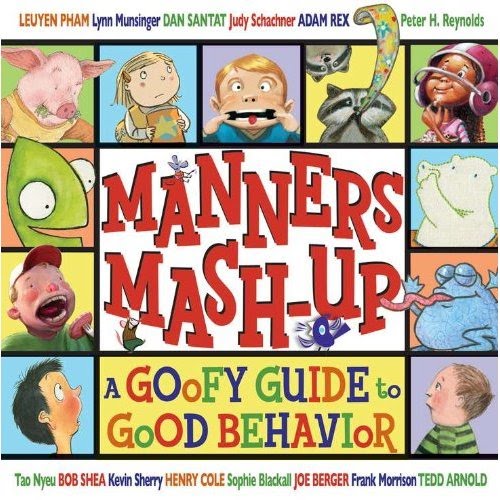
A Review of Manners Mash-up by a Bunch of People

Perhaps you've seen Why Did the Chicken Cross the Road? or Knock, Knock! by a team of terrific children's book illustrators, in which each artist presents a different take on the same theme. Now you can head to the library or bookstore in seach of the latest in this innovative series—Manners Mash-Up: A Goofy Guide to Good Behavior. This is definitely my favorite of the three, worthy of taking its place on the shelf next to such helpful manners books as Sesyle Joslin and Maurice Sendak's classic What Do You Say, Dear? and What Do You Do, Dear?

What's really great about this book—and the reason kids will like it—is that it mostly shows what not to do, though the written rules explain what should be done. That makes Manners Mash-up an outrageous demo of over-the-top behavior, as illustrated with great gusto by a top-flight array of illustrators. Each one addresses manners in a particular setting, starting with the school bus. I'll give you one or two of my favorite rules and illustrations from each spread.

Bob Shea, "Bus Manners": Here the animals match the rule-breaking, as the bear demonstrates the opposite of "Don't soak your seatmate with sleep drool," the skunk shows "Say 'excuse me' when you make a smell," and the giraffe doesn't do too well at "Try to keep your head in the bus," for example. The one about the driver is the best, also the most out there, but I'll leave you to discover that one for yourself.

Lynn Munsinger, "Cafeteria Manners": Featuring a darling cast of pigs, this spread shows us how not to break rules like "No food fights" and "Don't take all the desserts."

Henry Cole, "Don't Stare At": This one is going to please the bathroom humor crowd. It takes place in the main office of a school (with human characters), and includes several key things that should not be stared at, such as "Funny Outfits" and "Gross Things on People's Faces."

Leuyen Pham, "Playground Manners:" More animals! The chimps are throwing sand in the sandbox and a groundhog is hogging the ball, but there are some sweet ones, too, among them "Always watch out for little ones" and "Give friends a boost."

Peter H. Reynolds, "Classroom Manners": We're back to human children with Reynolds, who has the kids demonstrating positive rules with dialogue in voice bubbles. For example, beneath "Ask nicely" a girl says, "May I borrow the purple crayon, please?" (surely an allusion to Harold), while beneath "Share," the boy sitting next to her replies, "My pleasure, Holly! I have an extra one. Keep that one!"

Tedd Arnold, "Good Sports": Probably my favorite, but then, I'm a sci-fi/fantasy buff. Here we get to see "The All-Alien Slimeball Championship" on some moon or planet... There are only four rules, and each is illustrated by a little three-panel cartoon strip. Though the rules are ordinary, the way they play out is not. For instance, when one alien throws a slimeball, another eats it with a GULP and the coach says, "Eating the slime ball is against the rules. You're benched!"

Adam Rex, "Table Manners": The author-illustrator of Frankenstein Makes a Sandwich gives us a mad scientist attempting to have a nice, civil dinner with Igor and a three-headed boy he apparently created in his lab. (The good doctor looks like John Waters, if you ask me.) When the mad scientist says, "And chew with your mouths closed—were you raised in a barn?" the reply is quite literal. And what possible response is there to this instruction? "Igor—don't slouch."

Judy Schachner, "Party Manners": At first glance, Schachner's style doesn't seem to lend itself to poop jokes, but they're there... She can't resist playing with the idea of party poopers! And then we get a girl carrying an alligator I'm not entirely sure is stuffed, plus a raccoon in a party hat hanging upside down from a tree. Favorite rule? "Whack the piƱata. Not your friend."

Frank Morrison, "Be a Good Visitor": So far, the cast of characters has been nicely diverse, and now we get a living room gathering that consists mostly of African Americans. "Help out if you're asked" is a great idea, though "Don't play ball in the house" provides a more striking visual. I like the way the adults in this one look like they're at their wit's end over the kids' antics.

Sophie Blackall, "Good Behavior at the Doctor's Office": Sophie gets a little surreal with rules like "Prosthetic legs aren't toys." Watch out for the lady whose head is no longer attached and the child commandeering the receptionist's telephone, not to mention the doctor's name.

Dan Santat, "Proper Behavior at the Theater": Each rule at this opera performance has its own "do not" icon. You can imagine the one accompanying this admonishment: "Please don't pick your nose and leave the boogers under the seat. That spot is saved for old chewed gum wads only. Yummy! Yummy!"

Joe Berger, "Supermarket No-No's": "Don't eat all the free samples" shares shelf space with "Always take cans from the top of the stack" and, best of all, a warning about the produce section.

Kevin Sherry, "Pool Rules": These rules are pretty typical, but I like the artwork, especially the inclusion of a giant octopus who is just hanging out near the shallow end for some reason. Plus there's a nice big sign on top of the bathroom advising kids not to pee in the pool.

Tao Nyeu, "Please Don't Pick in Public": Yeah, this one's all about what not to pick! But the most astonishing thing about Nyeu's spread is that it's done in needlework. Which means that, not only is it darling, but a supposedly staid medium is used to show some decidedly unstaid activities. All animals again; I think my favorite is the crocodile picking his scabs, with a mouse saying, "Ew."

The last spread is a satisfying finale, giving us a small self-portrait or photo of each illustrator with the answer to this question: "What was your goofiest manners mishap?" Peter Reynolds's is a little off-topic and Bob Shea's is just plain weird (though kinda funny); the rest are pretty amusing. For some reason, I especially like the image of a two-year-old Dan Santat throwing chicken bones at the other diners in a restaurant.

So there you have it—a detailed modeling of mostly bad manners which should nevertheless provide fodder for a classroom or family discussion of good manners. What exactly does it mean to be polite? Why do we have rules like that in the first place? And hey, just what's wrong with asking total strangers why they're fat? (You should probably get your finger out of your nose and say "excuse me" before you answer these questions.)

Friday, June 11, 2010

Oh No! and Blue Whales from Mac Barnett

In January I reviewed Mac Barnett's The Case of the Case of Mistaken Identity, a tongue-in-cheek detective story that blithely and cleverly mocks the Hardy Boys. So I was eager to get my hands on a couple of Barnett's picture books, Billy Twitters and His Blue Whale Problem (2009) and now the brand-spanking-new Oh No! (or How My Science Project Destroyed the World).

Can you say surreal? That's one of the many words I'd use to describe Billy Twitters and His Blue Whale Problem. When Billy won't clean his room or brush his teeth or eat his peas, his mom threatens him with an ever-so-obvious punishment, "or we're buying you a blue whale."

Narrator Billy tells us, "But I'm not worried. See, I know a thing or two about blue whales. I mean, they're the biggest animals in the world, ever. It's not like you can just have one delivered to your house overnight."

Whereupon we turn the page to find a late-night spread showing a ginormous delivery vehicle driven by a company called "Fed Up." Clearly, it is making an overnight delivery! Then during breakfast, Billy feels something watching him... And we see a huge cetacean eye looking in the kitchen window.

Yep, Billy is now responsible for a blue whale—his mom expects him to take it everywhere he goes, including school.

This story requires some suspension of disbelief, since the whale does surprisingly well out of water. But once you get past that, or sidestep it rather, you can just have fun with the author's playful "what if" scenario. Why would it be such a pain to own a blue whale? And how might a resourceful boy eventually turn the punishment around to serve his own purposes?

Illustrator Adam Rex does a superb job of transforming the author's nutso story into a reality, creating wonderful characters like a teacher who thinks a blue whale is the perfect show-and-tell item and a school bully who tells Billy his blue whale is a stupid pet. Then there's the whale itself, which manages to look slightly stoic and put-upon. (Despite having a whale owner's manual, Billy finds himself struggling to fulfill tasks like feeding his pet. "Dad...where can I find ten thousand gallons of seawater?")

I'm guessing second and third graders will appreciate this funky tale, and it could easily be built into a class unit for writing stories about how other pets might create certain difficulties. Yak, anyone?

Don't forget to check out the endpapers, which are sepia-toned ads for other products from the same company that goes around selling blue whales to suburban families. The ad for the whale itself can be found on the book cover, beneath the jacket.

The endpapers in Barnett's newest book, Oh No! or How My Science Project Destroyed the World, are just as good, or maybe even better, done by another talented illustrator, Dan Santat. Be sure and take off the jacket, which has a movie-style poster on the back.

"Movie-style" is a good description for this picture book, actually, which is partly an homage to Japanese monster movies like Godzilla. (See the translations of Japanese phrases at the bottom of the spread preceding the title page.) Like a movie, Barnett's latest begins in media res, as TV screens blare about a disaster and a fifth grade girl walks through the ruined city saying, "Oh no..." "Oh man..." "I knew it."

On the next page turn, we see a giant robot rampaging through the city, and the narrator remarks, "I never should have built a robot for the science fair." She goes on to mention some of the features she wished she hadn't included in her robot--and the ones she wished she had. Ah, hindsight!

So what is our young mad scientist-in-training going to do about it now?

The storytelling here is almost entirely visual, but is easy to follow as Mac Barnett and Dan Santat gleefully build on the author's latest "what if." Santat uses strong colors tempered by browns and comic book as well as movie conventions in his amused portrayal of a science project gone amok. Look for the scene where the narrator is being awarded first prize, as almost everyone in the room is unaware that her project has taken an unusual turn. The titles of the other science projects are especially funny.

And of course, the main character's quick-labwork solution has a bit of that The King, the Mice and the Cheese thing going on... I doubt we'll see a picture book sequel, but a movie sequel is implied, which fits right into the whole cinematic approach of this tale.

The feminist/teacher in me has to stop and thank Barnett and Santat for making the robot builder and science fanatic a girl, by the way.

Of course, boys and girls alike will enjoy this one. (Okay, I don't know if the Fancy Nancy crowd will appreciate it, but a lot of other kids will!) Oh No! is probably more approachable than Billy Twitters, but then, I think it's good to shake up kids' thinking with a dose of absurdism every so often. With nothing but TV thrown at them, children are unlikely to grow up thinking outside the box. Mac Barnett and Co. are here to remedy the situation!

Note: Take a look at Seven Imp's terrific interview with Dan Santat about Oh No! There's a luxurious amount of art in Jules's post. See also reviews at Fuse #8 (with book trailer links) and Books4YourKids.

Update: Canadian author k.c. dyer has pointed out in the comments that Twitter has a blue whale fail symbol--which means there's another bit of satire from Mac Barnett in his Billy Twitters title. (This may even give us a glimpse into Barnett's off-the-wall brainstorming process.) Update of Update: Nope! I found out in reading an interview with Barnett that he came up with Billy Twitters and the blue whale before Twitter even hit the Internet.

Sunday, January 17, 2010

A Review of The Brixton Brothers: The Case of the Case of Mistaken Identity by Mac Barnett

Normally, I would question whether a parody seemingly intended for people over the age of 30 could appeal to kids, but I am reassured by two things: 1) Today's children are familiar with parody in the form of Simpsons and even Spongebob Squarepants episodes, and 2) Mac Barnett covers his bases by providing snippets from a mock-original book series he's created.

And what snippets they are! The target, of course, is the Hardy Boys detective series (whose characters inevitably remind me of boy bands like 'N Sync). Barnett's Steve Brixton believes in those dashing supersleuths, the Bailey Brothers, having practically memorized their books. Here's a sample we're given from Bailey Brothers #13, The Mystery of the Hidden Secret:

"Jumping jackals!" dark-haired Shawn exclaimed, pointing to the back wall of the dusty old parlor. "Look, Kevin! That bookcase looks newer than the rest!"
"General George Washington!" his blond older brother cried out. "I think you're right!" Kevin rubbed his chin and thought. "Hold on just a minute, Shawn. This mansion has been abandoned for years. So who would have built a new bookcase?"
Shawn and Kevin grinned at each other. "The robbers!" they shouted in unison.
(Note the over-use of adjectives and the pointed deliberation. Barnett is having a good time with this!)

When Steve encounters a mystery of his own while fulfilling an obnoxious school assignment, he is surprised and disappointed to find that the Bailey Brothers' methods don't always pan out in real life. He is even more surprised to learn that the town librarians are secret agents.

Yes, I know, that sounds like Brandon Sanderson's Alcatraz versus the Evil Librarians. But trust me, Barnett has a new take on it. For one thing, his librarians are fighting evil. For another, you'll be so caught up in the satire that the librarians will just flow in with the rest of the story. At least, that was my experience reading this book.

Steve's bible is The Bailey Brothers Detective Handbook. It tells him, among other things, how to "size up suspicious characters." This proves useful "if you're eating dinner with safecrackers, or cat burglars, or your mother's new boyfriend." In meeting the latter, Steve checks the book's list of villains, which includes "The Tough," "The Ringleader," and "The Hermit," all very old-fashioned and stereotyped, natch. Rick turns out to be a cop, and Steve solves a case for him in a manner more reminiscent of Encyclopedia Brown than the Hardy Boys, though Rick doesn't accept his solution, not at the moment.

Then Steve's teacher assigns him to research early American needlework. When he goes to the local library and checks out a book called An Illustrated History of American Quilting, a group of shadowy figures bursts through the skylight and doors and starts to chase him. Oddly enough, the Bailey Brothers' list of useful hiding places doesn't help one bit. Pretty soon Steve is stepping into a black limo at gunpoint and having a conversation with a very buff librarian named Mackintosh. All because he checked out a particular book and presented his Bailey Brothers Detective License instead of his library card at the front desk...

I can't even begin to tell you all the little in-jokes (e.g., about posters of basketball players reading books), but Barnett manages to make this story, not only smart, but funny, and without trying too hard. The Case of the Case of Mistaken Identity is tongue-in-cheek all the way. I should note that Barnett doesn't simply satirize the Hardy Boys by setting Steve Brixton up against grim reality; he stylizes the characters around Steve, having them act a little like the players in a Hardy Boys mystery—just enough to be funny.

What this book really reminds me of is M.T. Anderson's Whales on Stilts, which is high praise indeed. Except that Barnett's liberal inclusion of his pseudo-source material makes his story all the more accessible to young readers who might not otherwise understand just what he's satirizing. The fact that this book isn't 600 pages long will also appeal to some readers. (It's a tidy 179.)

Adam Rex's illustrations, appropriately retro and slightly satirical in style, add to the storytelling. You may remember this author-illustrator from The True Meaning of Smekday and his picture book of poems, Frankenstein Makes a Sandwich.

The past decade has seen a wave of books intended for boys, contemporary adventure and mystery series trying to reach a surprisingly sophisticated audience whose expectations have been honed by movies, TV, and video games. Today's 4th-6th graders like to feel like they're in on the joke. So yes, I think some of the kids who watch The Simpsons will get a kick out of something as clever and entertaining as Mac Barnett's Brixton Brothers.