Showing posts with label Dan Santat. Show all posts

Sunday, October 28, 2012

Not Your Grandma's Picture Books


It's true. Picture books don’t have to be about pink princesses who live sugarishly ever after…


The Conductor by Laƫtitia Devernay

I found out about this French illustrator’s book when it won the Society of Illustrator’s Original Show: Children’s Book Illustration gold medal this year. Then I learned that Devernay won a major British award for the book as well, top prize from this year’s V&A Awards. (I looked high and low to figure out what V&A stands for. It’s Victoria and Albert—the museum. Of course.)

Here's a plot summary: A conductor conducts the leaves on trees, which turn into birds and fly around a bit before coming back to the trees to be leaves again. This summary does not do the wordless book justice, however. Each spread has its own design and beauty, evoking Escher a little and, for children’s literature fans, the scene in which Milo conducts a sunrise in The Phantom Tollbooth—or rather, when he sees sunset conducted the night before.

Devernay illustrates the entire book using a couple of greens, a very pale yellow and black. There’s a whole lot of white space going on, as well. The trim size is unusual: it’s about 5 and ¾ by 13. (I measured.)


The Conductor has something to say about music, about trees, and about birds, but in a way it’s about none of these things. It’s only about them as they interact, creating something new. Perhaps I don’t care much about green lollipop trees with an almost paisley pattern or a little conductor in a black coat and striped pants. Maybe birds don’t move me, either. But when the conductor lifts his baton and the leaves begin to transform, rising into the sky—then I care very much. That is the magic of Devernay’s book.

I’m not going to tell you about the spread where the conductor takes his bow, or what he does with his baton. You really should find out for yourself.

I will say that the book may be too subtle for many young readers. This book certainly might appeal to an artsy, thoughtful child, though. And artsy, thoughtful grown-ups, too.

Note: As for the other winners of the Society of Illustrators' Original Show in the children's book category, we’ve got silver medals for The Beetle Book by Steve Jenkins and This Is Not My Hat by Jon Klassen, with a Founders Award to The Insomniacs, illustrated by the Brothers Hilts (author Karina Wolf).


Who Pushed Humpty Dumpty? by David Levinthal, illustrated by John Nickle

This book is so much like the movie Hoodwinked in certain respects that at first I looked all over to find some kind of credit. After all, that movie is about a land of fairy tale creatures in which a big bad wolf turns out to be an investigative reporter. He gets some help with crime solving from Little Red Riding Hood and a debonair frog P.I. in a fedora—Nicky Flippers.

For its part, Levinthal’s book is about a land of fairy tale creatures in which a debonair frog solves crimes. Oh wait—I stand corrected. Officer Binky is “a toad in a fedora,” according to the flap copy. So let’s move on.

Who Pushed Humpty Dumpty? gives us five fairy tale cases: a break-in at the home of the Bear family, the case of the death of a witch who lived in a gingerbread house, the title case, the case of a beauty pageant involving Snow White and the Queen, and the case of Jack and that beanstalk.

The book is more of a read-aloud for kids as young as 7. It’s really more geared towards the 8-to-10 crowd. Not only is the text small (usually an easy way to guess a picture book’s intended audience), but the whole thing’s a satire. Satire goes right over the heads of most younger readers.

However, that said, I really liked this book! Here’s how it begins:

There are eight million stories in the forest. This is one of them.
It was a typical Sunday morning for the Bear family. They had gone out for a walk while their porridge was cooling.
I was working the robbery detail out of the Pinecone Division. My name’s Binky. I’m a cop.

As always, John Nickle’s illustrations are just right. (Allow me one fairy tale pun!) I especially like the page on which Officer Binky is taking notes from the three Bears. He’s standing in front of a layered tower of bears—so all in one shape we have Binky (back to us) in front of Baby Bear, who’s in front of taller Mrs. Bear, who’s in front of taller Mr. Bear. All three bears are frowning and pointing one accusing clawed paw in the direction of the page on the other side of the spread. That page is divided in four. The first three frames contain the following clues: A strand of blond hair, an empty porridge bowl, blue cloth on a broken chair, and a rumpled quilt. The last frame shows Binky driving off. (He’s barely tall enough to see over the steering wheel.) He says, “I’d heard that story before. It could only be one dame: Goldilocks! I nabbed her trying to make her getaway.” The perp has an excuse, but she ends up in jail just the same.

I won’t tell you much about the other cases, but they are presented with panache, too. Hansel and Gretel’s encounter with the witch is told after the fact using sepia illustrations, a nice touch. The Humpty Dumpty mystery has an un-egg-spected solution. (Make that two fairy tale puns.) Setting the Snow White story in a beauty pageant gives the tale a whole new twist. And then there’s Jack. I’ll bet you think you know where that one’s going, but you’re probably wrong.

Meet Binky. And read his case files. You'll like them.


The Three Ninja Pigs by Corey Rosen Schwartz, illustrated by Dan Santat

I’ve been looking forward to this one. Just check out Dan Santat’s book trailer. The whole concept makes me laugh. There have been a lot of fairy tale parodies out over the last 10–15 years, but The Three Ninja Pigs gets off to a much funnier start than most. Just read the title!

Oh, all right, I suppose I’d better open the cover and look inside. Let’s pause at the front jacket flap:

Why do wolves think they can come to town and blow all the houses down? These three pigs just aren’t going to take it!
The first starts aikido lessons—he’ll make mincemeat out of that wolf!
His brother learns a little jujitsu—he’ll chop that guy to pieces!
But when the wolf actually appears, it turns out these two pigs aren’t quite ready after all. Good thing their sister has been training every day to master some serious karate moves. KIYA!

Yep, that’s my new favorite thing about this book: the third pig is a girl. Plus she’s a better ninja warrior than her brothers. (That would be because they don’t practice.)

Forgot to mention: the story is written in rhyme. I'm generally not fond of this choice for a narrative picture book, but I've decided to get over it for the moment in order to enjoy these ninja piggies.

Dan Santat’s illustrations are just as funny as the premise. For one thing, he delivers on the martial arts action. Well, perhaps not for the two pig brothers. I like the way Santat shows aikido practice—including the first little pig snoozing on the floor while an irritated instructor looks down at him. The teacher in Pig Two’s jujitsu class is a classic mentor. I think he's a water buffalo, but he reminds me of Obi Wan Kenobi. “Excellent progress,” he says, “But Pig-san, you MUST study more.” To which Pig Two replies, “No way! Sayonara, Sensei.”

In contrast, Pig Three studies karate diligently. After she gets better and better, she even breaks boards “by performing a perfect pork chop!”

Pigs One and Two don’t do so well with the wolf. Not even when Two yells, “Retreat! Or you’ll suffer defeat by the hair of my chinny-chin-chin.” But Pig Three isn’t joking when she says, “I’m a certified weapon.”

I think you’ll like the wolf, who wears red karate clothes, does that “bring it” move like in Karate Kid, and says to Pig Three, “Yo, Bacon,” at least until he sees her moves. Then he rethinks the idea of taking her on.

Of course, I agree with critics of spoofs like this one that kids should read the original first. Once they’ve done that, it's time for the porcine ninjas!

Note: A glossary at the back explains terms like sensei and provides pronunciations.

Saturday, July 7, 2012

A Review of Oh No! Not Again! by Mac Barnett, illustrated by Dan Santat


She’s back! And by she I mean the young girl who’s a scientist—okay, a mad scientist—in Oh No! Or How My Science Project Destroyed the World. This time she’s worrying about her history grade. There’s this one question about how the prehistoric cave art in France got there. It’s the only question she missed on her A-earning history test. And, being a perfectionist, she is determined to change that. “Luckily, there’s a simple solution.”

You know right there the solution isn't going to be simple! YMS (for Young Mad Scientist, though she’s not actually named in the book) goes home and builds a time machine. Her plan? “Change history so I am right.” (Which just may be the best phrase in the whole book.)

If you’ve read any Greek myths, epic poems, and plays, you’ll know that such an attitude is called hubris and YMS is in for it. Sure enough, after she gets to prehistoric France, she tries to get the cavemen to paint the walls, and they won’t. Nothing daunted, YMS starts painting the walls herself—with very funny results. (She brought spray paint and everything.)

But that’s nothing compared to what’s happening behind her back as the two cavemen go joy riding in her time machine. The ending of the book is not necessarily happy, but it’s definitely funny.

I think the jokes here may be a bit subtle for kids, but they should get a kick out of the basic plot and those cavemen. Their parents may appreciate the more complex implications. Once again, Mac Barnett and Dan Santat are a gleefully giddy team. I hope there’s a Book 3! Let’s also thank these two for making an elementary school girl a science whiz. People feeling dour about the state of the U.S. on the  current global scene should think about encouraging kids, especially girls, to go all out with math and science.

Teachers and parents might also want to have a discussion about what would happen if you really went back in time—the idea that even small changes you made could have far-reaching effects, as in Ray Bradbury’s famous short story, “A Sound of Thunder,” which spawned the term “the butterfly effect.” You could also talk about the drawbacks to perfectionism.

As in the first book, Dan Santat's exuberant illustrations suit an exuberant story. Santat's style gives a nod to animation while calling out plot points and oddball extra details in its own brash voice. Some of the artwork seems a little rougher around the edges than in Book 1, but I get the feeling that's a deliberate choice to match the rougher topic of prehistoric men.

By the way, be sure to check out the final spread with its looping time travel map, the endpapers with their time machine blueprints, and the poster on the other side of the book jacket. Even the bios on the back flap are funny. And check out the book trailer of Oh No! Not Again! (Or How I Built a Time Machine to Save History) (Or at Least My History Grade).

I’ve said it before and I’ll say it again: Mac Barnett and Dan Santat, along with Adam Rex, are the new young guns of picture books, especially when it comes to fresh and funny. Keep an eye out for their books—they may just destroy the world, but you’ll be laughing all the way.

Saturday, February 19, 2011

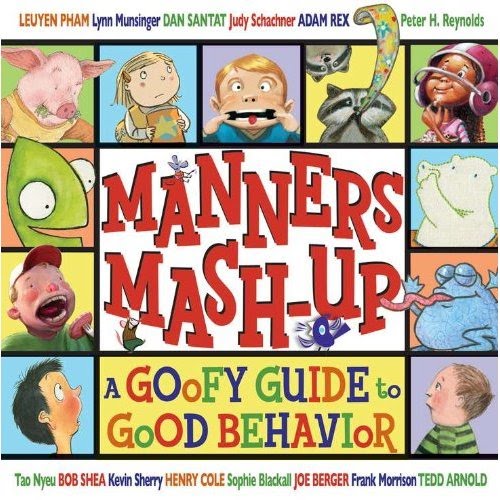
A Review of Manners Mash-up by a Bunch of People

Perhaps you've seen Why Did the Chicken Cross the Road? or Knock, Knock! by a team of terrific children's book illustrators, in which each artist presents a different take on the same theme. Now you can head to the library or bookstore in seach of the latest in this innovative series—Manners Mash-Up: A Goofy Guide to Good Behavior. This is definitely my favorite of the three, worthy of taking its place on the shelf next to such helpful manners books as Sesyle Joslin and Maurice Sendak's classic What Do You Say, Dear? and What Do You Do, Dear?

What's really great about this book—and the reason kids will like it—is that it mostly shows what not to do, though the written rules explain what should be done. That makes Manners Mash-up an outrageous demo of over-the-top behavior, as illustrated with great gusto by a top-flight array of illustrators. Each one addresses manners in a particular setting, starting with the school bus. I'll give you one or two of my favorite rules and illustrations from each spread.

Bob Shea, "Bus Manners": Here the animals match the rule-breaking, as the bear demonstrates the opposite of "Don't soak your seatmate with sleep drool," the skunk shows "Say 'excuse me' when you make a smell," and the giraffe doesn't do too well at "Try to keep your head in the bus," for example. The one about the driver is the best, also the most out there, but I'll leave you to discover that one for yourself.

Lynn Munsinger, "Cafeteria Manners": Featuring a darling cast of pigs, this spread shows us how not to break rules like "No food fights" and "Don't take all the desserts."

Henry Cole, "Don't Stare At": This one is going to please the bathroom humor crowd. It takes place in the main office of a school (with human characters), and includes several key things that should not be stared at, such as "Funny Outfits" and "Gross Things on People's Faces."

Leuyen Pham, "Playground Manners:" More animals! The chimps are throwing sand in the sandbox and a groundhog is hogging the ball, but there are some sweet ones, too, among them "Always watch out for little ones" and "Give friends a boost."

Peter H. Reynolds, "Classroom Manners": We're back to human children with Reynolds, who has the kids demonstrating positive rules with dialogue in voice bubbles. For example, beneath "Ask nicely" a girl says, "May I borrow the purple crayon, please?" (surely an allusion to Harold), while beneath "Share," the boy sitting next to her replies, "My pleasure, Holly! I have an extra one. Keep that one!"

Tedd Arnold, "Good Sports": Probably my favorite, but then, I'm a sci-fi/fantasy buff. Here we get to see "The All-Alien Slimeball Championship" on some moon or planet... There are only four rules, and each is illustrated by a little three-panel cartoon strip. Though the rules are ordinary, the way they play out is not. For instance, when one alien throws a slimeball, another eats it with a GULP and the coach says, "Eating the slime ball is against the rules. You're benched!"

Adam Rex, "Table Manners": The author-illustrator of Frankenstein Makes a Sandwich gives us a mad scientist attempting to have a nice, civil dinner with Igor and a three-headed boy he apparently created in his lab. (The good doctor looks like John Waters, if you ask me.) When the mad scientist says, "And chew with your mouths closed—were you raised in a barn?" the reply is quite literal. And what possible response is there to this instruction? "Igor—don't slouch."

Judy Schachner, "Party Manners": At first glance, Schachner's style doesn't seem to lend itself to poop jokes, but they're there... She can't resist playing with the idea of party poopers! And then we get a girl carrying an alligator I'm not entirely sure is stuffed, plus a raccoon in a party hat hanging upside down from a tree. Favorite rule? "Whack the piƱata. Not your friend."

Frank Morrison, "Be a Good Visitor": So far, the cast of characters has been nicely diverse, and now we get a living room gathering that consists mostly of African Americans. "Help out if you're asked" is a great idea, though "Don't play ball in the house" provides a more striking visual. I like the way the adults in this one look like they're at their wit's end over the kids' antics.

Sophie Blackall, "Good Behavior at the Doctor's Office": Sophie gets a little surreal with rules like "Prosthetic legs aren't toys." Watch out for the lady whose head is no longer attached and the child commandeering the receptionist's telephone, not to mention the doctor's name.

Dan Santat, "Proper Behavior at the Theater": Each rule at this opera performance has its own "do not" icon. You can imagine the one accompanying this admonishment: "Please don't pick your nose and leave the boogers under the seat. That spot is saved for old chewed gum wads only. Yummy! Yummy!"

Joe Berger, "Supermarket No-No's": "Don't eat all the free samples" shares shelf space with "Always take cans from the top of the stack" and, best of all, a warning about the produce section.

Kevin Sherry, "Pool Rules": These rules are pretty typical, but I like the artwork, especially the inclusion of a giant octopus who is just hanging out near the shallow end for some reason. Plus there's a nice big sign on top of the bathroom advising kids not to pee in the pool.

Tao Nyeu, "Please Don't Pick in Public": Yeah, this one's all about what not to pick! But the most astonishing thing about Nyeu's spread is that it's done in needlework. Which means that, not only is it darling, but a supposedly staid medium is used to show some decidedly unstaid activities. All animals again; I think my favorite is the crocodile picking his scabs, with a mouse saying, "Ew."

The last spread is a satisfying finale, giving us a small self-portrait or photo of each illustrator with the answer to this question: "What was your goofiest manners mishap?" Peter Reynolds's is a little off-topic and Bob Shea's is just plain weird (though kinda funny); the rest are pretty amusing. For some reason, I especially like the image of a two-year-old Dan Santat throwing chicken bones at the other diners in a restaurant.

So there you have it—a detailed modeling of mostly bad manners which should nevertheless provide fodder for a classroom or family discussion of good manners. What exactly does it mean to be polite? Why do we have rules like that in the first place? And hey, just what's wrong with asking total strangers why they're fat? (You should probably get your finger out of your nose and say "excuse me" before you answer these questions.)

Friday, June 11, 2010

Oh No! and Blue Whales from Mac Barnett

In January I reviewed Mac Barnett's The Case of the Case of Mistaken Identity, a tongue-in-cheek detective story that blithely and cleverly mocks the Hardy Boys. So I was eager to get my hands on a couple of Barnett's picture books, Billy Twitters and His Blue Whale Problem (2009) and now the brand-spanking-new Oh No! (or How My Science Project Destroyed the World).

Can you say surreal? That's one of the many words I'd use to describe Billy Twitters and His Blue Whale Problem. When Billy won't clean his room or brush his teeth or eat his peas, his mom threatens him with an ever-so-obvious punishment, "or we're buying you a blue whale."

Narrator Billy tells us, "But I'm not worried. See, I know a thing or two about blue whales. I mean, they're the biggest animals in the world, ever. It's not like you can just have one delivered to your house overnight."

Whereupon we turn the page to find a late-night spread showing a ginormous delivery vehicle driven by a company called "Fed Up." Clearly, it is making an overnight delivery! Then during breakfast, Billy feels something watching him... And we see a huge cetacean eye looking in the kitchen window.

Yep, Billy is now responsible for a blue whale—his mom expects him to take it everywhere he goes, including school.

This story requires some suspension of disbelief, since the whale does surprisingly well out of water. But once you get past that, or sidestep it rather, you can just have fun with the author's playful "what if" scenario. Why would it be such a pain to own a blue whale? And how might a resourceful boy eventually turn the punishment around to serve his own purposes?

Illustrator Adam Rex does a superb job of transforming the author's nutso story into a reality, creating wonderful characters like a teacher who thinks a blue whale is the perfect show-and-tell item and a school bully who tells Billy his blue whale is a stupid pet. Then there's the whale itself, which manages to look slightly stoic and put-upon. (Despite having a whale owner's manual, Billy finds himself struggling to fulfill tasks like feeding his pet. "Dad...where can I find ten thousand gallons of seawater?")

I'm guessing second and third graders will appreciate this funky tale, and it could easily be built into a class unit for writing stories about how other pets might create certain difficulties. Yak, anyone?

Don't forget to check out the endpapers, which are sepia-toned ads for other products from the same company that goes around selling blue whales to suburban families. The ad for the whale itself can be found on the book cover, beneath the jacket.

The endpapers in Barnett's newest book, Oh No! or How My Science Project Destroyed the World, are just as good, or maybe even better, done by another talented illustrator, Dan Santat. Be sure and take off the jacket, which has a movie-style poster on the back.

"Movie-style" is a good description for this picture book, actually, which is partly an homage to Japanese monster movies like Godzilla. (See the translations of Japanese phrases at the bottom of the spread preceding the title page.) Like a movie, Barnett's latest begins in media res, as TV screens blare about a disaster and a fifth grade girl walks through the ruined city saying, "Oh no..." "Oh man..." "I knew it."

On the next page turn, we see a giant robot rampaging through the city, and the narrator remarks, "I never should have built a robot for the science fair." She goes on to mention some of the features she wished she hadn't included in her robot--and the ones she wished she had. Ah, hindsight!

So what is our young mad scientist-in-training going to do about it now?

The storytelling here is almost entirely visual, but is easy to follow as Mac Barnett and Dan Santat gleefully build on the author's latest "what if." Santat uses strong colors tempered by browns and comic book as well as movie conventions in his amused portrayal of a science project gone amok. Look for the scene where the narrator is being awarded first prize, as almost everyone in the room is unaware that her project has taken an unusual turn. The titles of the other science projects are especially funny.

And of course, the main character's quick-labwork solution has a bit of that The King, the Mice and the Cheese thing going on... I doubt we'll see a picture book sequel, but a movie sequel is implied, which fits right into the whole cinematic approach of this tale.

The feminist/teacher in me has to stop and thank Barnett and Santat for making the robot builder and science fanatic a girl, by the way.

Of course, boys and girls alike will enjoy this one. (Okay, I don't know if the Fancy Nancy crowd will appreciate it, but a lot of other kids will!) Oh No! is probably more approachable than Billy Twitters, but then, I think it's good to shake up kids' thinking with a dose of absurdism every so often. With nothing but TV thrown at them, children are unlikely to grow up thinking outside the box. Mac Barnett and Co. are here to remedy the situation!

Note: Take a look at Seven Imp's terrific interview with Dan Santat about Oh No! There's a luxurious amount of art in Jules's post. See also reviews at Fuse #8 (with book trailer links) and Books4YourKids.

Update: Canadian author k.c. dyer has pointed out in the comments that Twitter has a blue whale fail symbol--which means there's another bit of satire from Mac Barnett in his Billy Twitters title. (This may even give us a glimpse into Barnett's off-the-wall brainstorming process.) Update of Update: Nope! I found out in reading an interview with Barnett that he came up with Billy Twitters and the blue whale before Twitter even hit the Internet.

Friday, April 30, 2010

A Review of Attack of the Fluffy Bunnies by Andrea Beaty, illustrated by Dan Santat

If the narrator of A Series of Unfortunate Events got on your nerves, or if you don't think a book like The Case of the Case of Mistaken Identity by Mac Barrett is funny, then this spoofy book is not for you. But if you're a fan of satire, not to mention old B horror movies on late-night TV, you should give this one a try.

Not long ago, in a galaxy just beyond the Milky Way—but not quite as far as the Peanut Cluster—there lived a race of fierce, large, ugly, and ferocious furballs known as the Fierce, Large, Ugly, and Ferocious _____. (Fluffs for short—though in reality, there is nothing short about Fluffs.)

The missing word above is supplied on a small insert included with the book (which I used as a bookmark!). It has a mean-looking picture of a Fluff and reads:

WARNING: A word on page 2 was removed for your protection. Under no circumstances should you insert the word "Furballs" at the end of the phrase "Fierce, Large, Ugly, and Ferocious." Doing so might cause this book to make sense.

Yep, this is that kind of book! Andrea Beaty cheerfully mocks summer camps—especially lanyards—glitter-obsessed girls, fluffy bunnies, High School Musical, surfers, B horror movies, and, most notably, SPAM. Since Joules and Kevin Rockman's parents are determined to retain their crowns as the SPAM king and queen, they drop the kids off at the gates of Camp Whatsitooya and roar off to a SPAM festival. (Mrs. Rockman's award-winning recipe the previous year was Funky-Chunky-Chocolate SPAM Pudding.)

Only, it just so happens that the camp is the landing spot for the Fluffs we met in Chapter 2, who have to relocate when their marshmallow planet is destroyed by a meteor. Naturally, or rather unnaturally, complications ensue, also horror and hilarity. The Fluffs' sweet tooth, which in no way detracts from their tendency to eat humans, contributes to plot development. And why are the camp counselors acting so strange, wanting the campers to build a three-stage intergalactic rocket with satellite communications out of popsicle sticks?

One nice touch here is the way Joules and Kevin reference the aforementioned B horror movies. I particularly like Kevin's Chart of Famous Last Words, e.g., "There's nothing in this musty, cursed tomb that could possibly hurt you." Which is from a movie called Curse of the Musty Tomb, in case you were wondering.

This is an adventurous, plot- and humor-driven story, so most of the characters are deliberately one-dimensional, but Joules and Kevin make a likable pair of heroes, with Joules being the risk-taker and Kevin the more cautious sibling.

Attack of the Fluffy Bunnies is not a true graphic novel; however, it does have sections of cartoon panels here and there, nicely drawn by illustrator Dan Santat. At 184 pages, this book shouldn't intimidate reluctant readers. And, as I've mentioned in previous reviews, today's kids don't seem to have any trouble understanding satire, no doubt thanks to having watched a couple of thousand Simpsons episodes each.

As for the plot, simply think of any B horror movie, and you'll have some idea how this tongue-in-cheek sci-fi story for middle grades is going to play out, with Joules and Kevin being called upon to save the planet. But I'll warn you: You'll never look at a bunny—or SPAM—the same way again!