Okay, I'm back from Seattle, full of turkey, and playing catch-up. I have started doing a sort of complicated post that's going to be book picks for your Christmas shopping... I hope to have it up mid-week, but we'll see how it goes!
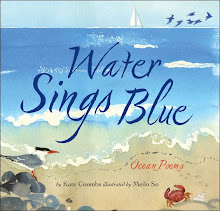
In the meantime, I have some good news about my poetry collection, Water Sings Blue: it has made Kirkus's list of the Best Children's Books of 2012. There are 100 books total in fiction, nonfiction, picture book, MG, YA, graphic novel, early reader, and poetry, so of course I'm in very good company.
Here's the Kirkus list as a starting point for your holiday book shopping.
Or there's the New York Times list of the best illustrated books of the year.
Not to mention the Boston Globe-Horn Book Awards for Excellence in Children's Literature.
You might also want to check out the Cybils nominations if you haven't already. I'm especially big on the poetry list, and not just because Water Sings Blue shows up there, too. It's simply that I feel people often don't know where to find good poetry for children. You certainly can't count on B&N to carry a full selection of the latest poetry collections! So this list makes a good place to browse.
Now, if you're looking for classics to buy for your children, grandchildren, and students, try USA Today's 100 Greatest Books for Kids list. Better still, here's Betsy Bird's Top 100 Chapter Books from her poll earlier this year at Fuse #8, along with her Top 100 Picture Books.
More soon, I promise!
Note: The "Blue Whale" spread below is an example of Meilo So's truly gorgeous artwork for Water Sings Blue.
Update 12-17-12: Wow! Water Sings Blue made a Wall Street Journal best 10 books of the year list!
Showing posts with label Betsy Bird. Show all posts
Sunday, November 25, 2012
Saturday, January 1, 2011
Cybils Shortlists and Other Listy Items
The 2010 Cybils nominees were announced today! In case you weren't aware, these are produced by a panel of Kidlitosphere bloggers who read something like a billion books and then try to balance that famous Newbery "distinguished" literary quality with the concept of strong kid appeal. One of my favorite things about the Cybils is that they include a graphic novel category. This is the 5th year for the Cybils and my first year as a judge. I'll be working on the shortlist for middle grade sci-fi/fantasy books to choose a single winner. Those titles are:
--The Dead Boys by Royce Buckingham
--Dragonbreath: Attack of the Ninja Frogs by Ursula Vernon
--Fever Crumb by Philip Reeve
--Ninth Ward by Jewell Parker Rhodes
--Reckless by Cornelia Funke
--The Books of Elsewhere: The Shadows by Jacqueline West
In other list news, we have Betsy Bird's very fun Golden Fuse Awards for 2010 over at Fuse #8. And at the Heavy Medal Mock Newbery blog, Jonathan Hunt kindly corrals the books that have made some of those key "best of" lists into, well, a list! As in, which books have made more than one such list?
The buzzword for this year's award season is "wild card," which means, "Your guess is as good as mine." It also means that there are a lot of quirky books this time around, the best of them appealing in such different ways that the air is positively scented with apples and oranges.
But the standout title for a Newbery win so far is One Crazy Summer by Rita Williams-Garcia. I would be very surprised if it didn't get at least an honor award, and I would not be at all surprised if it won the coveted crown this year.
P.S. I am absurdly pleased that my Cybils nominee for YA Fiction, Watt Key's Dirt Road Home, made the shortlist! (Here's my review.)
Also: My picks for the Newbery? I'll say One Crazy Summer for the win, then tell you that the Honor books I'd most like to see are A Conspiracy of Kings, The Night Fairy, and Dreamer.
Update on 1-5-10: One Crazy Summer has now won the 2011 Scott O'Dell Award for best children's historical fiction of the past year.
Saturday, September 18, 2010
Thinking about the Newberys and Caldecotts
So Betsy Bird has written a nice post speculating about the next Newbery and Caldecott winners over at Fuse #8. You should also read the comments to see what other people suggest.


I have not yet read One Crazy Summer, though it's definitely a frontrunner. (Me and my fantasy fixation!) I am pulling for The Dreamer and The Night Fairy for Honor books, assuming OCS is as good as everyone says it is. And of course, I am always up for a Megan Whalen Turner win, yet I worry (as do others) that a book in a series might not get the same respect as a standalone. So we'll see what happens with A Conspiracy of Kings.
While we're at it, let's just acknowledge that Kate Milford's The Boneshaker is one of the best books of 2010, not to mention a superior representative of the wave of new paranormals. Saying it's derivative of Ray Bradbury's work is ridiculous; Bradbury is clearly simply an inspiration, and not the only one. Milford's book stands on its own two creepy feet!
You'll also find some interesting thoughts from Betsy and commenters about how a number of the Newbery candidates seem to border on YA. Looking back, I'd say Lois Lowry's The Giver is a shining example of this sort of thing. Maybe we can call it Merchant-Ivory Syndrome: books with Serious Themes tend to dominate whenever somebody's passing out literary awards. And serious has a way of sounding more mature. (See Betsy's note on humor.)
I have less of a commitment to the Caldecott possibilities this time around. I would love to see Oh No! (Or How My Science Project Destroyed the World) by Mac Barnett and Dan Santat win an award. I just read David Wiesner's Art & Max and wasn't as sold on it as I was on Flotsam, but it's certainly pretty. (And I do applaud the theme of encouraging less-restrained creativity.) Still, I'd probably go with a poetry book like Mirror Mirror or Ubiquitous. But then, I have a poetry bias.
Except that Seven Imp is saying Mirror Mirror doesn't qualify... rats! Here's more Caldecott fun with Jules, who takes a look at Betsy Bird's suggestions, then adds some of her own. Lots of gorgeous art to peruse.
So, what do you think?
Labels:
Betsy Bird,
Caldecott Award,
Fuse #8,
Newbery Award,
speculation
Tuesday, April 13, 2010
And the Winner Is...
Charlotte's Web by E. B. White! That would be the best children's book of all time. Was there ever any doubt? Okay, I'll admit I put it at #2 myself, but I stand corrected: some 366 librarians, booksellers, writers, teachers, students, and parents can't be wrong!I am referring, of course, to Betsy Bird's marvelous poll over at her blog, Fuse #8 (School Library Journal). In case you missed it, Betsy has been posting a countdown of the Top 100 middle grade novels for lo, these many weeks. Each post is charming, intelligent, and full of fun facts and links. Here's the link to the full list, which is handily linked to the individual book posts. All I can say is that I'm going to be going into poll withdrawal over my breakfast cereal for the next week or so... But you can still catch up on the whole thing!
Update: I was asked in the Comments which book was my Number 1, so here are the ten books I submitted, with their ranking in the final poll results at Fuse #8 in parentheses afterwards: Charlie and the Chocolate Factory (19), Charlotte's Web (1), Maniac Magee (17), The King of Attolia (N/A), Harriet the Spy (16), Harry Potter and the Sorcerer's Stone (3), The Lion, the Witch, and the Wardrobe (4), A Wrinkle in Time (2), The Secret Garden (8), and Little House in the Big Woods (23). Not too bad!
And the ones I missed? From the Mixed-up Files of Mrs. Basil E. Frankweiler (5), Holes (6), The Giver (7), Anne of Green Gables (9), and The Phantom Tollbooth (10). The one on my own list that I knew might not make it (and didn't) is The King of Attolia. I will mention that I tend to think of The Giver as a YA book. My reasoning for Charlie and the Chocolate Factory outranking Charlotte's Web was influenced in part by my fourth grade student who said, "This is boring," of Charlotte's Web, but was entranced by Charlie and the Chocolate Factory. Much as I love the books in the Top 100, I suspect today's kids, left to their own devices, would make a slightly different list. For example, it would include Diary of a Wimpy Kid. However, the final list is a great resource and represents some very good taste in kidlit!
For my own list of 50 great books from the last century and my annotated Top 10 for the new millenium, see this post.
Update #2: Okay, here's something fun to ask yourself--how many of the books on this Top 100 list have you read? (I got this idea from MotherReader.) I tallied them up today and discovered that I have read 89 for sure. There are 7 I know I haven't read and 4 I think I might have read years ago, but can't quite remember. What about you? Let us know in the comments!
Tuesday, February 9, 2010
And So It Begins!
I woke up grumpy this morning and was saved by the realization that Betsy Bird of Fuse #8 has started her countdown of the Top 100 Children's Novels, the results of her poll regarding the best middle grade fiction. Bliss, bliss, joy!
I should point out that Bird gives quotes, commentary, history, and links for each title, so it's fascinating stuff, like opening a mysterious box of treasures (or a portal, or a time capsule: pick your adventurous MG analogy!). Please visit Betsy's blog and follow the evolution as she counts up to #1. It's better than breakfast cereal, trust me.
And even though the following is about a picture book, this seems like a good time for me to share a children's book moment. Yesterday I went to the home of a 6-year-old Latina child being treated for cancer and offered her a choice of picture book readalouds by way of starting class. When her eyes fell on Esphyr Slobodkina's Caps for Sale, her whole face lit up. She insisted on showing her mother that I had brought the book. "Te acuerdas, Mami?" Remember, Mom? Then she informed me, "There are monkeys!" A key fact, to be sure.

As I read her the book, she leaned forward, glowing with anticipation. When the peddler sat down beneath the tree to rest, she said again, "There are monkeys in the tree." (Like I said, key!). Of course, her joy brimmed over when the monkeys actually made their appearance.
She was a little less sure about joining me in acting out the fist shaking and foot stomping, but she loved making the monkey sound.
When the book ended, she sat back, her day made complete by the addition of monkeys. My efforts to teach her to count by tens seemed paltry at best after the glory that was Caps for Sale.
And that, my friends, is what children's books are all about.
I should point out that Bird gives quotes, commentary, history, and links for each title, so it's fascinating stuff, like opening a mysterious box of treasures (or a portal, or a time capsule: pick your adventurous MG analogy!). Please visit Betsy's blog and follow the evolution as she counts up to #1. It's better than breakfast cereal, trust me.
And even though the following is about a picture book, this seems like a good time for me to share a children's book moment. Yesterday I went to the home of a 6-year-old Latina child being treated for cancer and offered her a choice of picture book readalouds by way of starting class. When her eyes fell on Esphyr Slobodkina's Caps for Sale, her whole face lit up. She insisted on showing her mother that I had brought the book. "Te acuerdas, Mami?" Remember, Mom? Then she informed me, "There are monkeys!" A key fact, to be sure.

As I read her the book, she leaned forward, glowing with anticipation. When the peddler sat down beneath the tree to rest, she said again, "There are monkeys in the tree." (Like I said, key!). Of course, her joy brimmed over when the monkeys actually made their appearance.
She was a little less sure about joining me in acting out the fist shaking and foot stomping, but she loved making the monkey sound.
When the book ended, she sat back, her day made complete by the addition of monkeys. My efforts to teach her to count by tens seemed paltry at best after the glory that was Caps for Sale.
And that, my friends, is what children's books are all about.
Sunday, January 10, 2010
My Top 10, Your Top 10: Announcing Betsy Bird's Middle Grade Book Poll
By way of encouraging you to vote for your Top 10 middle grade books in Betsy Bird's new poll, I will share with you my nominations, annotated because hey, who doesn't annotate in this wild and wooly world of ours?
You may remember that last year, noted School Library Journal children's book blogger (and librarian) Elizabeth Bird of Fuse #8 collected votes for the Top 100 Picture Books of all time, a list I recommend you peruse if you haven't already—I keep a copy of the final list on my computer, but the detailed entries counting down to #1 are also a treat, starting here. (Or just link off the master list.)
Well, she's at it again, only this time for middle grade fiction. Each participant must suggest 10 titles, in order of preference, and Bird will do the math to create a Top 100 list. The deadline for giving your input is January 31, 2010. See contact information in her announcement post.
My Top 10 Middle Grade Books of All Time
1. Charlie and the Chocolate Factory by Roald Dahl—I put this first, over Charlotte's Web, because I've noticed that young contemporary readers sometimes find Charlotte's Web too slow paced. The idea of a kid like Charlie Bucket finding that one golden ticket, winning entry into a chocolate fantasyland and then beating out gruesome children like Mike TV and Veruca Salt, still entrances, the action holding its own against today's fast-paced adventures. The narrative voice is still perfectly appealing, with a faint satirical edge. Then there are the wonderful tiny details, like the fact that Mr. Bucket works in a factory putting the caps on tubes of toothpaste, or those four delightful, decrepit grandparents sharing one large
bed. Not to mention the powerful image of hungry Charlie finding money in the icy street...
2. Charlotte's Web by E.B. White—And yet, has there ever been a better book? One of my personal criteria for great stories is fresh, off-the-wall plots, and to this day, I challenge you to find an odder premise than the spider who saves a young pig by spinning words into her web. That's not even getting into the strength of the characterization, from patient Charlotte and imma
ture Wilbur to secondary delights such as the geese with their repetitive vocal patterns or surly Templeton and his smelly hoard. Did I mention well written? Such clean, sure language!
3. Maniac Magee by Jerry Spinelli—Here's the thing: every so often I get this book out, thinking I'll take it to a new student's house the next day, and a few hours later I look up, dazed, realizing I've read the whole thing again. Maniac Magee is one of the best characters in the annals of children's fiction, as innocent as Voltaire's Candide, an Everykid who questions the status quo without even meaning to, a tall tale hero at the same time. Able to unravel the unravellable ball of string, yet allergic to pizza? Able to read a book and run like the wind while catching a pass, yet unable to find a true h
ome? Maniac isn't just a legend in this book; he's a legend for young readers.
4. The King of Attolia by Megan Whalen Turner—This book beat out some very big names, insisting on a spot on the list because it is, quite simply, one of the best I've ever read. Yes, you really should read The Thief and The Queen of Attolia first, but that's simply extra payoff as you watch Turner create her compelling Greco-Byzantine fantasy world with its subtle pantheon of very real gods. Turner's work is the epitome of craftsmanship, the reason I've
read The King of Attolia repeatedly, something I can only say about a handful of books. You'll be hard-pressed to find the questions Turner brings up as thoughtfully considered in adult fiction: What makes a hero, or a leader? What does love really mean, and loyalty? All this and an adventure, too! As for the characters, they are rounded and real, with Gen leading the pack as a marvelously sly, cantankerous, vain, yet ultimately kind Trickster King, a new hero for a new millenium.
5. Harriet the Spy by Louise Fitzhugh—Harriet's family wasn't anything like mine, but I still recognized her as a kindred spirit when I was a kid. She was curious about things, and she didn't know when to stop. I loved following her around as she found her way into people's lives and wrote about what she saw. My heart broke when the other kids tur
ned on her, especially when they created a Harriet-hating club—every child's worst fear taken to an extreme. How real that bath felt to me after she ran home, covered with ink! And yet, she survived. I figured maybe I could, too. I still write in notebooks.
6. Harry Potter and the Sorcerer's Stone by J.K. Rowling—I seethed over the injustice of Uncle Vernon stealing Harry's letters of invitation to Hogwarts, then delighted in the humorous escalation as letters poured into the house with inhuman determination, finally followed by a benign giant on a flying motorcycle who had the good sense to acknowledge that it was Harry's birthday! And that first ride on the Hogwarts Express... On top of her ability to create a likable cast of characters and an impressive story arc, I most admire Rowling for her delicious details. I don't know which I like better, Quidditch or Bertie Bott's Everyflavor Beans!
7. The Lion, the Witch, and the Wardrobe by C.S. Lewis—I once worked with a man who wouldn't let his daughter read the Narnia books because of the religious symbolism. I thought to myself, Hey, if she doesn't know a thing about Christianity, she won't notice the symbolism! For that matter, I was raised Christian, and the only thing that mattered to me about the books was the storytelling. All of the hokey, derivative portals written about since in children's fantasy can't ruin the joy of that wardrobe with its forest of fur coats and the unexpected scent of snow beyond. The White Witch, with her bribe of Turkish Delight, gave me the shivers, and I loved characters like the pathetic, treacherous Faun, let alone the thought that a girl could learn to shoot an arrow and become a queen.

8. A Wrinkle in Time by Madeline L'Engle—This book remade the field, and it continues to shine in terms of its characterization, especially the gift of Meg Murry. I'm sure I wasn't the only gawky, ill-spoken girl to feel that if Meg could be a hero, so could I. Meg saves the world in such a homely way, out of simple love and loyalty. This, too, seems doable to a young reader. You would think that Camazotz, with its evil oppressor, the giant brain, would seem dated by now. But L'Engle's storytelling holds up. The little boy who bounces the ball wrong, the fact that the brain is named IT, and the marvelous Mrs. Whatsit, Mrs. Which, and Mrs. Who still stand out in a field where books about saving the world threaten to topple the shelves in bookstores with their combined weight.

9. The Secret Garden by Frances Hodgson Burnett—Again and again, I find myself thinking about character as I create this Top Ten list. Which makes The Secret Garden a somewhat surprising choice, since Mary is not a likable child. But who wants to read about sweet little dears who never have to worry about a thing? I've always loved how Mary managed first to survive, and then to find beauty and love in a world entirely unwilling to offer her those things. Her request for a bit of earth is right up there with Oliver's request for more food, and it ends up changing the lives of everyone around her. The garden itself is a character in the book, a place of refuge and kindness, like the best books themselves. To this day, I keep plants around me, as well as books. Mary taught me that.
10. Little House in the Big Woods by Laura Ingalls Wilder—I'm not usually a big fan of historical fiction, but these books are the exception. Laura's family feels like a piece of my own history, not of my country and my ancestors, but as a child growing up in a family. In today's world, when families are more likely to seem disconnected, it doesn't hurt to take the Ingalls as role models. They aren't perfect, but they work together, handling life in such a sturdy, dedicated way. Laura and her family are real and dimensional as they laugh and cry over things like harvesting maple sugar, playing ball with a pig's bladder, getting through the winter, and making music together. And that's just the first book!
Note: For a longer list of middle grade picks, see my post from December 11, 2009, in which I select the best 40 titles from the last century and the best 10 from the past decade.
Update: If you'd like to participate in a comparable poll for the top 100 YA (Young Adult/teen) books, link through to Diane Chen's announcement post at Practically Paradise.
You may remember that last year, noted School Library Journal children's book blogger (and librarian) Elizabeth Bird of Fuse #8 collected votes for the Top 100 Picture Books of all time, a list I recommend you peruse if you haven't already—I keep a copy of the final list on my computer, but the detailed entries counting down to #1 are also a treat, starting here. (Or just link off the master list.)
Well, she's at it again, only this time for middle grade fiction. Each participant must suggest 10 titles, in order of preference, and Bird will do the math to create a Top 100 list. The deadline for giving your input is January 31, 2010. See contact information in her announcement post.
My Top 10 Middle Grade Books of All Time1. Charlie and the Chocolate Factory by Roald Dahl—I put this first, over Charlotte's Web, because I've noticed that young contemporary readers sometimes find Charlotte's Web too slow paced. The idea of a kid like Charlie Bucket finding that one golden ticket, winning entry into a chocolate fantasyland and then beating out gruesome children like Mike TV and Veruca Salt, still entrances, the action holding its own against today's fast-paced adventures. The narrative voice is still perfectly appealing, with a faint satirical edge. Then there are the wonderful tiny details, like the fact that Mr. Bucket works in a factory putting the caps on tubes of toothpaste, or those four delightful, decrepit grandparents sharing one large
bed. Not to mention the powerful image of hungry Charlie finding money in the icy street...2. Charlotte's Web by E.B. White—And yet, has there ever been a better book? One of my personal criteria for great stories is fresh, off-the-wall plots, and to this day, I challenge you to find an odder premise than the spider who saves a young pig by spinning words into her web. That's not even getting into the strength of the characterization, from patient Charlotte and imma
ture Wilbur to secondary delights such as the geese with their repetitive vocal patterns or surly Templeton and his smelly hoard. Did I mention well written? Such clean, sure language!3. Maniac Magee by Jerry Spinelli—Here's the thing: every so often I get this book out, thinking I'll take it to a new student's house the next day, and a few hours later I look up, dazed, realizing I've read the whole thing again. Maniac Magee is one of the best characters in the annals of children's fiction, as innocent as Voltaire's Candide, an Everykid who questions the status quo without even meaning to, a tall tale hero at the same time. Able to unravel the unravellable ball of string, yet allergic to pizza? Able to read a book and run like the wind while catching a pass, yet unable to find a true h
ome? Maniac isn't just a legend in this book; he's a legend for young readers.4. The King of Attolia by Megan Whalen Turner—This book beat out some very big names, insisting on a spot on the list because it is, quite simply, one of the best I've ever read. Yes, you really should read The Thief and The Queen of Attolia first, but that's simply extra payoff as you watch Turner create her compelling Greco-Byzantine fantasy world with its subtle pantheon of very real gods. Turner's work is the epitome of craftsmanship, the reason I've
read The King of Attolia repeatedly, something I can only say about a handful of books. You'll be hard-pressed to find the questions Turner brings up as thoughtfully considered in adult fiction: What makes a hero, or a leader? What does love really mean, and loyalty? All this and an adventure, too! As for the characters, they are rounded and real, with Gen leading the pack as a marvelously sly, cantankerous, vain, yet ultimately kind Trickster King, a new hero for a new millenium.5. Harriet the Spy by Louise Fitzhugh—Harriet's family wasn't anything like mine, but I still recognized her as a kindred spirit when I was a kid. She was curious about things, and she didn't know when to stop. I loved following her around as she found her way into people's lives and wrote about what she saw. My heart broke when the other kids tur
ned on her, especially when they created a Harriet-hating club—every child's worst fear taken to an extreme. How real that bath felt to me after she ran home, covered with ink! And yet, she survived. I figured maybe I could, too. I still write in notebooks.6. Harry Potter and the Sorcerer's Stone by J.K. Rowling—I seethed over the injustice of Uncle Vernon stealing Harry's letters of invitation to Hogwarts, then delighted in the humorous escalation as letters poured into the house with inhuman determination, finally followed by a benign giant on a flying motorcycle who had the good sense to acknowledge that it was Harry's birthday! And that first ride on the Hogwarts Express... On top of her ability to create a likable cast of characters and an impressive story arc, I most admire Rowling for her delicious details. I don't know which I like better, Quidditch or Bertie Bott's Everyflavor Beans!
7. The Lion, the Witch, and the Wardrobe by C.S. Lewis—I once worked with a man who wouldn't let his daughter read the Narnia books because of the religious symbolism. I thought to myself, Hey, if she doesn't know a thing about Christianity, she won't notice the symbolism! For that matter, I was raised Christian, and the only thing that mattered to me about the books was the storytelling. All of the hokey, derivative portals written about since in children's fantasy can't ruin the joy of that wardrobe with its forest of fur coats and the unexpected scent of snow beyond. The White Witch, with her bribe of Turkish Delight, gave me the shivers, and I loved characters like the pathetic, treacherous Faun, let alone the thought that a girl could learn to shoot an arrow and become a queen.
8. A Wrinkle in Time by Madeline L'Engle—This book remade the field, and it continues to shine in terms of its characterization, especially the gift of Meg Murry. I'm sure I wasn't the only gawky, ill-spoken girl to feel that if Meg could be a hero, so could I. Meg saves the world in such a homely way, out of simple love and loyalty. This, too, seems doable to a young reader. You would think that Camazotz, with its evil oppressor, the giant brain, would seem dated by now. But L'Engle's storytelling holds up. The little boy who bounces the ball wrong, the fact that the brain is named IT, and the marvelous Mrs. Whatsit, Mrs. Which, and Mrs. Who still stand out in a field where books about saving the world threaten to topple the shelves in bookstores with their combined weight.

9. The Secret Garden by Frances Hodgson Burnett—Again and again, I find myself thinking about character as I create this Top Ten list. Which makes The Secret Garden a somewhat surprising choice, since Mary is not a likable child. But who wants to read about sweet little dears who never have to worry about a thing? I've always loved how Mary managed first to survive, and then to find beauty and love in a world entirely unwilling to offer her those things. Her request for a bit of earth is right up there with Oliver's request for more food, and it ends up changing the lives of everyone around her. The garden itself is a character in the book, a place of refuge and kindness, like the best books themselves. To this day, I keep plants around me, as well as books. Mary taught me that.

10. Little House in the Big Woods by Laura Ingalls Wilder—I'm not usually a big fan of historical fiction, but these books are the exception. Laura's family feels like a piece of my own history, not of my country and my ancestors, but as a child growing up in a family. In today's world, when families are more likely to seem disconnected, it doesn't hurt to take the Ingalls as role models. They aren't perfect, but they work together, handling life in such a sturdy, dedicated way. Laura and her family are real and dimensional as they laugh and cry over things like harvesting maple sugar, playing ball with a pig's bladder, getting through the winter, and making music together. And that's just the first book!
Note: For a longer list of middle grade picks, see my post from December 11, 2009, in which I select the best 40 titles from the last century and the best 10 from the past decade.
Update: If you'd like to participate in a comparable poll for the top 100 YA (Young Adult/teen) books, link through to Diane Chen's announcement post at Practically Paradise.
Subscribe to:
Posts (Atom)