By way of encouraging you to vote for your Top 10 middle grade books in
Betsy Bird's new poll, I will share with you my nominations, annotated because hey, who doesn't annotate in this wild and wooly world of ours?
You may remember that last year, noted
School Library Journal children's book blogger (and librarian) Elizabeth Bird of Fuse #8 collected votes for the
Top 100 Picture Books of all time, a list I recommend you peruse if you haven't already—I keep a copy of the final list on my computer, but the detailed entries counting down to #1 are also a treat, starting
here. (Or just link off the master list.)
Well, she's at it again, only this time for middle grade fiction. Each participant must suggest 10 titles, in order of preference, and Bird will do the math to create a Top 100 list. The deadline for giving your input is January 31, 2010. See contact information in her announcement post.
 My Top 10 Middle Grade Books of All Time
1.
Charlie and the Chocolate Factory by Roald Dahl—I put this first, over
Charlotte's Web, because I've noticed that young contemporary readers sometimes find
Charlotte's Web too slow paced. The idea of a kid like Charlie Bucket finding that one golden ticket, winning entry into a chocolate fantasyland and then beating out gruesome children like Mike TV and Veruca Salt, still entrances, the action holding its own against today's fast-paced adventures. The narrative voice is still perfectly appealing, with a faint satirical edge. Then there are the wonderful tiny details, like the fact that Mr. Bucket works in a factory putting the caps on tubes of toothpaste, or those four delightful, decrepit grandparents sharing one large

bed. Not to mention the powerful image of hungry Charlie finding money in the icy street...
2.
Charlotte's Web by E.B. White—And yet, has there ever been a better book? One of my personal criteria for great stories is fresh, off-the-wall plots, and to this day, I challenge you to find an odder premise than the spider who saves a young pig by spinning words into her web. That's not even getting into the strength of the characterization, from patient Charlotte and imma

ture Wilbur to secondary delights such as the geese with their repetitive vocal patterns or surly Templeton and his smelly hoard. Did I mention well written? Such clean, sure language!
3.
Maniac Magee by Jerry Spinelli—Here's the thing: every so often I get this book out, thinking I'll take it to a new student's house the next day, and a few hours later I look up, dazed, realizing I've read the whole thing again. Maniac Magee is one of the best characters in the annals of children's fiction, as innocent as Voltaire's Candide, an Everykid who questions the status quo without even meaning to, a tall tale hero at the same time. Able to unravel the unravellable ball of string, yet allergic to pizza? Able to read a book and run like the wind while catching a pass, yet unable to find a true h

ome? Maniac isn't just a legend in this book; he's a legend for young readers.
4.
The King of Attolia by Megan Whalen Turner—This book beat out some very big names, insisting on a spot on the list because it is, quite simply, one of the best I've ever read. Yes, you really should read
The Thief and
The Queen of Attolia first, but that's simply extra payoff as you watch Turner create her compelling Greco-Byzantine fantasy world with its subtle pantheon of very real gods. Turner's work is the epitome of craftsmanship, the reason I've

read
The King of Attolia repeatedly, something I can only say about a handful of books. You'll be hard-pressed to find the questions Turner brings up as thoughtfully considered in adult fiction: What makes a hero, or a leader? What does love really mean, and loyalty? All this and an adventure, too! As for the characters, they are rounded and real, with Gen leading the pack as a marvelously sly, cantankerous, vain, yet ultimately kind Trickster King, a new hero for a new millenium.
5.
Harriet the Spy by Louise Fitzhugh—Harriet's family wasn't anything like mine, but I still recognized her as a kindred spirit when I was a kid. She was curious about things, and she didn't know when to stop. I loved following her around as she found her way into people's lives and wrote about what she saw. My heart broke when the other kids tur

ned on her, especially when they created a Harriet-hating club—every child's worst fear taken to an extreme. How real that bath felt to me after she ran home, covered with ink! And yet, she survived. I figured maybe I could, too. I still write in notebooks.
6.
Harry Potter and the Sorcerer's Stone by J.K. Rowling—I seethed over the injustice of Uncle Vernon stealing Harry's letters of invitation to Hogwarts, then delighted in the humorous escalation as letters poured into the house with inhuman determination, finally followed by a benign giant on a flying motorcycle who had the good sense to acknowledge that it was Harry's birthday! And that first ride on the Hogwarts Express... On top of her ability to create a likable cast of characters and an impressive story arc, I most admire Rowling for her delicious details. I don't know which I like better, Quidditch or Bertie Bott's Everyflavor Beans!
%5B1%5D.jpg)
7.
The Lion, the Witch, and the Wardrobe by C.S. Lewis—I once worked with a man who wouldn't let his daughter read the Narnia books because of the religious symbolism. I thought to myself, Hey, if she doesn't know a thing about Christianity, she won't notice the symbolism! For that matter, I was raised Christian, and the only thing that mattered to me about the books was the storytelling. All of the hokey, derivative portals written about since in children's fantasy can't ruin the joy of that wardrobe with its forest of fur coats and the unexpected scent of snow beyond. The White Witch, with her bribe of Turkish Delight, gave me the shivers, and I loved characters like the pathetic, treacherous Faun, let alone the thought that a girl could learn to shoot an arrow and become a queen.

8.
A Wrinkle in Time by Madeline L'Engle—This book remade the field, and it continues to shine in terms of its characterization, especially the gift of Meg Murry. I'm sure I wasn't the only gawky, ill-spoken girl to feel that if Meg could be a hero, so could I. Meg saves the world in such a homely way, out of simple love and loyalty. This, too, seems doable to a young reader. You would think that Camazotz, with its evil oppressor, the giant brain, would seem dated by now. But L'Engle's storytelling holds up. The little boy who bounces the ball wrong, the fact that the brain is named IT, and the marvelous Mrs. Whatsit, Mrs. Which, and Mrs. Who still stand out in a field where books about saving the world threaten to topple the shelves in bookstores with their combined weight.

9.
The Secret Garden by Frances Hodgson Burnett—Again and again, I find myself thinking about character as I create this Top Ten list. Which makes
The Secret Garden a somewhat surprising choice, since Mary is not a likable child. But who wants to read about sweet little dears who never have to worry about a thing? I've always loved how Mary managed first to survive, and then to find beauty and love in a world entirely unwilling to offer her those things. Her request for a bit of earth is right up there with Oliver's request for more food, and it ends up changing the lives of everyone around her. The garden itself is a character in the book, a place of refuge and kindness, like the best books themselves. To this day, I keep plants around me, as well as books. Mary taught me that.

10.
Little House in the Big Woods by Laura Ingalls Wilder—I'm not usually a big fan of historical fiction, but these books are the exception. Laura's family feels like a piece of my own history, not of my country and my ancestors, but as a child growing up in a family. In today's world, when families are more likely to seem disconnected, it doesn't hurt to take the Ingalls as role models. They aren't perfect, but they work together, handling life in such a sturdy, dedicated way. Laura and her family are real and dimensional as they laugh and cry over things like harvesting maple sugar, playing ball with a pig's bladder, getting through the winter, and making music together. And that's just the first book!
Note: For a longer list of middle grade picks, see my post from December 11, 2009, in which I select the best 40 titles from the last century and the best 10 from the past decade.Update: If you'd like to participate in a comparable poll for the top 100 YA (Young Adult/teen) books, link through to Diane Chen's announcement post at Practically Paradise.

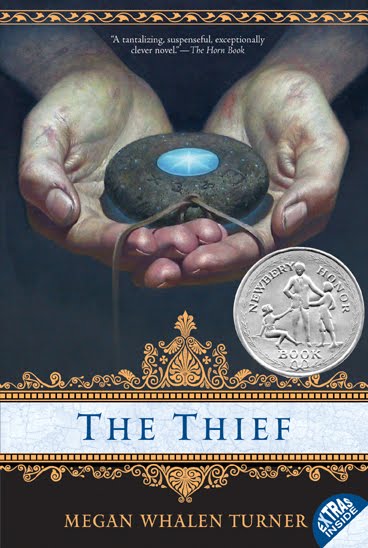 One of the most intelligent, dimensional, and rewarding MG/YA fantasy series out there today is Megan Whalen Turner's Queen's Thief books: thus far The Thief (a Newbery Honor winnter), The Queen of Attolia, The King of Attolia, and A Conspiracy of Kings. Thanks to Chachic of Chachic's Book Nook, you can read all about it during Queen's Thief Week, jump starting yesterday but officially posting January 22-28.


%5B1%5D.jpg)