Showing posts with label Savvy. Show all posts

Friday, September 10, 2010

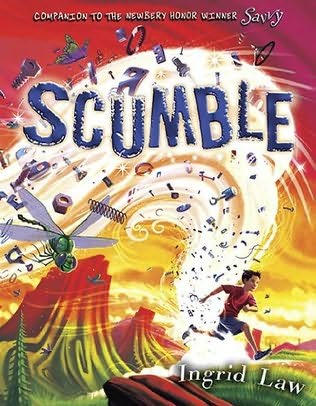
A Review of Scumble by Ingrid Law

When Ledger Kale's dad speculates about the boy's savvy, the magical gift kids in his family inherit on their thirteenth birthday, he talks about running fast. The man doesn't seem to realize that Ledger will feel like his dad won't be happy if his savvy turns out to be something else. But no one could have guessed what a tough savvy Ledger would get: making all kinds of man-made constructions fall apart without even touching them. Starting with a stopwatch, then a stranger's motorcycle—and that's before everyone gathers for his cousin's wedding and Ledger makes all hell break loose.

On top of Ledger's general humiliation and the fear that he'll hurt someone, he has to deal with a witness, a girl named Sarah Jane. And not just any witness: even though Sarah Jane is about his age, she's a pint-sized tabloid reporter, publishing her own news of the weird in her small town. The town where Ledger gets dumped once things get really bad. He's right there on his uncle's ranch with a couple of his older cousins whose powers are so out-of-control that they're social misfits. For the summer, at least, his little sister stays with him, but Ledger suspects she'll be going home without him at the end of August. His savvy is just too dangerous.

So Ingrid Law begins Scumble, a companion book to her Newbery Honor-winning 2008 debut, Savvy. Once again, we get a small-town Americana setting, colorful characters, and the coming-of-age feel of a kid dealing with the onset of a surprising magical power.

A couple of secondary characters provide some of the book's best subplots. First and foremost, there's Sarah Jane, who has secrets of her own, but is too busy digging up dirt on Ledger to notice. It doesn't help that the girl's father, Noble Cabot, hates Ledger's entire family and is trying to take Uncle Autry's farm away. (True to form, Law makes the family ranch a genuine bug farm.) Then there's a junkyard owner who might indirectly help Ledger with the difficult business of learning to scumble—or control—his savvy. And Ledger's little sister Fedora is sneaking around with his young twin cousins, who are fun characters in their own right. Perhaps most poignant of all is the presence of Rocket, whom you'll remember as Mibs's older brother in Savvy. Despite his own uneasy exile, he reaches out to give Ledger a little much-needed mentoring.

Of course, Ledger has two key objectives in this story: one is to learn to scumble his savvy, and the other is to stop Sarah Jane from printing his family's secrets in one of her tabloids. Later in the book, he adds "save the family farm" to his list.

I will just mention that you may, like I did, spend chapter after chapter waiting for Ledger to destroy his uncle's Bug House! But the threat actually comes from another direction, Noble Cabot's enmity, until finally the Bug House and Uncle Autry's happiness are at risk. At which point Sarah Jane and Ledger work together in surprising ways to stop Mr. Cabot. (Law touches very lightly on the age-appropriate attraction Ledger feels for his all-too-appealing nemesis, the blonde-braided Sarah Jane.)

And let's not forget Law's way with words. Try this paragraph on for size, when Ledger ventures into enemy territory; that is, Sarah Jane's house:
A fly buzzed in the window, breaking the stillness that choked the room. The housekeeper dispatched the bug with three swift smacks of her alien-invasion tabloid—ka-thwap! ka-thwap! ka-thwap!—busting the silence into smaller and smaller fragments. Then she pointed the tabloid my way, making it clear that I would share the fly's fate if I stepped out of line.

Law's setting will be more familiar to readers this time around, and in that sense, this book for middle graders may not be quite as striking as Savvy. But Scumble is told with a sure and friendly hand, making it the kind of book you will spend happy hours reading. And then, I'm guessing, you'll find yourself picturing one of Ingrid Law's terrific secondary characters getting his or her own story in Book 3.

Update: Summer Oh (daughter of writer Ellen Oh) has posted a charming interview with Ingrid Law on Enchanted Inkpot.

Monday, February 23, 2009

Anarchy of the Imagination: Why I Love Children’s Books

The only law I’ve ever been inclined to break is the speed limit. I believe humans need some kind of social structure in order to live well, and I’m basically a solid citizen. Among other considerations, social anarchy strikes me as being shortsighted.

But when it comes to the imagination, I’m all for anarchy. And children’s book writers are some of the most subversive people I know. One obvious example is Maurice Sendak’s Where the Wild Things Are, AKA the best picture book of all time. This book actually makes my mother uncomfortable, I suspect because she’d rather not be reminded that kids can be little monsters.

The audacious thing about children’s books is that they cast children as heroes and then refuse to spare them from the law of consequences. In the best children’s books, parents are generally absent from the scene as young characters struggle, problem solve, and pretty much take over the world, sometimes even saving it. In contrast, parents are the ultimate deus ex machina, so they are wisely avoided for pages on end. Max and his mother forgive each other at the conclusion of Sendak’s book because that’s what families do, but in the meantime, Max bravely faces and tames his own ravenous monsters.

Roald Dahl is another author known for his anarchic tendencies. The adults in his books are often despicable, for example the aunts in James and the Giant Peach or the headmistress and parents in Matilda. It’s easy to get caught up in this child-against-parent dynamic and feel, like my mother, vaguely troubled by it. However, Dahl’s adults are ultimately peripheral: what’s more important is the creative problem solving practiced by his young characters. After all, if your guardians are deeply evil, it’s a fantastic idea to befriend some oversized bugs and escape in a giant, rolling piece of fruit.

Where most television shows emphasize predictable solutions to paltry problems, children’s books offer their readers endless possibilities. These books go beyond encouraging kids to think outside the box. In fact, said box lies moldering and forgotten as children travel into enchanted forests or ride swift horses into the distance or follow winding paths of friendship in more realistic settings. The promise of unexpected possibilities is one of the great gifts of children’s literature.

I noticed that an Amazon customer recently reviewed Ingrid Law’s book Savvy with disdain. She was particularly bothered by the fact that Mibs and her friends and siblings choose to get on a bus with a stranger, clearly a high-risk social behavior. But Law isn’t writing a TV episode about serial killers, she’s describing an archetypal journey. Questions of protection are left behind when literary characters dive down rabbit holes, walk through wardrobes, or fight secret wars with their peers (see Printz winner Jellicoe Road). Two of the challenges Mibs faces are figuring out how to get where she’s going—in part by solving the discouraged Bible salesman’s problems—and how to make her savvy serve her cause even though it isn’t what she wanted it to be. Not talking to strangers is an easy real-life lesson to remember. Mibs’s problems require far more effort, imagination, and courage.

In Mo Willems’s books, characters are inclined to make assumptions about the world, and those assumptions regularly turn out to be wrong. That’s what it’s like to be a child, of course. Elephant and Piggie work it out together, but Pigeon is on his own, fighting an inexplicably uncooperative, faceless team of grown-ups. When his assumptions get turned upside down he must adapt, and fast, learning to think in new ways. For example, the Pigeon is sure he will love having a puppy—right up until he encounters one. But his enthusiasm is not squelched. Instead he quickly comes up with a fresh solution, a shiny new goal for himself.

In my favorite chapter of Neil Gaiman’s The Graveyard Book, young Bod sets out to buy a headstone for his new friend, the ghost of a witch. Like Voltaire’s Candide, he is not nearly as frightened by the obstacles he encounters as he should be. When Bod’s original plan doesn’t work, he comes up with a new one, never losing sight of his compassionate purpose even when he must escape from a menacing pawnshop owner.


The cleverness, courage, and creativity of children's book heroes is one kind of anarchy: these young characters defy the limited expectations of their elders. A more overt type of anarchy is the necessity of avoiding adult supervision in order to accomplish the tasks of the plot. This is so familiar to readers of children's books that we tend to overlook it. Anarchy can also be a literary theme or a character trait. As such, it may be celebrated openly, as in Brock Cole's picture book Larky Mavis or a YA I just read, The Disreputable History of Frankie Landau-Banks by E. Lockhart. Other times anarchy is a whisper, really just the power of a character being so thoroughly him- or herself. Winnie the Pooh is quietly determined to do his own thing, as is supposedly sweet Sara Crewe in the classic, A Little Princess. These subtler heroes may be just as powerful for the young reader as those more obvious warriors clankingly clad in full armor.

I was just talking to a teacher who gave his new student a typical writing assignment to test her skills: "Describe your favorite place." When she handed in her paper, my friend expected to see yet another description of "My Room" or "The Beach." But this girl had chosen well: Her favorite place was her mind.

Together, children’s book writers conspire to build a vast, edgeless playground of the imagination where children can deal with surprising situations in surprising ways. In this space, moral behavior is often rewarded, but so is creativity. Whereas in the real world, kids encounter few true opportunities to stretch their creative muscles and take risks, children’s book writers trust their young characters and the readers who accompany them to accomplish miraculous feats in the land formed from ink and myth.

Friday, January 16, 2009

Book Riff: Move Over, Steampunk!

In looking back over the children’s fantasy books I’ve been reading for the last few years, I think I see a new trend forming on the horizon. And, unless you count Charlaine Harris’s Southern Vampire books for adults, which I don’t, I am proud to say that children’s literature is leading the charge on this one.

Do half a dozen books make for a trend? Possibly—read Malcolm Gladwell’s The Tipping Point and draw your own conclusions. Me, I’m going to go out on a limb and at least predict a new trend, a subgenre I like to call rural fantasy. Now, “rural fantasy” isn’t nearly as cool a term as “steampunk” (e.g., Phillip Reeve’s Larklight and sequels), but it seems an apt counterpoint to the recognized subgenre of “urban fantasy,” as practiced in young adult literature by Delia Sherman, Charles de Lint, Will Shetterley, and Holly Black. (I’ll admit I thought about the term “backwoods magic,” but it felt just a little too Hatfield-and-McCoyish.)

Savvy is the most recent example and has gotten the most recognition so far. Joseph Helgerson’s Horns and Wrinkles (2006) is number two, I would say. A less well-known book, Marly Youmans’s Ingledove, is another contender, along with its predecessor, The Curse of the Raven Mocker (2003). Another example of rural fantasy would be Magpie Gabbard and the Quest for the Buried Moon, by Sally Keehn (2007), as well as Keehn’s earlier work, Gnat Stokes and the Foggy Bottom Swamp Queen (2005). The Witches of Dredmoore Hollow by Riford McKenzie (2008) is the last book on my list.

I suppose we could add Jodi Lynn Anderson’s May Bird and the Ever After (2005), along with its sequels, except that the rural girl who is its main character spends most of her time in the land of death, not her home town, which I’m guessing makes it Bangsian fantasy instead. (Anderson has since gone on to write Sisterhood of the Traveling Pants-type contemporary realism about teenage girls in a rural Southern setting with her Peaches trilogy.)

I hope the Southern belles and the Appalachian folks won’t mind that I’m grouping their work together under one heading, but it does seem to share a similar sensibility. And just what is that sensibility, you may ask? Why, it’s pluck, dagnabbit! Much as I love classic British fantasy, it’s great to see someone come along with a new take on magical storytelling. Not that we’re talking about cross-Atlantic rivalry, but an American tall tale flavor permeates the books I’ve mentioned, particularly Savvy and Magpie Gabbard and the Quest for the Buried Moon.

Savvy is arguably the most successful of the group. Rather than being grandly elven, its magic is on the home-cooked side: members of the Beaumont clan have talents like going back in time twenty minutes whenever they sneeze or saving snatches of music in mason jars. Though Mibs Beaumont’s brothers’ talents are more awe-inspiring—channeling electricity and calling up storms—even those gifts have a kind of front porch feel in this particular setting. It only takes a traveling Bible salesman with his troublesome stock of pink Bibles to complete the picture. If Savvy had a guardian angel, I imagine it would be Sid Fleischman’s McBroom, all dolled up in overalls and wings. Savvy is getting a lot of much-deserved critical attention, including a recent Boston Globe-Horn Book Honor Award.

Of the two Appalachian tales, Ingledove is dark where Magpie Gabbard and the Quest for the Buried Moon is light, although both are quest stories. Moody, atmospheric Ingledove features an orphaned girl who travels the mountains with her older brother, seeking answers about her mother’s hidden homeland of Adantis. When her brother is attacked and then stalked by an evil creature in the guise of a fey young woman, Ingledove must go to the Witchmaster for help. Together they journey beneath the mountain, looking for a cure before spirit-poisoned Lang can be completely destroyed. Marly Youmans creates an unusual mix of Celtic and Cherokee magic in this book.

Sally Keehn based Magpie Gabbard and the Quest for the Buried Moon in part on two English fairy tales, one about the lost moon and another called “The Three Heads in a Well.” And speaking of body parts, Keehn’s book has a great first line: “Dear All and Sundry, I mean to visit my brother Milo and give him back his foot.” Magpie Gabbard is so rollicking it makes Savvy seem tranquil by comparison. You should know that Granny Goforth has a prophesying kettle, Gabbard honey has teeth-whitening properties, and goblins have stolen the moon. But Magpie is more than equal to tracking down the moon, let alone ending a backcountry feud and returning her brother’s foot.

Joseph Helgerson’s Horns and Wrinkles opens with Claire being dangled from a bridge over the Mississippi River by her cousin Duke, who has just swiped her box turtle, to boot. When he drops her but she floats her way down, while Duke takes a tumble of his own and ends up sprouting a rhino horn, Claire concludes that “Something rivery is happening.” We soon discover that Duke has to perform a highly unselfish act to keep from turning into a rock troll. Fortunately, the plot turns out to be more adventuresome than instructional. I look forward to reading the sequel, Crows and Cards, due out in April 2009.

I was less impressed by The Witches of Dredmoore Hollow, although I’m hoping Riford McKenzie will pick up steam in his next offering. He has such a great name, for one thing! And his main character, Elijah, is quite promising, as are some of the details of the boy’s encounter with his witchy aunts, who take an inordinate interest in the appearance of Elijah’s first chin hair. Turns out Elijah’s mother never told him she comes from a family of witches and that she is the cause of them losing their magic. Elijah has always been a chicken, but when he observes strange happenings in the family cemetery and then his parents disappear, he finds out his everyday worries have seriously underestimated the potential for real trouble.

So—what are we to make of this sudden sprouting of fantasy set in the backwoods, the back hills, or the back forty? I think one explanation is that writers have felt a need to distance themselves from Hogwarts. It seems that after the first wave of imitation died down, J.K. Rowling inadvertently prompted another kind of Renaissance in children’s fantasy writing, a backlash that is giving us fresh and welcome books to read, including the ones in the infant subgenre I’ve described. Will the woman’s influence never stop?

Of course, it’s only been a few paragraphs and I’m already starting to think about changing the name of this possible subgenre to “tall tale fantasy”—maybe that way we could include Shannon Hale’s graphic novel, Rapunzel’s Revenge, which might otherwise fall under Westerns. Another upcoming fantasy that sounds like a Western is Patricia Wrede’s Thirteenth Child, part of her new Frontier Magic series. (Shades of Josh Whedon’s Western sci-fi show, Serendipity!) Still, any which way you slice it, seems like Americana is taking over fantasy right about now... What do you-all readers, writers, parents, and librarians think about that?