Showing posts with label rural fantasy. Show all posts

Friday, September 10, 2010

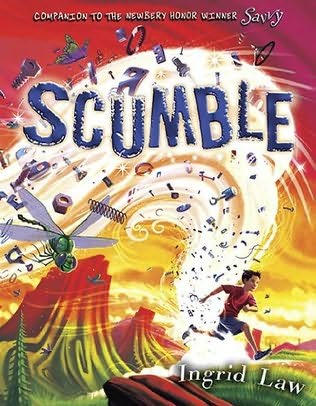
A Review of Scumble by Ingrid Law

When Ledger Kale's dad speculates about the boy's savvy, the magical gift kids in his family inherit on their thirteenth birthday, he talks about running fast. The man doesn't seem to realize that Ledger will feel like his dad won't be happy if his savvy turns out to be something else. But no one could have guessed what a tough savvy Ledger would get: making all kinds of man-made constructions fall apart without even touching them. Starting with a stopwatch, then a stranger's motorcycle—and that's before everyone gathers for his cousin's wedding and Ledger makes all hell break loose.

On top of Ledger's general humiliation and the fear that he'll hurt someone, he has to deal with a witness, a girl named Sarah Jane. And not just any witness: even though Sarah Jane is about his age, she's a pint-sized tabloid reporter, publishing her own news of the weird in her small town. The town where Ledger gets dumped once things get really bad. He's right there on his uncle's ranch with a couple of his older cousins whose powers are so out-of-control that they're social misfits. For the summer, at least, his little sister stays with him, but Ledger suspects she'll be going home without him at the end of August. His savvy is just too dangerous.

So Ingrid Law begins Scumble, a companion book to her Newbery Honor-winning 2008 debut, Savvy. Once again, we get a small-town Americana setting, colorful characters, and the coming-of-age feel of a kid dealing with the onset of a surprising magical power.

A couple of secondary characters provide some of the book's best subplots. First and foremost, there's Sarah Jane, who has secrets of her own, but is too busy digging up dirt on Ledger to notice. It doesn't help that the girl's father, Noble Cabot, hates Ledger's entire family and is trying to take Uncle Autry's farm away. (True to form, Law makes the family ranch a genuine bug farm.) Then there's a junkyard owner who might indirectly help Ledger with the difficult business of learning to scumble—or control—his savvy. And Ledger's little sister Fedora is sneaking around with his young twin cousins, who are fun characters in their own right. Perhaps most poignant of all is the presence of Rocket, whom you'll remember as Mibs's older brother in Savvy. Despite his own uneasy exile, he reaches out to give Ledger a little much-needed mentoring.

Of course, Ledger has two key objectives in this story: one is to learn to scumble his savvy, and the other is to stop Sarah Jane from printing his family's secrets in one of her tabloids. Later in the book, he adds "save the family farm" to his list.

I will just mention that you may, like I did, spend chapter after chapter waiting for Ledger to destroy his uncle's Bug House! But the threat actually comes from another direction, Noble Cabot's enmity, until finally the Bug House and Uncle Autry's happiness are at risk. At which point Sarah Jane and Ledger work together in surprising ways to stop Mr. Cabot. (Law touches very lightly on the age-appropriate attraction Ledger feels for his all-too-appealing nemesis, the blonde-braided Sarah Jane.)

And let's not forget Law's way with words. Try this paragraph on for size, when Ledger ventures into enemy territory; that is, Sarah Jane's house:
A fly buzzed in the window, breaking the stillness that choked the room. The housekeeper dispatched the bug with three swift smacks of her alien-invasion tabloid—ka-thwap! ka-thwap! ka-thwap!—busting the silence into smaller and smaller fragments. Then she pointed the tabloid my way, making it clear that I would share the fly's fate if I stepped out of line.

Law's setting will be more familiar to readers this time around, and in that sense, this book for middle graders may not be quite as striking as Savvy. But Scumble is told with a sure and friendly hand, making it the kind of book you will spend happy hours reading. And then, I'm guessing, you'll find yourself picturing one of Ingrid Law's terrific secondary characters getting his or her own story in Book 3.

Update: Summer Oh (daughter of writer Ellen Oh) has posted a charming interview with Ingrid Law on Enchanted Inkpot.

Saturday, March 27, 2010

A Review of The Boneshaker by Kate Milford

Natalie loves machines. She helps her mechanic father in his shop, repairing motorcars and bicycles and trying to build clockwork machines like a small flyer. It's 1914, and Arcane isn't an ordinary small town. The crossroads is a place of power, where the devil once battled an old musician for his soul and lost.

At least, that's the story Natalie's mother tells her, but is it true? As The Boneshaker progresses, we learn not only that the story is true, but that the uncanny Doctor Jake Limberleg's Nostrum Fair and Technological Medicine Show has something to do with demons, as well.

Natalie, whose biggest concern up till now has been her inability to ride the odd bicycle her father has rebuilt for her, the titular boneshaker, now has a whole new set of worries. With her friends, she begins to explore the eerie doctor's medicine show. What she discovers frightens her, but things get even worse when her brother and father decide to bring her ailing mother to the medicine show for treatment.

The author builds her story—and the suspense—beautifully, pulling readers deeper into Natalie's all-too-appropriate fears about Dr. Limberleg and the "paragons" who accompany him. Meanwhile, Natalie's continuing efforts to ride the boneshaker lead us to a final chase scene in which she must ride the bike on a wild night-time journey to save her town and everyone she loves.

Milford gives us fun details like the time Natalie tries to sell a single bee to the town's shopkeeper, along with curious details such as the miniature automata inside Dr. Limberleg's trailer or the way the front left wheel pops off of every vehicle that comes into Arcane through the crossroads. And the medicine show, a kind of carnival, is described nightmarishly well.

The characters here are as marvelously strange as the medicine show. We get to know Old Tom Guyot, the elderly black musician who challenged the devil and won; a devious drifter named Jack (whom you might recognize from folklore); a mysterious rich man who isn't quite human; and stalwart townspeople like the pharmacist and Natalie's friends Alfred and Miranda.

You'll find that Kate Milford has a way with words. Here's Natalie's first glimpse of the flame-haired doctor:

Something about this man seemed...out of place in the general store. It was hard to say where a man like that might belong, but he surely didn't belong here.
He was taller than anyone she knew, and he wore an old-fashioned frock coat like her grandfather wore in old pictures: long and flared at the bottom and too heavy for a summer noon. He carried a tall silk hat under one arm, and there was something odd about his hair, too; the way it stood off his scalp was like the way her hair billowed when she dunked her head underwater.
But, evil though he seems, there is more to Dr. Limberleg than readers first suspect. For that matter, Natalie discovers there is more to her own self than she had previously realized. Natalie solves the problems in Arcane in difficult and thoughtful ways, achieving far more than a victory over her uncooperative bicycle.

Milford's work hints of magical realism and Alfred Hitchcock's subtle touch rather than today's scare-a-minute horror stories. A rich and shivery historical fantasy—or what I like to call rural fantasy—The Boneshaker will appeal to kids who are willing to take the time to watch fear unfold in increasingly unnerving detail.

(Listen to the old Charlie Daniels Band song, "The Devil Went Down to Georgia," for an earlier take on the American musician's-pact-with-the-devil legend. And here are the Muppets performing the song!)

Note for Worried Parents: In addition to mature themes relating to the serious illness of a parent, The Boneshaker features pacts with the devil and demonic horror elements. It's definitely creepy, which explains the publisher's suggested reading range of 10 and up.

I requested this book from the Amazon Vine program after hearing about it on The Enchanted Inkpot. The Boneshaker will come out on May 24.

Sunday, April 5, 2009

A Review of Thirteenth Child by Patricia C. Wrede

I’ve been looking forward to this book coming out for months! So when I saw it in the bookstore yesterday, I snatched it up, ran home, and read the whole thing straight through. Why, you may ask, such transportations of delight? Well, fantasy is my favorite genre, and Patricia C. Wrede has written some very fun books, most notably the Enchanted Forest Chronicles, starting with Dealing with Dragons. She also coauthored Sorcery and Cecilia or the Enchanted Chocolate Pot and its sequels with Caroline Stevermer—novels of manners set in an alternate England where magicians are the norm.

Another reason I’ve been dying to read Thirteenth Child is because it clearly falls in the new subgenre I’ve been talking about, rural fantasy. (See my blog entry for January 16: “Move Over, Steampunk!”) With this book, Wrede is starting a new series called Frontier Magic, in which Americans in the 1800s have magicians to help them settle the Wild West (only here they're called Columbians). Wrede’s world is new in other ways, I discovered: the frontier is populated by “natural” animals such as mammoths, bison, and woolly rhinoseroses, along with magical creatures such as steam dragons, spectral bears, and swarming weasels.


On the far side of the plains were mountains, sharp and high, that no one had seen but a few explorers. Papa said that at least ten expeditions had tried to find a way through them to the Pacific Ocean, but only three men had ever come back alive, and they were stark out of their heads. There was a monument in the capital to Lewis and Clark, who headed the first group that went missing, back in 1804. It was more than wild country; it was unknown.

Alternative history, indeed! But there’s more: formerly, magicians led by Thomas Jefferson and Benjamin Franklin erected the Great Barrier Spell, intended to keep the lethal beasts of the frontier from overrunning and devouring Columbians. Now Eff and her family are moving out to the edge of the frontier, where her father will teach magic at a small college.

Eff is the hero of our story, though she thinks she's its villain. Because she is the thirteenth child, her superstitious uncles and aunts and cousins tell her over and over that she will turn out to be evil and should have been drowned at birth. To make matters worse, her twin Lan is the golden boy, seventh son of a seventh son and mightily magical. Fortunately, he and Eff are very close. But one of the reasons Eff’s parents are moving out west is to get away from the relatives who treat their daughter as if she were cursed.

The story telling has an epic feel, beginning when Eff is five and ending when she is eighteen. Eff and Lan attend a small public school out in the settlement, though Lan is given supplemental lessons to cultivate his gifts. It doesn’t occur to anyone except the amazing Miss Ochiba that Eff might be plenty gifted in her own right. Miss Ochiba schools Eff and her friend William in Aphrikan magic during after-school tutoring sessions while Lan is busy learning the more commonly valued Avrupan (European) magic.

We also meet the Society of Progressive Rationalists, who abhor magic and are determined to build a settlement without using any at all. One such rationalist, Brant Wilson, studies with Eff’s father and turns out to be a bit of a hero; he also turns Eff’s older sister’s head. Another character of note is “Wash” Washington Morris, a circuit riding magician who troubleshoots problems in the scattered settlements.

In time, Eff’s gifts begin to show in unexpected ways as she and her family and friends take on a problem that is destroying the crops of the entire region. It’s not dragon fighting, but it’s a matter of life and death for these struggling farmers.

Thirteenth Child reads like historical fiction, and I was thoroughly caught up in the way the Columbian settlers handled their challenges. One of the strengths of the book is the way Wrede captures the "can do" feeling of frontier living and this era in our country's history. Her greatest success, though, is the character of Eff and her story, which is what really kept me going. I did get a little bogged down near the end of the book during explanations about different stages of beetles, but that’s the only place my reading faltered. I can assure you that Patricia C. Wrede’s latest series, like a settler taming new land, is off to a brave, strong start.

Friday, January 16, 2009

Book Riff: Move Over, Steampunk!

In looking back over the children’s fantasy books I’ve been reading for the last few years, I think I see a new trend forming on the horizon. And, unless you count Charlaine Harris’s Southern Vampire books for adults, which I don’t, I am proud to say that children’s literature is leading the charge on this one.

Do half a dozen books make for a trend? Possibly—read Malcolm Gladwell’s The Tipping Point and draw your own conclusions. Me, I’m going to go out on a limb and at least predict a new trend, a subgenre I like to call rural fantasy. Now, “rural fantasy” isn’t nearly as cool a term as “steampunk” (e.g., Phillip Reeve’s Larklight and sequels), but it seems an apt counterpoint to the recognized subgenre of “urban fantasy,” as practiced in young adult literature by Delia Sherman, Charles de Lint, Will Shetterley, and Holly Black. (I’ll admit I thought about the term “backwoods magic,” but it felt just a little too Hatfield-and-McCoyish.)

Savvy is the most recent example and has gotten the most recognition so far. Joseph Helgerson’s Horns and Wrinkles (2006) is number two, I would say. A less well-known book, Marly Youmans’s Ingledove, is another contender, along with its predecessor, The Curse of the Raven Mocker (2003). Another example of rural fantasy would be Magpie Gabbard and the Quest for the Buried Moon, by Sally Keehn (2007), as well as Keehn’s earlier work, Gnat Stokes and the Foggy Bottom Swamp Queen (2005). The Witches of Dredmoore Hollow by Riford McKenzie (2008) is the last book on my list.

I suppose we could add Jodi Lynn Anderson’s May Bird and the Ever After (2005), along with its sequels, except that the rural girl who is its main character spends most of her time in the land of death, not her home town, which I’m guessing makes it Bangsian fantasy instead. (Anderson has since gone on to write Sisterhood of the Traveling Pants-type contemporary realism about teenage girls in a rural Southern setting with her Peaches trilogy.)

I hope the Southern belles and the Appalachian folks won’t mind that I’m grouping their work together under one heading, but it does seem to share a similar sensibility. And just what is that sensibility, you may ask? Why, it’s pluck, dagnabbit! Much as I love classic British fantasy, it’s great to see someone come along with a new take on magical storytelling. Not that we’re talking about cross-Atlantic rivalry, but an American tall tale flavor permeates the books I’ve mentioned, particularly Savvy and Magpie Gabbard and the Quest for the Buried Moon.

Savvy is arguably the most successful of the group. Rather than being grandly elven, its magic is on the home-cooked side: members of the Beaumont clan have talents like going back in time twenty minutes whenever they sneeze or saving snatches of music in mason jars. Though Mibs Beaumont’s brothers’ talents are more awe-inspiring—channeling electricity and calling up storms—even those gifts have a kind of front porch feel in this particular setting. It only takes a traveling Bible salesman with his troublesome stock of pink Bibles to complete the picture. If Savvy had a guardian angel, I imagine it would be Sid Fleischman’s McBroom, all dolled up in overalls and wings. Savvy is getting a lot of much-deserved critical attention, including a recent Boston Globe-Horn Book Honor Award.

Of the two Appalachian tales, Ingledove is dark where Magpie Gabbard and the Quest for the Buried Moon is light, although both are quest stories. Moody, atmospheric Ingledove features an orphaned girl who travels the mountains with her older brother, seeking answers about her mother’s hidden homeland of Adantis. When her brother is attacked and then stalked by an evil creature in the guise of a fey young woman, Ingledove must go to the Witchmaster for help. Together they journey beneath the mountain, looking for a cure before spirit-poisoned Lang can be completely destroyed. Marly Youmans creates an unusual mix of Celtic and Cherokee magic in this book.

Sally Keehn based Magpie Gabbard and the Quest for the Buried Moon in part on two English fairy tales, one about the lost moon and another called “The Three Heads in a Well.” And speaking of body parts, Keehn’s book has a great first line: “Dear All and Sundry, I mean to visit my brother Milo and give him back his foot.” Magpie Gabbard is so rollicking it makes Savvy seem tranquil by comparison. You should know that Granny Goforth has a prophesying kettle, Gabbard honey has teeth-whitening properties, and goblins have stolen the moon. But Magpie is more than equal to tracking down the moon, let alone ending a backcountry feud and returning her brother’s foot.

Joseph Helgerson’s Horns and Wrinkles opens with Claire being dangled from a bridge over the Mississippi River by her cousin Duke, who has just swiped her box turtle, to boot. When he drops her but she floats her way down, while Duke takes a tumble of his own and ends up sprouting a rhino horn, Claire concludes that “Something rivery is happening.” We soon discover that Duke has to perform a highly unselfish act to keep from turning into a rock troll. Fortunately, the plot turns out to be more adventuresome than instructional. I look forward to reading the sequel, Crows and Cards, due out in April 2009.

I was less impressed by The Witches of Dredmoore Hollow, although I’m hoping Riford McKenzie will pick up steam in his next offering. He has such a great name, for one thing! And his main character, Elijah, is quite promising, as are some of the details of the boy’s encounter with his witchy aunts, who take an inordinate interest in the appearance of Elijah’s first chin hair. Turns out Elijah’s mother never told him she comes from a family of witches and that she is the cause of them losing their magic. Elijah has always been a chicken, but when he observes strange happenings in the family cemetery and then his parents disappear, he finds out his everyday worries have seriously underestimated the potential for real trouble.

So—what are we to make of this sudden sprouting of fantasy set in the backwoods, the back hills, or the back forty? I think one explanation is that writers have felt a need to distance themselves from Hogwarts. It seems that after the first wave of imitation died down, J.K. Rowling inadvertently prompted another kind of Renaissance in children’s fantasy writing, a backlash that is giving us fresh and welcome books to read, including the ones in the infant subgenre I’ve described. Will the woman’s influence never stop?

Of course, it’s only been a few paragraphs and I’m already starting to think about changing the name of this possible subgenre to “tall tale fantasy”—maybe that way we could include Shannon Hale’s graphic novel, Rapunzel’s Revenge, which might otherwise fall under Westerns. Another upcoming fantasy that sounds like a Western is Patricia Wrede’s Thirteenth Child, part of her new Frontier Magic series. (Shades of Josh Whedon’s Western sci-fi show, Serendipity!) Still, any which way you slice it, seems like Americana is taking over fantasy right about now... What do you-all readers, writers, parents, and librarians think about that?