Saturday, March 17, 2012

A Review of Friends with Boys by Faith Erin Hicks

I'm surely not the only one who will immediately compare this graphic novel from Canadian author Hicks to Anya's Ghost by Vera Brosgol. After all, it has a similar visual style with its stark black-and-white illustrations, it's about a high school girl trying to get along socially, and it features a ghost. Which makes it sound, in thumbnail form, derivative, until you read the book and find out that it really, truly is not. Friends with Boys is a wonderful book in its own right.

Maggie is starting high school, which would be scary enough, except that she has also been homeschooled her entire life—and the mother who taught her has abandoned the family. Maggie would like to think her three older brothers could give her some support, but her oldest brother Daniel is busy with his many friends and theater, while her twin brothers Zander and Lloyd are locked in an epic battle of their own.

At her new school, Maggie does make two friends, peppy Lucy and her moody brother Alastair. But she wonders what's going on between Alastair and hotshot soccer captain Matt. Then there's Maggie's shortcut through the cemetery on her way home, which brings her into contact with a sad-looking nineteenth century woman ghost. Eventually she learns who the silent ghost is and why she is sad, but what does it have to do with Maggie, who feels like the ghost is following her around?

This book is made up of small incidents, like the fact that Maggie's father finally cuts his longish hair short and how that bothers Maggie. But the incidents add up to matter, just the way they do in real life.

Hicks's characters are so angular that they sometimes look older than they are, especially the boys with their strong noses and jaws. But I soon got used to her style. And Hicks is a dab hand at dialogue, not to mention humor. The high school play Daniel stars in is about zombies, for example. Here are a few lines that come up after the play:
"You were great in the play. I completely believed you were horribly killed by zombies."

"Thanks. It's a gift."

I like the way Maggie's brother Daniel is popular, but with a different group of kids than most books show, and he is a little chunky. There is a bullying theme here, but it's not handled in the usual way. Hicks manages to create a minor mystery out of that subplot, and we find that boys have their struggles and secrets, just as girls do.

I should mention that this story is not about high school romance, though there's just a hint of it in spots. Being friends with boys seems to have as much to do with Maggie's brothers as with people like Alastair. I found this rather welcome! Maggie has enough on her plate without a gigantic romance, too.

Besides the challenges of being the new girl and bullying, two themes at the heart of the book are sibling loyalties—especially when they are tested—and the pain of a family whose mother has left them. This is all handled subtly, building beautifully to a quiet but satisfying conclusion. Hicks is not into easy answers, but the answers she does give are real and possible and right.

Scoot Anya's Ghost over on your book shelf and make room for Friends with Boys!

Also: See Page by Paige by Laura Lee Gulledge, another graphic novel about a shy high school girl who's new in town and finding her place in the world.

Note: I will be at a history education conference in Kansas City next weekend, so I won't be posting. But then I'll come roaring back with my annual Pistachio Awards the weekend of March 31.

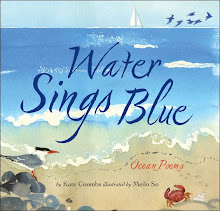
Water Sings Blue Launch

Big week for my ocean poems! They started shipping on Wednesday, but are already being reprinted. Today I'm doing a story time/book launch at a very cool indie bookstore in Salt Lake City, The King's English. Trying to think how to present well to 6-year-olds and my elderly aunts, who will turn out in force to support me!

Meanwhile, I've done some interviews around the blog and gotten a few nice reviews, to boot. (There's a little overlap among the interviews, but I tried to say different things when possible!) Here are the links:

Blog Interviews/Reviews

Seven Impossible Things Before Breakfast (Julie Danielson, also about Hans My Hedgehog)

Jama's Alphabet Soup (Jama Rattigan)

Cracking the Covers (Jessica Harrison; click here for a complete transcript)

Paper Tigers (Marjorie)

Thanks very much to all those who hosted and interviewed me!


Press/Journal Reviews

Wall Street Journal (short but sweet!)

Deseret News (Salt Lake City)

Kirkus Reviews

Publishers Weekly

Oh, and check out the seashell gallery I put up on my author's website.

Wish me luck today...

Update, 3/25: For those of you wondering why Amazon says "11 to 14 days" to ship WSB, it's because the first printing sold out and Chronicle is reprinting. (This is partly because B&N is going to use the book in a beach book display coming up soon, so they've ordered a lot of copies.)

Update, 3/27: Another starred review! This one's from Booklist. That makes three—hooray!

Update, 4/15: Take a look at this post in which Meilo and I interviewed each other for the Chronicle blog. Great pictures and stories from Meilo!

Saturday, March 10, 2012

When Maurice Sendak and Randall Jarrell Teamed Up

The other day I was in a great little used bookstore in Salt Lake City and found a book I'd never seen before by poet Randall Jarrell, with illustrations by Maurice Sendak, Fly by Night. I brought it home to form a trio with two other books created by Jarrell and Sendak: The Animal Family and The Bat-Poet. Here's a look at all three:

Fly by Night (1976)

This is a fairly random piece of writing, which I suppose makes sense, considering it's about the world of dreams. Jarrell tells of a boy who can fly—or float, actually—at night. He appears to be somewhere between 8 and 10. In the first few paragraphs David seems pretty ordinary, living in a pretty neighborhood where he climbs trees with the cat. But then we learn "At night David can fly." Though apparently he has trouble remembering these dreams and how to fly when morning comes. Anyway, we follow David one night as he floats into his parents' bedroom, where he can see what they are dreaming:
He comes to his mother's and father's bedroom, and floats in over them. His father is a big mound under the blanket, with his head sticking out at the top. His mother is a medium-sized mound, but where her head should be there's nothing but pillow—she's put the pillow over her head to help herself go to sleep.

His mother and father are dreaming: he can see their dreams. Just over his father's head it's round and yellow and warm, like firelight, and his father, looking very small, is running back and forth with David on his back, only David is as big as ever. His father is panting. His mother is dreaming she is making pancakes: she pours them out, and turns them over, and piles them in a pile on a plate. Her dream is round and yellow too, but it has got mixed up with the pillow, so that the feathers the pillow is stuffed with float through her dream like snowflakes.

After David floats out of the house, the cat on the porch advises him:
Wake by night and fly by night,
The wood is black, the wood is white,
The mice are dancing in the moonlight.

The mice and rabbits talk to him, too, and then David floats out into the woods, where he meets a female owl that takes him under her wing and back to her nest to join her nestlings till morning. This is where I came to my favorite metaphor in the book, when we're told that the owl has caught a fish which "shines in the moonlight like a spoon."

At the owl's nest, David meets the baby owls, which surprise him by being white and by having "a sad, absurd look." Then we get a long narrative poem from the mother owl titled "The Owl's Bedtime Story." (About this point you'll probably decide that the mother owl is a stand-in for David's own mother.) The owl escorts floating David home, and when he wakes up in the morning, as promised, he can't quite remember his dream.

This is a solemn tale, one that probably has more appeal for dreamy adults than for kids. It also makes an interesting counterpoint to the book Sendak published six years earlier, In the Night Kitchen (1970). Compare the two illustrations shown above right, for example. I should point out that Jarrell's piece was first published in 1969, so it's entirely possible that the text of Fly by Night was one of the inspirations for Sendak's own book, In the Night Kitchen, though that book is much more jovial in tone and takes off in a different direction. Still, both books feature naked floating boys who are dreaming. Which is to say, the child in Fly by Night looks a little like Mickey five years later, still up to nighttime adventuring.

I will say, aside from the fact that a lot of people dream about being naked in an embarrassing way, there's something inherently naked about dreaming, about the way one's psyche is bared in dreams.

The nicest piece of art in the book is a full spread of David floating away home, with the owl's face filling a large piece of space on the upper right and views of a mother with a baby below left and a lamb with its mother below right, plus other interesting things like a fox, a shepherdess, two ducks on a pond, a bridge, a couple of rabbits, and some marvelous trees (all in a scene vaguely reminiscent of the old masters).

Fly by Night is an odd book, but if you're a collector of Maurice Sendak's work, let alone Randall Jarrell's, it's worth tracking down a copy. There's something sweetly surreal about this one.


The Animal Family (1965)

Another slightly surreal tale from Jarrell, The Animal Family, is about a hunter who lives alone on the coast of a nameless country. He has no neighbors, and he is lonely now that his parents have died. But one night he hears someone singing, and he goes down to the shore to find out who or what it is. Little by little he befriends a mermaid, teaching her his language. He tries to learn hers, but he's pretty bad at it. There's gentle humor here:
The hunter said her words awkwardly and ruefully, like something learned too late, but she said his like an old magician learning a new trick, a trick almost too easy for her to need to learn. The hunter said to her, bewildered: "You never make mistakes."

"What is mistakes?"

"The wrong word—the wrong sound, one you don't mean to make. The way I do. Mistakes are what I make when I try to talk the way you talk."

The mermaid repeated in a satisfied voice: "Mistakes." She had one more word.

The mermaid ends up moving into the hunter's cottage. She is intrigued by his world, amused by things like the way he uses fishing gear to catch fish instead of just swimming and grabbing them like everyone else in the ocean does. I should not
e that she respects dolphins but thinks seals are numbskulls. (Like I said, funny!)

In time the hunter feels a longing for a child. This is expressed in a dream he does not understand, but the mermaid figures it out. "It means you want a boy to live with us. Then you'll be your father's shadow, and I'll be your mother's, and the boy will be yourself the way you used to be—it will all be the way it used to be." So the hopeful hunter goes out and brings home a bear cub. The new addition to the family turns out to be messy, yet loved. A few years later the hunter finds a lynx cub and brings home a second baby. But it is the lynx that finds the last child to join this strange little family...

Jarrell's story is full of funny details about how the mermaid perceives the hunter's world and about what it's like to raise the bear and lynx babies, not to mention the youngest child. The gentleness, even tenderness of the story is balanced out by the author's rather matter-of-f
act tone. Again, I'm having trouble picturing the child who will appreciate The Animal Family—maybe a creative kid, a bit of a deep thinker. The book might make a nice bedtime read-aloud. I do know a lot of grown-ups who would probably like it and would consider the book something of a fable. It is certainly a nice riff on families. (E.g., the way even the most seemingly homogenous families are made up of disparate, surprising personalities.)

I should note that Sendak deliberately avoids showing the characters in his illustrations. Instead he mostly gives us scenery in his pen-and-ink drawings (see example, right). About the only details that allude to the characters are a boat and a bow and arrow. I
think the illustrator was wise to go this route, since these characters, especially the mermaid, might have been spoiled by being captured in artwork. The timelessness of the tale is thus preserved.


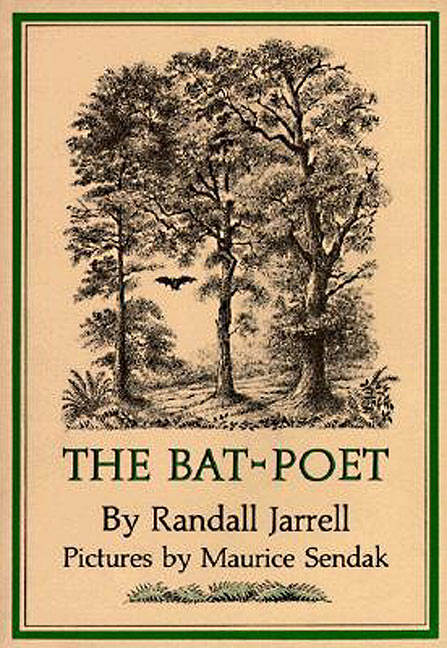
The Bat-
Poet (1964)

I once loaned this third book to a friend who's a children's playwright, and when she returned it she said, "It's about what it's like to be a poet!" I would agree, but I will add that The Bat-Poet is more broadly about what it's like to be a writer or a creative person. Now, for the next few paragraphs, I'm going to steal from myself, since I wrote about The Bat-Poet in June 2010:

Character is king, and especially in this book. The little brown bat at the heart of poet Randall Jarrell's tale is just so eager and sweet and shy and curious, yet manages all this, like a real human child, without being overly sentimental. The small bat wants to know things, and then he wants to sing, and when that doesn't work, he begins to make up poems, trying to give shape to the yearning he has inside, a powerful need for self-expression. That description sounds like pop psychology, I'm afraid, but all of these ideas are couched in a nice little plot about a bat who's not like the others. He sets out to explore the day world, for example, and he gets a creative crush on the vain yet talented mockingbird. Little by little, he puts his observations into words.

Here's a piece of his first poem about the day, for example:
At dawn, the sun shines like a million moons
And all the shadows are as bright as moonlight.
The birds begin to sing with all their might.
The world awakens and forgets the night.

To which another bat responds, "The sun hurts... It hurts like getting something in your eyes." But the bat-poet eventually finds a better audience in the form of a semi-interested chipmunk.

Poetry fans will find two of Jarrell's most well-known poems embedded in this story, descriptions of an owl and of a baby bat. (The latter begins, "A bat is born/
Naked and blind and pale.") I'm noticing Jarrell really liked owls!

Sendak depicts the animal characters in this one, still using pen-and-ink. My only quibble is that Jarrell's owl in the poem is pretty terrifying, but Sendak's owl isn't. The chipmunk and the little bat are wonderful, however. And again, the illlustrator gives us a superb full spread near the end of the book. It shows a bat in flight above a forest with a lioness and her cub.

The Bat-Poet won't appeal to every child, only the more thoughtful, patient reader, probably in the 10-to-12 range. If you have a child who writes poetry, or if you write poetry yourself, this is a book for you to share, a peaceful yet gently humorous story about the joy of creating.

All three of these books are as much for adults as they are for children. At least, they are for a rather special kind of young reader. Randall Jarrell's poetic voice is clear and touched with perfect metaphors. It is also thought-provoking and poignant. I suggest you experience the quiet beauty of his children's books—and the power of Maurice Sendak's illustrations.

Sunday, March 4, 2012

Water Sings Blue and the Shetland Islands

Okay, so I just have to tell you: my poetry collection, Water Sings Blue, has gotten two starred reviews so far, from Kirkus and Publishers Weekly! (And they gave two starred reviews to Hans My Hedgehog a month or so ago).

If you go to Water Sings Blue illustrator Meilo So's new website, it currently features our book with the starred reviews. You can also explore more of her amazing artwork.

Alas, my envy of Meilo has reached epic proportions. She lives in the Shetland Islands. Where they have puffins! And pink flowers! And little white cottages! While, sadly, living across the Atlantic makes Meilo ineligible for the Caldecott (Betsy Bird and I both think she'd be up for it, though I'm slightly more biased), it's still an incredibly pretty place to live. So I will give you a glimpse of what the rest of us non-Shetlanders are missing out on, even if we're not ponies. Um, you know what I mean.

See? SEE? I think I should go on a book tour to the Shetland Islands. I'm pretty sure the fishermen (fisherpeople) would love to hear me read poems from the book. The puffins might enjoy it, too. (Which reminds me, you really should read Eleanor Farjeon's The Silver Curlew, a classic fairy tale retelling with puffins in it.) In the meantime, I'll just have to dream. And try to control my envy, which is as green as the Shetland Islands.

Update: Meilo and I interviewed each other for the Chronicle blog. Check out Meilo's photos and stories about her island home.

Saturday, March 3, 2012

BIG Numbers

Millionaire. Billionaire. Three hundred million dollars to make Spiderman 3 and $5 billion to clean up the BP oil spill. Nine million people living in Mexico City and 1.3 billion people living in China. More than 100 million homeless people in the world today... We throw these numbers around all the time, but they're so large that they're truly difficult to picture. Leave it to children's book makers to address that problem! A new book about the concept of a million just came out—so how does it stack up compared to earlier books on the same topic? Here's a look at the latest attempt to wrap our brains around big numbers, along with reviews of two its predecessors.

How Many Jelly Beans? A Giant Book of Giant Numbers! by Andrea Menotti, illustrated by Yancey Labat

Let me just start off by pointing out that the book, like the number it honors, is really big—I personally measured it (because this is a full-service book review blog, dontchaknow): we're talking 11 by 14 inches. Definitely going on the oversize shelf!

Where other authors have considered the question of large numbers using different objects and scenarios, Menotti keeps it simple; she merely considers jelly beans in bigger and bigger quantities. Which brings me to the framing plot, one that will appeal to just about any kid... two siblings are trying to decide how many jelly beans they want. Pretty soon they are imagining greater numbers, the question being, "Is there such a thing as too many jelly beans?" Emma and Aiden and their little dog, Murphy, mostly don't think so. Mostly.
How many jelly beans would you like, Emma?
TEN!
How about you, Aiden?
TWENTY!

And the jelly beans are shown in the children's hands. The kids and their dog are presented in strong, simple black lines on a white background, in contrast to the jelly beans, which are brightly colored and are not outlined. An occasional pool of blue and the use of contour in the ink lines add some depth to the rather flat scenes.

Of course, the kids start topping each other with bigger numbers. "He can have twenty? I'll have TWENTY-FIVE!" And we see bigger and bigger batches of jelly beans. "I changed my mind," Aiden says. "I'll have FIVE HUNDRED JELLY BEANS!" Whereupon Emma tells him, "That's too many. You can't eat five hundred jelly beans." Aiden replies that in a whole year he could eat a thousand jelly beans. Next we get a thousand jelly beans parsed out on a dozen calendar pages. As a teacher, I appreciated how Menotti made the number more accessible by breaking it down into pieces again, "two or three a day," as Emma realizes. And when Aiden says he can eat a hundred thousand jelly beans, we are shown the number first as one huge bunch and then divided into different batches by color—ranging from 50,000 grape jelly beans to an amusing "1 lemon."

In this way, Menotti keeps her progression of numbers and questions from becoming entirely predictable. She also throws in a single analogy, with Emma comparing 5,000 stacked jelly beans to the height of a building.

At last, in a feat of tiny computer-generated jelly beans on a REALLY big foldout spread, Menotti and Labat give us all 1 million pieces of candy—along with the punch line to Emma and Aiden's conversation.

I will just note that illustrator Labat's little dog Murphy quietly steals the show as his facial expressions and ears offer commentary on the kids' statements. Being a dog, he is of course interested in all things edible, and he is more than willing to partake in a jelly bean feast.

I suppose my only quibble with this book from a teaching standpoint is that not every number is given numerically. Some are presented only as words. I would have liked to see both forms for each number. Overall, however, this is a very nice addition to a special subgenre of math books for children, offering readers a clear, upbeat take on the big number question.


A Million Dots by Andrew Clements, illustrated by Mike Reed

Clements is best known for middle grade fare such as Frindle, but here he, too, tackles the concept of 1 million. This picture book doesn't include any particular narration or characters, but it does march kids right through a count that goes all the way up to 1,000,000 dots.

So how do the writer and illustrator add interest? On each counting page, we are given an interesting little factoid about just one of the numbers that appears along the way. Here are a few of the facts:
Dot Number 1,860—A person must climb 1,860 steps to walk to the top of the Empire State Building.

Dot Number 24,901—It is 24,901 miles around the Earth at the equator.

Dot Number 87,600—The sooty tern can fly nonstop for 87,600 hours after it leaves the nest—that's ten years on the wing!

Dot Number 134,000—A person blinks about 134,000 times each week.

Each page notes the spotlighted number, and additional signposts indicate how many dots have been counted so far. (I suspect these two numbers might be confusing for some young readers.)

The particular dots that accompany the facts are highlighted, though sometimes this is hard to see. To add visual interest, the background of the mass of ranked dots is rendered on each page as a fairly simple illustration. For example, the backgrounds of the facts mentioned above are the Empire State building, the planet Earth, a sooty tern wearing goggles and carrying a suitcase, and a goat winking in an airplane (we get mountain heights on that page, as well).

The so-so illustrations and the lack of characters and a narrative frame (however slim) make this one somewhat austere. However, the facts are compelling, as is the diligent build to 1 million.

I mean, come on: Did you know that "a queen-size bedsheet is woven from more than 153,000 feet of cotton thread?"

I will add that this book begins and ends on a page with just one dot—the first dot and the millionth one. I find this especially satisfying, both from the literary standpoint of a framing device and from the mathematical standpoint of recognizing that even a huge number like a million is made up of units, dot after dot after dot.


How Much Is a Million? by David M. Schwartz, illustrated by Steven Kellogg

This one is the gold standard for books on the topic of big numbers. I have read it, not only to first graders, but to third graders, sixth graders, and twelfth graders. So how does is stand up after 27 years? The answer is, really well.

The ambitious Schwartz gives us a series of analogies to help us envision, not only a million, but a billion and a trillion. Kellogg packages it all up using a group of exuberant kids and a mathematical magician, not to mention a dog, a cat, and a unicorn. The book begins:
If one million kids climbed onto one another's shoulders, they would be taller than the tallest buildings, higher than the highest mountains, and farther up than airplanes can fly.

The other analogies are how long it would take to count to each number, how big of a goldfish bowl you'd need to hold that many goldfish, and how many little stars would be needed to reach the number in question.

The stars section shows rows and rows of tiny stars for seven pages. The characters float across the pages in a hot air balloon, making funny little remarks. We're told we would have to take that same journey of seven pages ten times to pass a million. Later in the book, the star pages are referenced for other, larger numbers.

David Schwartz's genius lies, not only in making the idea of a million accessible, but in building a comparative understanding of a billion and even a trillion while he's at it. Steven Kellogg's genius lies, as always, in creating slightly nutsy, appealing characters to humanize the concepts.

I think my favorite pages are the depictions of the counting question: With counting to a million, we get our little cast under a tree and learn it would take about 23 days. But counting to a billion would take 95 years—and Kellogg shows the kids all elderly, with a gravestone for the mathematical magician. Counting to a trillion would take almost 200,000 years. Not surprising, Kellogg gives us gravestones for the entire group this time (after showing the alarmed kids faced with boxes and boxes of calendars.)

I'll admit I am book greedy, and I would want to own all three of these books about big numbers if I were you. If you really must choose, I still think Schwartz and Kellogg's book is the best. But I have to say—I do love those jelly beans. And Murphy!

On a related topic, I recommend Betsy Franco and Shino Arihara's poetic book on the concept of zero, Zero Is the Leaves on the Tree. (See my review from a few years back.)

Note: Chronicle Books sent me a copy of How Many Jelly Beans?

Wednesday, February 29, 2012

SLJ's Battle of the Kids' Books

Have you heard of School Library Journal's Battle of the Kids' Books, fondly known as BoB? No? Well, take a look! I'm one of the site's "Super Fans," and my post introducing the contest just went up. You can check out the brackets while you're at it.

With BoB in the house, you may not even need that cup of coffee to deal with your bleary-eyed mornings during the weeks to come... The build-up, which began with the introduction of the judges, continues till March 13, and then it's battle time!

Saturday, February 25, 2012

Princess, Cyborg, Witch, Thief

Princess of the Wild Swans by Diane Zahler

With this retelling of Hans Christian Andersen's "The Wild Swans," Zahler is becoming the go-to author for middle grade fairy tale retellings. (Well, Zahler and Jessica Day George!) Her previous outings include a retelling of "The Twelve Dancing Princesses" called The Thirteenth Princess and a retelling of Andersen's "The Princess and the Pea" called A True Princess.

As in the other two books, our heroine is a tween, this time 12-year-old Meriel. She and her five older brothers are surprised when the king their father comes home from a journey with a new queen, coldhearted Lady Orianna. The lady is surprised, as well—in the course of her whirlwind (read: calculating) romance, she had not realized her new husband had five sons. This puts a cramp in her plans to have a son and put him on the throne. Orianna transforms the five princes into wild swans, and it is up to Meriel to save them. As you may recall from the original tale, this means Meriel must weave five shirts out of nettles before it's too late. (It's eleven brothers and shirts in Andersen's story, but this is a minor change.) In addition, Meriel must not speak a word while she makes the shirts. Here we see the princess preparing for the task:
I put on an old dress that Riona had outgrown, for she told me that the nettles would rip and stain anything we wore. Then we started out for the field. I felt the weight of my task heavy on me as we walked, and knew I was afraid. Riona had explained that we had to soak the nettles, so that their fine, stinging needles would come off, and then dry them, even before I began to spin. It seemed an endless series of labors, and the very thought of it wearied me. My days, I saw now, had been filled with play and entertainment, and I wondered why I had complained so about the simple tasks Mistress Tuileach set me. I did not know how to work. How could I possibly pick and soak and dry, spin and weave and sew, and do it all before the lake froze?

Rather than sending the princess to a foreign land and introducing her to a prince who wants to wed her, as in the original story, the author keeps Meriel around to continue challenging the witchy queen. Fortunately, there are other, nicer witches (or half-witches) around, and they help Meriel. Zahler gets past the silence thing by allowing Meriel to speak mind-to-mind with her allies. She'll need all the help she can get, especially since the author introduces a new threat—apparently Orianna has been wheeler-dealing with the fay. The ending may be a foregone conclusion, but it's nice to see how Meriel's struggle with the evil queen plays out.

Zahler's retellings are reader-friendly books for the 8 to 12 crowd with feisty tween heroines whose friends and pluck help them combat the forces of evil. There's a hint of romance for the younger crowd in each one, along with a more serious romance between an older prince or princess and a potential mate (often a worthy commoner). Recommended for fairy tale-mad middle graders, as well as for teens who prefer their retellings without violence and sex.


Cinder by Marissa Meyer

This one has a really great premise—it's a Cinderella retelling set in a dystopian future, with Cinder as a cyborg! Cyborgs being people who are part machine and don't have rights because they are merely property, of course. Cinderella was adopted by her father, who remarried and gave her an evil stepmother and two stepsisters (one of whom is pretty nice). In a further world-building twist, Cinder lives in New Beijing, so we get details incorporated from the place's Asian heritage. Our story begins with Cinder working in the marketplace at her little repair booth when Prince Kai stops by and asks her to fix his malfunctioning android. He seems to be flirting with her, but she can't believe it. She does hide her mechanical hands and leg from him, not wanting him to look down on her.

The plot is rather complex thanks to an evil queen who rules the colony on the moon. The Lunars have mind-controlling powers similar to fairy glamour in the old tales, which makes them even more dangerous. Warmongering Queen Levana threatens to destroy the Earth if Kai doesn't marry her. Also, a plague is spreading across the land—and scientists are allowed to experiment freely on cyborgs.

Here are the first few paragraphs, where we meet Cinder:
The screw through Cinder's ankle had rusted, the engraved cross marks worn to a mangled circle. Her knuckles ached from forcing the screwdriver into the joint as she struggled to loosen the screw one gritting twist after another. By the time it was extracted far enough for her to wrench free with her prosthetic steel hand, the hairline threads had been stripped clean.

Tossing the screwdriver onto the table, Cinder gripped her heel and yanked the foot from its socket. A spark singed her fingertips and she jerked away, leaving the foot to dangle from a tangle of red and yellow wires.

She slumped back with a relieved groan. A sense of release hovered at the end of those wires—freedom. Having loathed the too-small foot for four years, she swore to never put the piece of junk back on again. She just hoped Iko would be back soon with its replacement.

Cinder is a fresh approach to fairy tale retelling with some excellent world-building. Cinder makes a valiant heroine, and the low social status of the cyborg class is genuinely poignant. My only real source of disappointment is that the story doesn't wrap up on the last page. We get Cinderella's ball, but we don't get a happily ever after. Yep, we'll have to wait for the sequel (second in a total of four planned books, as I understand). Consider yourself warned!


Born Wicked by Jessica Spotswood

In Spotswood's alternate history, there really were witches during the time of the Salem Witch Trials, and they ruled the land with their powers until men rose up to destroy most of them. Now witches must keep their abilities hidden or the Brothers will punish them with imprisonment or worse. A nun-like group called the Sisters support the Brothers in their work. All girls have to choose or accept a husband or join the Sisters by the time they turn seventeen. In the meantime, they must attend church classes where the Brothers thunder against immorality, strong women, and magic, i.e., the power of the witches.

Cate Cahill has spent the years since her mother's death trying to keep her younger sisters Maura and Tess out of trouble. The problem is, Maura is getting increasingly restless. All three of the girls are witches, something they must keep secret. Take a look at Cate and her sisters, not to mention Cate's childhood friend, Paul:
"You're hopeless, both of you. Perhaps you ought to go and ask Elena about the proper etiquette for entertaining callers." I take Paul's arm and feel his muscles twitch beneath my palms. "A walk would be delightful. Please. Before I murder them both."

I mean to sweep out dramatically, but somehow the doorsill drops away and I lift my foot into empty air. I trip forward, narrowly avoiding rapping my skull on the hall table and destroying an heirloom vase that belonged to Great-Grandmother. Instead, Paul catches me. In fact, he holds me closer than is entirely necessary. I hear a titter behind me and spin around to see Maura, her hand over her mouth, shoulders shaking. Even Tess can't suppress a smile.

Lord help me, my sisters are evil and my best friend's become a rake.

Paul is back from the city and wooing Cate, but she finds herself attracted instead to a poor bookseller's son named Finn instead. A meddling neighbor introduces a governess named Elena into the household and Cate begins learning of her mother's secrets. Turns out there's a prophecy about three sisters who are witches, and the Brothers really want to stop it from happening...

This is quite the potboiler and fairly engrossing. It is also a book for teens, with some frank references here and there to sex and sensuality (e.g., passionate kissing leads to Cate's magic acting up!). Naturally, the story cliff-hangs in the final pages, so you'll have to look for a sequel to see what happens to our girl Cate—who is willing to sacrifice anything to protect her sisters. I have to say: This book reminds me a tiny bit of Stephanie Burgis's Kat, Incorrigible. If you take out the lightheartedness, focus on the oldest sister, and add witch hunters, that is.


Thief's Covenant by Ari Marmell

I'm a Megan Whalen Turner fan, so maybe I just like stories about clever thieves, but Thief's Covenant is a good book in its own right. I will caution you that the author makes extensive use of flashbacks, which adds to the suspense but might irritate some readers just a tad. The other caution I have is that the book has a rather high level of violence and gore. It's definitely meant for teens (and adults)!

But let's turn to page 1 of the Prologue, where we discover a young woman named Adrienne Sati clinging to the rafters high above a room filled with people being slaughtered. Tears run down her face, but she keeps silent even after the murderers depart and the city guardsmen arrive. It seems they don't see her up there in the shadows. And Adrienne is about to reinvent herself once more, this time as a thief named Widdershins.

The Prologue takes place "Two years ago" and Chapter One starts off "Eight years ago." How did Adrienne come to be in that room, and how did she get out? More important, how did she wind up carrying her own pocket god named Olgun around the city?

Now Widdershins is trying to carry out a bit of honest theft undisturbed, but the city thieves' guild is after her, and so is the city guard, along with a couple of far more ominous villains. Somebody isn't happy that Adrienne escaped the carnage that terrible day. Couple all of this with a visit to the city from the high priest of the land's number one religion (basically the pope), and Widdershins is up to her neck in trouble.

The book is also pretty darn funny. Here's an excerpt that introduces Adrienne and gives you a small taste of the humor.
Hours later, the sun setting at her back, Widdershins wandered the crowded boulevard, whistling a jaunty tune. She wore a tunic of verdant green and earth-brown breeches topped by a green-trimmed black vest, a combination that made her look vaguely like an ambulatory shrubbery. Her chestnut hair hung in a loose tail, her rapier swung freely at her side (the intricate silver basket now reattached), and her coin purse overflowed with the smallest portion of the baron's liberated gold. All in all, the last couple of days had been magnificent, and she was determined to share her good cheer.

And, Olgun aside, the thief possessed only one close friend in Davillon with whom she might share it.

Some parts of the story use recognizable fantasy tropes. For example, the clever thief hero has certainly been done before. But Marmell's tapestry of plot threads is intriguing, especially thanks to his creative use of gods. Widdershins herself has dash worthy of the Scarlet Pimpernel and a bit of Gen's whininess and self-doubt. We even get a few city guardsmen who may remind you of characters from Pierce or Pratchett. I'm pretty sure you'll be cheering for Widdershins and her buddies every step of the way. I know I'm looking forward to Book 2. (And I'd like to thank Ari Marmell for actually ending the book! Hooray!)

Saturday, February 18, 2012

Black History Month Medley

Lots of bits and pieces today, all in honor of Black History Month. First, two new picture books from HarperCollins:

Freedom's a-Callin Me by Ntozake Shange, illustrated by Rod Brown

Shange is well known as a poet and author, perhaps most notably for For Colored Girls Who Have Considered Suicide/When the Rainbow Is Enuf. She has written other children's books, We Troubled the Waters—illustrated by Rod Brown—and Coretta Scott and Ellington Was Not a Street, illustrated by Kadir Nelson.

This new book is a collection of poems about the African American slave experience, with the focus on failed and successful efforts to escape to freedom. There is a loose narrative arc, beginning with a poem about a young man who tries to escape. In the second we see he has been caught and is being whipped for it. "Never again?" Hardly. Again he tries, and he seems to get farther this time. The poems aren't all about the same young man, though. We get a poem about Sojourner Truth and a group of slaves who are escaping, one about a slave tracker, and another about a man who is caught while the rest of his group gets away. The swamp, an abolitionist, a secret hiding place, and more make their appearances in Shange's book. The poems are strong of voice and spirit. They are probably too strong in theme for the younger crowd, but their very potency makes them a valuable, moving read for children perhaps 8 or 9 and up. Here's a sample from "Time Tuh Go," in which a wife asks her husband not to go and he replies:
but listen to me
ah jus' can't take it no more
ah am not some animal to be worked from dawn to dusk
livin on the entrails of hogs & such
ah am a livin bein' & ah got to be free
or ah am goin to kill somebody real soon
somebody white who don't even see me
ah don't want to be a killer
ah jus' want to be a free man


When Grandmama Sings by Margaree King Mitchell, illustrated by James E. Ransome

Belle's Grandmama has an amazing voice, and when she gets a chance to tour the South with a swing jazz band, she takes Belle along. The story begins:
My Grandmama Ivory Belle Coles loved to sing. She sang in the church choir. She sang while she cooked and cleaned and worked in the garden. Whenever she wasn't singing, she was humming.

We lived in Pecan Flats, Mississippi. The summer I was eight, Grandmama would come by the house and listen to me read to my sister, Carrie. Grandmama couldn't read herself. But she always had a song to sing.

When Grandmama goes on tour and brings Belle, Belle experiences segregation and discrimination firsthand in the form of whites-only hotels and restaurants, a club manager who refuses to pay Grandmama and the band, and police who pull the group over and dump all of their things on the side of the road just because. Without getting everyone in trouble, Grandmama stands up for what's right as best she can. The book ends with a marvelous concert at the band's last stop, and even though the white people sit on the main floor and the black people sit in the balcony, everyone there loves the same music. When Grandmama Sings doesn't shy away from the hard realities of the era, but it shows how Grandmama perseveres and sets an example of hope for her granddaughter. Belle's voice and the simple narrative keep the book from being preachy, but the story carries a great message just the same.


Next, an homage to one of my favorite poets, Langston Hughes. Did you know it was his birthday a few weeks ago, on February 1? Here's a nice bit of biography from Wiki (see footnotes for original sources):
While in grammar school in Lincoln, Hughes was elected class poet. Hughes stated that in retrospect he thought it was because of the stereotype that African Americans have rhythm.[12] "I was a victim of a stereotype. There were only two of us Negro kids in the whole class and our English teacher was always stressing the importance of rhythm in poetry. Well, everyone knows, except us, that all Negroes have rhythm, so they elected me as class poet."[13] During high school in Cleveland, Ohio, he wrote for the school newspaper, edited the yearbook, and began to write his first short stories, poetry, and dramatic plays. His first piece of jazz poetry, "When Sue Wears Red", was written while he was in high school. It was during this time that he discovered his love of books.

Langston wrote one of his most famous poems at the age of 17 as a he rode a train over the Mississippi. Here is how "The Negro Speaks of Rivers" begins:
I've known rivers:
I've known rivers ancient as the world and older than the flow of human blood in human veins.

My soul has grown deep like the rivers.

Langston attended Columbia University for a year or so, but left because of prejudice and his focus on Harlem. He was part of the Harlem Renaissance and a key inventor of jazz poetry. (See photo of Ella Fitzgerald and Dizzy Gillespie, below left.) He also wrote short stories, plays, and numerous essays. Langston began basing his poetry more and more on the rhythms of the street. He explains:
Seventh Street in Washington was the long, old, dirty street where ordinary Negroes hang out. On Seventh Street they played the blues, ate watermelon, shot pool, told tall tales, and looked at the Dome of the Capitol and laughed out loud. I listened to their blues. And I went to their churches and heard the tambourines play and the little tinkling bells of the triangle adorn the gay shouting that sent sisters dancing down the aisle for joy. I tried to write poems like the songs they sang on South Street, ...songs that had the pulse beat of the people who keep going. Like the waves of a sea coming one after another, so is the undertow of black music with its rhythm that never betrays you, its strength like the beat of a human heart, its humor, and its living power. [quoted in the Introduction to Poetry for Young People: Langston Hughes, ed. David Roessel and Arnold Rampersad, Sterling 2006.]

You might call Langston Hughes the father of the "black is beautiful" movement. His own father was ashamed of his race, but Langston worked long and hard to express his love and honor for his people, as in the poem "My People":
The night is beautiful,
So the faces of my people.

The stars are beautiful,
So the eyes of my people.

Beautiful, also, is the sun.
Beautiful, also, are the souls of my people.

Langston was a wise and diligent dreamer, and some of his best poems are about dreams. One that is dear to my heart is titled simply "Dreams":
Hold fast to dreams
For if dreams die
Life is a broken-winged bird
That cannot fly.

Hold fast to dreams
For when dreams go
Life is a barren field
Frozen with snow.

Certain poems by Langston Hughes are often anthologized, of course. Here is one you may not have seen, "Homesick Blues":
De railroad bridge's
A sad song in de air.
De railroad bridge's
A sad song in de air.
Ever time de trains pass
I wants to go somewhere.

I went down to de station.
Ma heart was in ma mouth.
Went down to de station.
Heart was in ma mouth.
Lookin' for a box car
To roll me to de South.

Homesick blues, Lawd,
'S a terrible thing to have.
Homesick blues is
A terrible thing to have.
To keep from cryin'
I opens ma mouth an' laughs.

I highly recommend two books about Langston Hughes and his poems: the poet's own The Dream Keeper and Other Poems, illustrated by Brian Pinkney (Alfred A. Knopf, 2007) and Poetry for Young People: Langston Hughes, referenced above. You can read an account of the writing of "The Negro Speaks of Rivers" in a picture book, Langston's Train Ride, by Robert Burleigh, illustrated by Leonard Jenkins (Orchard, 2004). Or look for a lovely rendering of the poem itself, The Negro Speaks of Rivers, illustrated by E.B. Lewis (Hyperion, 2009).

Now, here's a nice link to some good books for kids about African American history and achievements. You'll notice that one is a book of poems for children by Langston Hughes, The Sweet and Sour Animal Book.


Finally, a shout-out to some of my favorite black illustrators, whether elder statesmen or up-and-comers:

Ashley Bryan—2012 winner of the Coretta Scott King/Virginia Hamilton Lifetime Achievement Award; among his many wonderful books are three Coretta Scott King winners: Beat the Story Drum, Pum-Pum (1981); Beautiful Blackbird (2004); and Let It Shine: Three Favorite Spirituals (2008). He has won numerous Coretta Scoot King honor awards, as well. One of my own favorites is Ashley Bryan's ABC of African American Poetry. Bryan won the 2009 Laura Ingalls Wilder Medal for his contributions to children's literature. The illustrator uses bold, bright colors with strong lines and shapes.

R. Gregory Christie—Christie won Coretta Scott King honor awards for his illustrations for The Palm of My Heart: Poetry by African American Children (1997), Only Passing Through: The Story of Sojourner Truth (2001), and Brothers in Hope: The Story of the Lost Boys of Sudan (2006). My own favorite book he illustrated is Yesterday I Had the Blues by Jeron Ashford Frame (2008). Christie's style varies by the project, but his baseline voice as an illustrator merges flat shapes and blocks of color with more realistic facial expressions and other details. It's a little different, but it works. (Here's a trailer for his latest, It Jes' Happened: When Bill Traylor Started to Draw by Don Tate, due out in April.)

Bryan Collier—This artist is the Caldecott Honor and Coretta Scott King illustration winner for Dave the Potter: Artist, Poet, Slave (2011); Coretta Scott King winner and Caldecott honor for Rosa (2006), and Coretta Scott King winner for Uptown (2001). He has won Coretta Scott King honors for other books, too, including one about Langston Hughes, Visiting Langston (2005). Collier's work has a rich, smooth realism, often with a dark palette.

Leo and Diane Dillon—He's black, she's white, and this husband-and-wife team have been winning illustration awards throughout a 40-year career, including back-to-back Caldecott wins in 1977 and 1978 for Ashanti to Zulu: African Traditions and Why Mosquitoes Buzz in People's Ears, respectively. They've done a slew of book jackets in addition to their picture books. The Dillons won the 1997 Grand Masters Award for their body of work from Spectrum for being Best In Contemporary Fantastic Art, a Virginia Hamilton award for their body of work in children's literature in 2002, and a World Fantasy Convention Lifetime Achievement Award in 2008. They've actually won more body-of-work awards, but you get the picture: people are rightfully impressed! One of my favorite books from the Dillons is To Everything There Is a Season (1997), in which they use art styles from various countries and historical periods to illustrate the famous verses from Ecclesiastes in the Bible. I'm partial to a story called Wind Child, too. But there are just so many to choose from! Though the Dillons do experiment, you can usually recognize their distinctive style, which has a sort of airbrushed look to it. Their latest is Never Forgotten by Patricia C. McKissack.

Kadir Nelson—A talented author/illustrator, Nelson won the Coretta Scott King Award this year for writing for Heart and Soul: The Story of America and African Americans, and he won an Honor for the book's illustrations. As an illustrator, he won Caldecott honor awards in 2008 for Henry's Freedom Box and in 2007 for Moses: When Harriet Tubman Led Her People to Freedom; the latter book garnered Nelson a Coretta Scott King win. He has won further King awards and honors in both writing and illustration, e.g., for We Are the Ship: The Story of Negro League Baseball. Nelson's Moses is a wonderfully tender and inspiring book about Harriet Tubman. The illustrator's work is realistic, though slightly stylized. He tends to work with warm tones.

Jerry Pinkney—This 2011 Caldecott winner for The Lion and the Mouse had previously won five Caldecott honor awards and five Coretta Scott King awards, among other honors. Pinkney won a Virginia Hamilton lifetime achievement award in 2000 for his long, highly regarded career as a watercolor genius.

Brian Pinkney—Brian is Jerry Pinkney's son, and he specializes in scratchboard art; he won a Caldecott honor and a Coretta Scott King honor in 1996 for The Faithful Friend, as well as a Coretta Scott King honor award in 1993 for Sukey and the Mermaid and in 1999 for Duke Ellington: The Piano Prince and His Orchestra. The latter won a Caldecott honor award, too. Brian won the Coretta Scott King Award for illustration in 2000 for In the Time of the Drums.

At my day job, I am currently working on curriculum materials for a South Carolina state history book for eighth graders, and I included instructional activities relating to slavery. E.g., I'm having the kids read Julius Lester's To Be a Slave. I've also included an activity featuring Hill and Collier's book, Dave the Potter. I'm heading into the twentieth century soon, so we'll see what that brings. I may not be able to cover the Harlem Renaissance in a South Carolina book, but that won't stop me from thinking about Langston Hughes' wonderful voice, let alone about the artwork and writing in today's children's books that celebrates African American history and present-day experience.

Some people may find Black History Month a little scripted, but I think of all those kids of many races who, if they know nothing else, now understand a few things about Harriet Tubman, Rosa Parks, and Martin Luther King. And maybe even about George Washington Carver, Marion Anderson, Thurgood Marshall, Malcolm X, Maya Angelou, General Colin Powell, Toni Morrison, President Barack Obama—and always, please, Langston Hughes.

Tuesday, February 14, 2012

A Bushel and a Peck: Picture Book Quick Picks for Valentine's Day

My grandmother used to say, "I love you, a bushel and a peck, a bushel and a peck and a hug around the neck."

My grandfather would sing us an old song:
Oh, I'll think I'll be wed in the summertime,
I think I'll be wed in July.
I think I'll be wed when the roses are red
And the weather is sunny and dry.
Hand in hand, together we'll stand,
My sweetheart united to be.
Hand in hand, together we'll stand,
My bonny wee [grandchild's name] and me!

This was sung in a rather roaring voice as we rode in a big old farm truck up the mountain to the sheep camp. My grandfather's family were sheep ranchers.

People claim Valentine's Day is a holiday invented by (or at least hyped by) greeting card companies, but I hope you have a few fond memories of grade-school valentines and, better still, of the ones you used to make for your mom and dad. Let alone however you may celebrate with your sweetheart today. Here is a bouquet of red rose picture books in honor of Valentine's Day.


Plant a Kiss by Amy Krouse Rosenthal, illustrated by Peter H. Reynolds

The plot is a little vague for children, but the simple, cheerful text and illustrations rescue it for the smaller crowd (though it clearly makes a good gift book for older romantics). A small girl takes the old expression literally and plants a kiss in the ground like a seed. (She doesn't actually kiss the ground, but you get the idea.) Like the boy in The Carrot Seed, she waits with some impatience for it to come up. Here are the first few pages of text:
It goes like this.
Little Miss planted a kiss.
Planted a kiss? Planted a kiss.
Sunshine. Water. Greet. Repeat.
Wait and Wait. Getting Late.
Doubt. Pout.

But then her seed does come up! And her friends show up to tell her not to share it. Of course, she does. The plant is shown as a sort of gold sparkly something, by the way. A sweet V-day treat.


Hugs from Pearl, written and illustrated by Paul Schmid

The first of two books about somebody who's too prickly to hug, this story features a grade school-age porcupine (Pre-K or kindergartner, I'd say) who loves to hug her friends. Unfortunately, they don't love being hugged by her. Pearl tries various solutions and finally comes up with a way to give hugs without hurting anyone. Another fairly minimalist text (the current style for picture books), though it sounds more like a Narrator telling the tale. The art is clean and cute. Pearl is adorable in a very young way. A nice celebration of hugs and of individuality.


Hedgehug: A Sharp Lesson in Love, created and illustrated by Dan Pinto, written by Benn Sutton

This book has a similar message to Schmid's, but it's a more prickly story. Even the artwork is less sweet.
"Hello, bunny." Hedgehug waved. "I have something for you." And he gave the bunny his heart [in the form of a valentine]. Hedgehug was so happy he could... [hugs bunny]

"OUCH!" [page turn]

"You spiked me," said the bunny.

"Sorry, bunny," mumbled Hedgehug.

"My name isn't bunny, it's Doris! And I don't want your stupid heart!" Doris stormed off.

Hedgehug continues on his quest to find love. Until finally he comes across someone who appreciates him. And no, it's not another hedgehog. I found the artwork in this one a little less appealing, but it does the job just fine. This is a fun pick for the Kinder and Grade 1 crowd, who will like the humor.


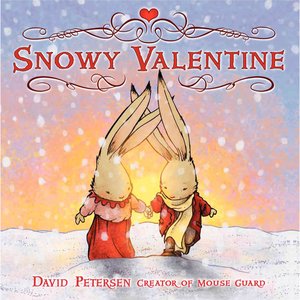
Snowy Valentine by David Petersen (Creator of Mouse Guard)

A longer story about an adult rabbit named Jasper Bunny who sets out in the snow to find the perfect valentine for his wife, Lilly. He visits various neighbors and asks them what they're giving their sweethearts for Valentine's Day, even experiencing some peril before giving up... But then he inadvertently comes up with a lovely gift. This book is a little too didactic for me, but the artwork is pretty and the final twist is a lot of fun.


French Ducks in Venice by Garret Freymann-Weyr, illustrated by Erin McGuire

Keeping it sort of real, here's a book that came out a few months ago, and it's about a broken heart. Believe it or not, there are folks out there thinking, "Oh, great, Valentine's Day" in a pink-tinged version of Scrooge this morning. This is the book for them! It's a picture book, but it seems to be meant for adults, or at least older children. Georges and Cécile are ducks living in Venice Beach, California, where they are friends with a pretty young fashion designer named Polina Panova. When her heart is broken, the two ducks set out to find the magic that will make her feel better. Their gift is marvelous, but Polina is still sad about her lost love. This baffles Georges, an incurable romantic.
"Polina Panova is a Russian princess," Georges says. "How is it possible that she will always be sad?"

"A little bit sad," Cécile says.

"Princesses are not sad," Georges says. "Not even a little bit."

The artwork resembles Disney animation rather strongly (and beautifully), but the author wants us to know that Disney got it wrong. Heartache is part of the human condition. Right along with talking ducks? Don't ask me how, but it works! This book is for sharing with your artsy friends.


In the interest of "Hey, I just had a book come out," I will mention that my retelling of the Brothers Grimm tale Hans My Hedgehog is also about the redeeming power of true love. In a rather convoluted, prickly, and magical way. With pigs.


Happy Valentine's Day!


Note: The first four books were sent to me by HarperCollins. Thanks, HC!

Thursday, February 9, 2012

There Is Such a Thing as a Tesseract

It was a dark and stormy night.

In her attic bedroom Margaret Murry, wrapped in an old patchwork quilt, sat on the foot of her bed and watched the trees tossing in the frenzied lashing of the wind. Behind the trees clouds scudded frantically across the sky. Every few moments the moon ripped through them, creating wraith-like shadows that raced along the ground.

The house shook.

Wrapped in her quilt, Meg shook.

She wasn't usually afraid of weather. —It's not just the weather, she thought. —It's the weather on top of everything else. On top of me. On top of Meg Murry doing everything wrong.

I read a lot when I was a kid, and I mean a lot. But I still remember the feeling I got from reading A Wrinkle in Time. I was an odd duck, like Meg, and late elementary/junior high school was a difficult time for me. I just didn't fit. So reading the book was reassuring—here was someone like me, and she said the wrong things, and she got emotional like me, and yet, she was a hero. Not in a smooth and shiny way, but in a prickly, klutzy way, which I knew very well was the only way I would ever be any kind of hero.

That wasn't the only reason I loved the book, though. I was enchanted by the rest of the cast, too, particularly Charles Wallace and the three not-exactly-witches with the way-clever names. I loved the strangeness of the story, as well, the way it led me across the fold of a skirt to planets where beautiful beings lived, and terrifying ones.

Of course, IT was such a brazenly B-movie villain (even if I didn't know the term "B-movie" quite yet); I'm still asking myself just how it is that Madeleine L'Engle makes him/it work? She leads us up to that moment with those robotic kids playing in front of their poison cookie-cutter houses, that's how. And the mind-capture of Charles Wallace—shudder! L'Engle has a wonderful touch with details. I've never forgotten the disquieting softness of a father's beard and hair that have grown out as he stood trapped inside his futuristic cell.

Well. It's been 50 years since the book first come out. I can't remember where I first read the story, but Madeleine L'Engle had a very difficult time getting the book published. She sent it off to a couple of dozen publishers and they all turned it down, so she stuck it in a drawer and basically gave up. Then a friend of hers told her she knew John Farrar of Farrar Straus and Giroux. Please note that FSG did not have a children's division at the time. The friend passed the manuscript to Farrar and he loved it, so FSG basically started a children's division for L'Engle's book. The next year, when she won the Newbery, Madeleine went to a celebratory dinner and was approached by various editors saying, "Why didn't you send it to me?" Her answer, of course, was, "I did." They were astonished, but she had the rejection slips to prove it. (Part of this account appears in the commemorative edition's afterword.)

One interesting note: I've found that people (especially librarians) can debate endlessly over whether this book is science fiction or fantasy. It fits easily in both categories, though I suppose I lean a little towards science fiction, myself. At any rate, A Wrinkle in Time opened the door to a new kind of creativity in the children's SFF genre. (The art to the above left depicting Mrs. Which, Mrs. Whatsit, and Mrs. Who is by Eugene Eian Lee.)

As a participant in A Wrinkle in Time's 50th anniversary blog tour, I agreed to write a poem or two in honor of the occasion. (And yes, I will give a brazen shout-out to my forthcoming poetry book, Water Sings Blue, while I'm at it.) It was easy to decide to write a poem about Meg, but then I said half-jokingly on Twitter that I might write a poem about the boy with the ball, and the response was pretty positive. So I've written both. The second poem also attempts to answer the question my sister asked me last week when I told her about the post: "What happened to the rest of the people on Camazotz?" And by the way, in case you were wondering, the planet was named after a Mayan bat god associated with death, night, and sacrifice.


Tesseract

Sometimes I look down
at my feet as I walk
through dirt and gravel
and dead grass, stepping
and stepping, not getting
very far really.

The numbers line up
in my head like the students
in my class.

At lunch, who
will sit with me?

After school, which
one should I punch first?

Every morning, why
do I brush my hair
and go back?

There is no one who
will tell me what
to do or why
to do it.

All I am
is Meg walking down a street
to meet something terrible.

All I am
is Meg holding hands
with a small
wise-eyed brother.

All I am
is Meg.


The Boy with the Ball

It hurts, it hurts, it hurts
and then—
it stops. I drop the ball
(the thing that started it all).
But it is mine.
I pick it up again, put it
in my pocket.

Nothing.
Where before there were walls
without windows or doors.
I walk down a gray hall.

Up ahead, I see someone running
the other way.
No one comes.
No one yells at me.

I wander
till I find a vast space.
A brain pulses on a dais.
I feel unseen claws grasping.
This is the thing
that hurt me. I stand still.

Boy, you are one of mine,
the brain tells me. But its words
cannot hold me.
My heart skips. I stumble
and fall like a dropped ball.

I scramble up.
"No," I say. "I am broken."
That's what they told me.
(But I got up just now.)
I take the ball from my pocket
and throw it as hard as I can.
It makes a dull thunk.

I run out of the building,
past confused people
in dark suits. I run
to the street where my house is.
Children stand staring down
at red rubber balls
and jump ropes lying there
like dead snakes.

"Come on," I say,
and they follow me
up the hill, where I show them
how to climb a tree.


Meg and Charles Wallace, Calvin and Mrs. Whatsit—like Harriet the Spy and Charlie of chocolate factory fame, they will live on across many wrinkles of time, iconic, flawed, and lovable. Because Meg loves her little brother, and so, in spite of Meg's feeling of being all wrong, everything really is all right.


Here's the link to the Wrinkle in Time Facebook page and the list of 50 participating blogs (wow!).

The 50th Anniversary Commemorative edition has some extra features. It's the orange book shown at the top of this post on the right; the book at the top left is the paperback commemorative edition.

o Frontispiece photo*+
o Photo scrapbook with approximately 10 photos*+
o Manuscript pages*+
o Letter from 1963 Caldecott winner, Ezra Jack Keats*+
o New introduction by Katherine Paterson, US National Ambassador for Young People's Literature +
o New afterword by Madeleine L'Engle's granddaughter Charlotte Voiklis including six never-before-seen photos +
o Murry-O'Keefe family tree with new artwork +
o Madeleine L'Engle's Newbery acceptance speech

I will confess that this list came with no explanation for the various asterisks, so feel free to make up your own meaning for them. But you get the idea!

This post is linked to Poetry Friday (2/10), hosted by poet Laura Purdie Salas.

Also: I have the book with the yellow cover, 2nd up on the right. What about you? Which version matches
your memory of A Wrinkle in Time? Or did you have that turquoise one?