Showing posts with label Diana Wynne Jones. Show all posts

Saturday, July 14, 2012

Reflections, Observations, and Inspirations: Authors Speak

Reflections

Unwilling to wait for September, I recently ordered from the UK Reflections on the Magic of Writing, an upcoming collection of the late Diana Wynne Jones’s thoughts on life and her writing process. I began considering a post about books of essays on writing, and then The Enchanted Inkpot came out with a great post on books about writing fantasy for children and teens, so I’ll just refer you there for those (including my quick note on DWJ’s book). But really, the books I’m thinking of are a little different. They’re the books that have inspired me as a children’s writer, and they’re not how-to books. They’re one of two things: interviews with and stories about children’s book writers or essays and lecture transcripts from notable children’s book writers.

Apart from Reflections, most of these books are a little older. I figured I must have simply missed the boat and that there had been other such essay collections since I acquired my batch of inspirational writing about the making of children’s books. Well, as it turns out, not so much. There’s one I missed and have now ordered: On Writing for Children and Other People by Julius Lester. In addition, I will point out that Leonard S. Marcus has become the de facto chronicler of the world of children’s literature. His latest is Show Me a Story! Why Picture Books Matter: Conversations with 21 of the World’s Most Celebrated Illustrators. Marcus’s Dear Ursula: The Letters of Ursula Nordstrom and Golden Legacy, a history of the little Golden Books, are just fascinating. And as a fantasy writer, I love-love-love his book, The Wand in the Wood: Conversations with Writers of Fantasy. Some day I’ll read the others. They all look good.

But why haven’t more children’s book writers come out with collections of lectures and essays in the past decade or so? One thought, of course, is that the market doesn’t support such books. Another is that most children’s book writers are too busy writing books for kids to spend time compiling books for older readers about process and craft. It may be that this task is left to elder statesmen and/or really big names in the field. All of which explains more or less why the incredibly lovely books I’m about to share are mostly out of print.

These are books for people who are absolutely nuts about children’s books or the works and thoughts of certain authors, or those who are children’s book writers themselves. They are also a way of getting to know some very fine, idiosyncratic creative minds. Reading these books won’t just give you ideas about writing for children, it will give you ideas about life and what it means to be human.


Reflections by Diana Wynne Jones

Oh, sure, you can read a really long analysis of Tolkien’s work called “The Shape of the Narrative in The Lord of the Rings” in this book. I’ll admit I faltered a bit there, though I read “Reading C.S. Lewis’s Narnia” and even her letter to the editor of The Times Literary Supplement titled “The Value of Learning Anglo-Saxon” with some relish. But most of the essays in this book are about writing, and many of them incorporate stories from Diana Wynne Jones’s childhood. You will find some repetition, of course, since writers tend to use the same (very good) anecdotes when presenting at different conferences, and more to the point, certain experiences really do shape us as individuals and as writers.

Reading Reflections is like getting to know Diana Wynne Jones (why does one hate to say simply Jones? But DWJ works!), and she is just as you might expect from reading every one of her books—brilliant, creative, a little acerbic, dry in a bright and witty way, and reluctant to allow the world to be simply ordinary.

You will also discover, if it’s something you didn’t already know, that DWJ had a pretty horrific, neglected childhood that somehow contributed, not only to her imagination, but to her skill with character. Have you noticed that all of DWJ’s characters feel so real because they are flawed, and that her adults in particular (and I do mean in her children’s books) tend to be flawed in amazingly honest, complex, and selfish ways?

Diana Wynne Jones also explains that her own approach to writing is almost never to outline, though the mythological bases of Fire and Hemlock were so intricately layered that she did relent and outlined part of the book sometime after completing a first draft. In fact, when you hear how many myths DWJ alluded to in writing Fire and Hemlock, you will be vastly impressed; I know I was, though I have read the book more than once.

I can't forget to mention the wry humor in Reflections, most notably when DWJ describes the worst of her school visits: hair-raising! And yes, though it isn’t funny, the semi-hanging incident in The Time of the Ghost comes from DWJ’s childhood, when she and her next sister came within inches of hanging their younger sister, who wanted to play Peter Pan in the rafters. (Their parents were nowhere to be found. They hardly ever were, including when it came to feeding and clothing their offspring.) And in Aunt Maria, the manipulation of feminine power was surely drawn from DWJ’s mother, who was jealous of her own daughters simply for being girls.

Another interesting aspect of some of these lectures and essays is that they trace the evolution of fantasy, showing how it became more common in the years following Tolkien's Lord of the Rings books and, though often filled with odd rules, eventually opened up—though one reason DWJ mostly stuck to writing children’s fantasy was that it seemed much more inclined to accept an “anything goes” approach, at least in comparison to what was being more rigidly expected of adult fantasy writers. (See “A Talk about Rules.”) Diana Wynne Jones was a rule breaker, or perhaps more accurately, a rule ignorer. She was busy traveling new ground even as she carried a bundle of myths like useful herbs in a fantasy healer’s pack.

DWJ speaks of writing for children as a great responsibility because of the power a good children’s fantasy book can have in a specific child’s life. She tells of the heroic ideal and her own odyssey. She offers hints on writing and reviews a book by Mervyn Peake. She creates an apt and beautiful analogy in “The Children in the Wood,” comparing the games of let’s-pretend that children create to writing fantasy. And she warns children who want to write: “Most teachers will tell you that you need to make a careful plan of your story before you start. This is because most teachers do not write stories.”

I’ve said before, as have others, that the best children’s books are subversive. Look at Maurice Sendak, for example—a born mischief-maker. And you just know that Mo Willems is partly his character, Pigeon. The best books surprise and challenge young readers, demanding that they see the world aslant, whether in beautiful ways or perfectly silly ones. DWJ's books are certainly among them.

I’ll just close with what came to be the most influential motif from DWJ’s childhood, a locked garden:
The garden that everyone saw was pleasant enough, though somewhat boringly laid out around a large square of grass. The Other Garden was quite different. It was like that garden in fairy tales where the king has counted all the apples. It was across a road, walled away from everyone, a blaze of manicured lawn leading to a tunnel of roses ending in an inlaid wood summer house, where espalier apple trees of types that are no longer grown surrounded plots of fruit, flowers, and vegetables. The bees had a plot of their own because they did not get on with the visionary gardener. Something about this garden caused him to build little shrine-like places in the wall niches and ornament them with posies and old Venetian glass.
     My father would not let anyone go there. He kept the large, old key to it in his pocket and it often took several days of pleading to get him to release it to me, grudgingly, for an hour or so. When I got there I simply wandered, in utter bliss. I talked to the bees, who never once stung me, although they pursued the visionary gardener once a week, in clouds, and occasionally turned on my father too; I ate apples; I watched things grow; and I never once connected it with the garden in the piano-playing picture, though that was more or less what it was.

Meet the unusual, delightful, and thoroughly subversive Diana Wynne Jones in her book, Reflections

Note: UK cover shown above.


Other Books from or about Children’s Book Writers


INTERVIEWS AND SUCH

The ABCs of Writing for Children, ed. Elizabeth Koehler-Pentacoff

This book is a kind of encyclopedia of quotes—mostly 1-3 paragraphs—from children’s writers on a variety of topics. It’s just decadent with ideas!

Quote from Marilyn Singer under "Pacing":
When you’re doing a novel, it’s a mistake to follow a quiet chapter with another quiet chapter. When people talk about books being too quiet—a book can be about emotion and not be quiet. If one chapter is more dramatic, then the next chapter can be more quiet.


Origins of Story: On Writing for Children by Barbara Harrison and Gregory Maguire (yes, that Gregory Maguire!)

These essays started out as Children’s Literature New England lectures given between 1988 and 1996. The writers include such luminaries as Sharon Creech, Maurice Sendak, Susan Cooper, Tom Feelings, Madeleine L’Engle, Virginia Hamilton, Margaret Mahy, Ursula Le Guin, and Katherine Paterson.

Quote from Sharon Creech’s essay, “Leaping Off the Porch”:
When I begin a book I feel like that “smoothbeautifulhorse” of e.e. cummings’s poem “the little horse is newlY.” I know nothing, but feel everything. All around me is perfectly a strangeness of light and smell, of a world that is welcoming me in, a world full of smoothbeautiful folds in which lies the breathing and silence of that someone—that character who is about to break her silence.


Worlds of Childhood: The Art and Craft of Writing for Children, ed. William Zinsser

Long essays from six marvelous authors: Jean Fritz, Maurice Sendak, Jill Krementz, Jack Prelutsky, Rosemary Wells, and Katherine Paterson. This is the book which told me that Maurice Sendak’s wild things were based on his Jewish relatives, for example.

Quote from Rosemary Wells’s essay, “The Well-Tempered Picture Book”:
I had written a picture book that summer. I put every ounce of love, wit and lyricism in my jittery soul into that book. It was a real loser. I had wanted to write about an old woman who digs in her heels and hangs on to her house in the face of avaricious developers who wanted to tear it down. It wasn’t that this was a poor idea; it’s just that writing about anything is a mistake. The only books that work are those which fly through the air—the ones you let happen, not make happen.


ESSAYS, LECTURES, AND THOUGHTS

Dreams and Wishes: Essays on Writing for Children by Susan Cooper

This book is a collection of essays from the author of the Dark Is Rising sequence.

Quote from her 1976 Newbery acceptance speech, “Seeing Around Corners”:
[Cooper was writing “a family adventure story” for a contest.] I invented three children called Simon, Jane and Barney, and a rather vague plot about villainy and hidden treasure. I wrote a first chapter in which they traveled down from London to Cornwall by train for a summer holiday, as my brother and I had done as children.
     And then a funny thing began to happen. The story, somehow, took over. My children were met at their destination by a very strange great-uncle named Merriman (why did I call him Merriman? I didn’t know) and before I quite knew what I was doing, the plot began to change completely. I forgot all about the E. Nesbit prize and the family adventure story—and the deadline. And I found I was writing a fantasy, full of images which had haunted me since childhood but which I’d never thought to put into fiction. In the final version I even cut that first deliberate chapter.


Dear Mem Fox, I Have Read All Your Books Even the Pathetic Ones and Other Incidents in the Life of a Children’s Book Author

The title says it all, doesn’t it? This is largely an autobiography of the vibrant teacher, reading advocate and author of Possum Magic, Wilfrid Gordon McDonald Partridge, Time for Bed, and many other picture books. Some of the later chapters do address craft, however.

Here’s a quote from the chapter called “Growing Up in Africa”:
There used to be a thorn tree near the bus stop, where people would gather for the meager shade. I heard unearthly sounds coming from there once—it was close to our house—so I leaped onto my bike and raced round to see what it was. A small crowd of Africans had gathered to watch a woman writhing at the base of the tree, to which she had been tied with strips of cloth. White froth spat from her mouth as she moaned and screamed.
     “What’s happening?” I asked.
     “Never mind, Merri,” said one of my friends. “She’s having a fit. She’s mad but she’ll be all right soon. You go home now.”
     I couldn’t go home. I was transfixed.


The Spying Heart: More Thoughts on Reading and Writing Books for Children by Katherine Paterson

Paterson grew up in China as the child of missionaries, and her work is influenced by themes from the Bible, e.g., in her book Jacob Have I Loved, which is about sibling rivalry and envy. See also her books of essays The Invisible Child and A Sense of Wonder. (The latter consists of two previous books, The Spying Heart and Gates of Excellence.) Note that Paterson has been criticized for her imperfect characters (e.g., the title character of The Great Gilly Hopkins) and difficult themes. Her books have won every major award you can think of, including two Newbery medals and a National Book Award.

This is a quote from a chapter (and lecture) titled “Do I Dare Disturb the Universe?”
It was, therefore, with fear, alarm, and timorousness that I sidled up to the title of this lecture, “Do I Dare Disturb the Universe?” Certainly not. I hardly dared disturb my springer spaniel. But, then, I had a sneaking suspicion that I was looking at quite a different universe from the one Prufrock was referring to. The universe that confronted me was no sleeping spaniel. It was a universe already greatly disturbed. What could I do, puny creature that I was, that would make a perceptible stir in such a whirlwind? Better, I thought, to gather my children about me, double-lock the doors, bolt the windows, and huddle together against the elements. The trouble with this metaphor is that I knew full well that my husband and probably my children would be out there somewhere battling the storm. I have never figured out just how Chicken Little managed to get herself married to the Man of La Mancha, but there you are…. Perhaps writing a book is a form of timidity.
     The irony, of course, is that try as I may, I cannot escape the universe. And in the end, the books I write must mirror it in all its terror as well as its grandeur.


Telling Time: Essays on Writing by Nancy Willard

Nancy Willard’s 1981 collection of poems, A Visit to William Blake’s Inn, won the Newbery and the Caldecott. Willard has written poetry and adult fiction in addition to children’s books.

This quote is from a chapter called “High Talk in the Starlit Wood”:
The fear at the heart of the ghost story is the fear of meeting our own fate; shall we not all, in the end, lie down in darkness and leave nothing behind but our bones? When I was a child, I used the word spooky to mean “terrifying.” I used it, for example, to describe my encounter in a dark church one night before a Christmas pageant in which I was to play an angel…. One by one, the children had been picked up by their parents, and I was left alone to wait for my father while Miss Blaine, the Sunday-school teacher, turned off the lights. I stood barefoot on the stone floor before the altar in my cardboard wings and thin white gown, waiting. Both of us had unsteady nerves. Neither of us knew that sickness would keep me out of the pageant and out of school for a month. Neither of us knew that Miss Blaine was on the verge of a nervous breakdown that would send her to an institution for a long recovery. A ghastly light from the street filtered in through the dark windows, which at this hour showed me none of the friendly saints whose company I enjoyed on Sunday mornings.
     Suddenly Miss Blaine took my hand. “Cold hands,” she observed. “I love little girls with cold hands.”
     In that moment she seemed to me a ghost come from the grave to take me with her, acknowledging that I, with my cold hands, was a willing victim. The cold floor, the darkness, the unsettling presence of a woman on the verge of madness—these natural phenomena I erroneously called spooky. I would not call them so today.


Take Joy: A Book for Writers and Touch Magic: Fantasy, Faerie & Folklore in the Literature of Childhood by Jane Yolen

Jane Yolen has written poetry, picture books, middle grade, nonfiction, novels, anthologies, and young adult fiction. She is known for her fantasy and was given a Lifetime Achievement Award at the 2010 World Fantasy Awards. I especially like the premise of Take Joy, in which she argues against what the flap copy calls “the cult of the despondent writer.” Then there’s the enlightening way she discusses the tropes and traditions of fairy tales, folktales, and fantasy in Touch Magic, e.g., the idea of what she calls Tough Magic: “It is the old bargain principle. One cannot receive without first giving. Every miracle requires an initial disaster. Magic has consequences. That kind of wisdom can be found in the best of the old tales….”

And here’s a quote from Take Joy:
Even when it is not being taught in the classroom, a children’s book is teaching its young reader something. Ursula Nordstrom, the great editor at Harper, said something instructional to a new writer worried about writing what had already been written. “The children,” she said, “are new, though we are not.” 
Everything in a good book (perhaps even in a bad book) is a new truth, a new revelation to a child whose experiences are, as yet, so limited. Therefore writers for children need to be extra careful about preaching, about filling in those empty spaces for the child.


Now, you may be thinking I chose the above quotes very carefully, they’re all so good. But no, I flipped a few pages and picked something easily from each book because they are simply chock-full of quotable quotes, rich ideas and wonderful anecdotes. You may have to track these books down at the library or order them used on Amazon, but however you manage to find them, you’ll be glad you did.

Update: Jennifer of Jean Little Library has two more books to add—Eleanor Cameron's The Green and Burning Tree and E.L. Konigsburg's Talk Talk. Thanks, Jennifer!


Update #2: Catherine of Cath in the Hat has two, too! Celebrating Children's Books, ed. Betsy Hearne and Marilyn Kaye (essays by Lloyd Alexander, Paula Fox, Arnold Lobel, and more) and The Zena Sutherland Lectures, 1983-1992, also edited by Betsy Hearne. Thank you, Catherine!


Update #3: Ruth Donnelly recommends Library of the Early Mind, a documentary about children's literature that includes interviews with the likes of Maurice Sendak and Jack Gantos.

Tuesday, May 1, 2012

Thank You, Diana Wynne Jones

Last spring, British fantasy author Diana Wynne Jones passed away from cancer. I felt a huge, personal sense of loss. After all, I've loved her books for as long as I can remember. She's in my trio of best children's fantasy writers, along with Megan Whalen Turner (whom she helped to publish a first book) and another Brit, Terry Pratchett.

What makes DWJ's books so great?

I'll begin with the details. I've noticed a lot of the best fantasy books and stories have shockingly creative details. Just think about it: glass slippers, a giant beanstalk, a cat in boots, an aerial school sport played on broomsticks, a young witch who uses her little brother as bait and hits a river monster with a frying pan.

Now, consider Diana Wynne Jones's inventiveness: a dirty sneakers spell, a scrawny young goddess who longs to go to a girls' boarding school, a nine-lived enchanter supervising magic through the dimensions like a chief of police, a song that brings down a mountain, a goon at the kitchen table, a young woman who is cursed with old age, a spell that's a conga line...

And Jones's parallel worlds always include big doses of the ordinary, making the dragon's blood matter all the more.

Convolution. (I wanted to say convolutedness, perhaps because it sounds more twisty!) DWJ's books are unpredictable, with a subtle vein of humor running through most of them. One of the biggest compliments of my life was when an editor compared the ending of my manuscript to Diana Wynne Jones's work because I had what he called a cast of thousands plus a complicated ending.

There are certain scenes in Diana Wynne Jones's books—you know, the kind that make you smile and even laugh a little because you know they're coming up in a few pages. One of them is the conga line mentioned above, actually from one of Jones's books for grown-ups, A Sudden Wild Magic.

Of course, the reason you know they're coming up is because you're rereading. Some books can only be read once. But DWJ's books are rereadable in a big way.

One of the best things about Diana Wynne Jones's writing is her way with characters. For example, her kid characters aren't heroic, particularly. They're grubby and surprised and sometimes unkind, though they do have their good points. I am very fond of Christopher Chant and Millie, not to mention Howard and Sophie and obviously Howl, just for starters. Plus the Goon. And a cat named Throgmorten! The villains are dimensional, too. Anyone who has ever had a horrible older sister will nevertheless gasp at Gwendolyn Chant's complete and utter ruthlessness, as well as her ongoing efforts to upset Chrestomanci with her over-the-top spells.

DWJ's books are also characterized by a kind of practical, nearly hardnosed, sort of whimsy.

I have my favorites, as you can tell. Here are a handful of them:


Cart and Cwidder

Like the other books in this unconnected set, the Dalemark Quartet, Cart and Cwidder takes place in a vaguely medieval setting. You'll find that the author's way with character extends to an understanding of families and how they function, or rather how they straggle along. Clennen is a larger-than-life personality on a small stage, a musician and performer traveling around Dalemark with his children. But when they pick up a new passenger, Moril learns that his father is not what he seems, and Moril will have to be braver and more musical than he ever imagined. I say this, sounding epic, but the fact is that these kids squabble along even as they try to fulfill their father's mission and beat the bad guys. They don't always know what to do, and yet they plug along, alternately messing up and getting it right. Like I said, real.

Random excerpt:
While Lenina was cooking supper, Clennen fetched the big cwidder down, polished it, tuned it carefully, and beckoned Moril. Moril came reluctantly. He was rather in awe of the big cwidder. Its shining round belly was even more imposing than Clennen's. The inlaid patterns on the front and arm, made of pearl and ivory and various colored woods, puzzled him by their strangeness. And its voice when you played it was so surprisingly sweet and quite unlike that of the other cwidders. Clennen took such care of it that Moril still sometimes thought—as he had when he was little—that this cwidder was an extra, special part of Clennen, more important than his father's arm or leg—something on the lines of a wooden soul.

How's that for writing?? Keep in mind that that's her early stuff. DWJ was just getting started!


Howl's Moving Castle

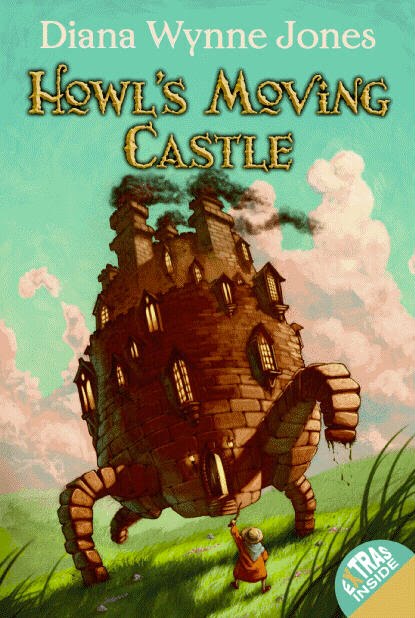
A lot of people know about this book, or at least the 2004 film of the story made by Japanese animator Hayao Miyazaki. In a world where fairy tale rules dictate that the younger daughters will have all the luck, Sophie doesn't see herself having much of a future—and that's even before the Witch of the Waste turns her into a little old lady. Freed from her shyness by dint of old age, Sophie sets out on an adventure. She catches up with the terrible wizard Howl's moving castle and basically forces herself in, making friends with a strange fiery creature named Calcifer. Of course, this is a DWJ books, so there are about 50 subplots. Yet she makes them all work!

Random excerpt:
[When Sophie tries to tidy up Howl's room and then the yard.] "Not here either," he said. "You are a terror, aren't you? Leave this yard alone. I know just where everything is in it, and I won't be able to find the things I need for my transport spells if you tidy them up."

So there was probably a bundle of souls or a box of chewed hearts somewhere out here, Sophie thought. She felt really thwarted. "Tidying up is what I'm here for!" she shouted at Howl.

"Then you must think of a new meaning for your life," Howl said... "Now trot along indoors, you overactive old thing, and find something else to play with before I get angry. I hate getting angry."

Sophie folded her skinny arms. She did not like being glared at by eyes like glass marbles. "Of course you hate getting angry!" she retorted. "You don't like anything unpleasant, do you? You're a slitherer-outer, that's what you are! You slither away from anything you don't like!"

Howl gave a forced sort of smile. "Well now," he said. "Now we both know each other's faults."


Archer's Goon

A boy named Howard comes home to find the Goon sitting at the kitchen table, scaring baby sitter Fifi and not exactly scaring Howard's holy terror of a little sister, Awful. The Goon wants something, but what? I can sincerely predict that you'll never guess where this is going, but it has something to do with the two thousand words Howard's father must turn in to a man named Mountjoy every three months. When the pages get waylaid, the electricity is turned off. And that's just the beginning of the troubles that come to Howard's family. Let's just say things escalate—it's rotten and hilarious all at the same time. Howard discovers that a group of unpleasant siblings are running the city, a crime family with magical powers. I'll stop there, but this is another odd, convoluted tale. I love it! Especially the Goon.

Not-So-Random Excerpt (because it's the prologue):
1. A Goon is a being who melts into the foreground and sticks there.
2. Pigs have wings, making them hard to catch.
3. All power corrupts, but we need electricity.
4. When an irresistible force meets an immovable object, the result is a family fight.
5. Music does not always soothe the troubled breast.
6. An Englishman's home is his castle.
7. The female of the species is more deadly than the male.
8. One black eye deserves another.
9. Space is the final frontier, and so is the sewage farm.
10. It pays to increase your word power.


Dogsbody

To my dismay, when I sat down to write this post, I realized I had loaned Dogsbody to my associate editor. Why, oh why? Well, I figure it speaks volumes that when I realized she was a fantasy reader and writer who had missed out on a lot of the best stuff, this was one of half a dozen books I loaned her, as well as Howl's Moving Castle (she had seen the movie). Dogsbody has a fairly gritty subplot about a little girl who is living with unloving relatives and a parallel subplot about a puppy she rescues from the river. Only, this being DWJ, the puppy is something more, a lost somebody on the run from enemies, but stuck in a puppy mind. He has trouble protecting Kathleen, let alone himself. A strange and tender story with an appearance by the horned god in the forest.

No excerpt. Sorry!


The Lives of Christopher Chant and Charmed Life

DWJ's best invention is arguably Chrestomanci, which sounds like a name but is actually a title. The most powerful enchanter in the series of known worlds is obligated to be trained to police magic in those worlds. In The Lives of Christopher Chant, the son of rather awful feuding parents is often at loose ends. Is it any wonder he responds when his too-bland governess and his mother's friend involve him in a scheme to take advantage of the fact that he travels to the Anywheres in his dreams? One of the two funniest things about this book is the gruesomely amusing way Christopher keeps getting killed in his dreams (in answer to the old question, if you die in your dreams, do you die in real life?). The other is a friend Christopher makes in one of the worlds, the young Goddess of Asheth. Her idea of bliss is to read books about girls at boarding schools, e.g., Head Girl Millie. Then the plot thickens. And swerves. And does a loop-de-loop. I especially like the creativity of the bootboy, the cook, the gardeners, and some maids who are called upon to join the magical defense of the house.

Charmed Life features a Chrestomanci who turns out to be the grown-up Christopher Chant. He always wears silk dressing gowns around the mansion full of magic workers. Since he can be summoned by repeating his name three times, he tends to show up in his dressing gown. But our story begins with a boy named Cat (Eric) Chant and his vain, ringleted older sister Gwendolyn. The two go to live with Chrestomanci. Gwendolyn expects to be cosseted, if not revered, so she is enraged to find that's not what happens. Meanwhile, Cat wanders around, bewildered, finding out the various small secrets of a house full of magic. There's a mystery surrounding Cat and his sister that gradually emerges as the plot progresses. And then Gwendolyn disappears, leaving an astonished doppelganger behind.

Random Excerpt (from Charmed Life):
"Why were you in the bath?" he said, wondering whether to search the bathroom.

"I don't know. I just woke up there," said Janet, shaking out a tangle of hair ribbons in the bottom drawer. "I felt as if I'd been dragged through a hedge backward, and I'd no clothes on, so I was freezing."

"Why had you no clothes on?" Cat said, stirring Gwendolen's underclothes about, without success.

"I was hot in bed last night," said Janet. "So naked I came into this world. And I wandered about pinching myself—especially after I found this fabulous room. I thought I must have been turned into a princess. But there was this nightdress lying on the bed, so I put it on—"

"You've got it on back to front," said Cat.

Janet stopped scanning the things on the mantelpiece to look down at the trailing ribbons. "Have I? It won't be the only thing I'm going to get back to front, by the sound of it. Try looking in that artistic wardrobe. Then I explored outside here, and all I found was miles of long green corridor, which gave me the creeps, and stately grounds out the windows, so I came back in here and went to bed. I hoped that when I woke up it would all have gone away. And instead there was you. Found anything?"

"No," said Cat. "But there's her box—"

"It must be in there," said Janet.


The Tough Guide to Fantasyland

If you're going to write fantasy, you should read this book. And if you're a fantasy reader, you should, too. DWJ presents a delightfully diabolical, tongue-in-cheek look at all the most standard-issue fantasy tropes every written. This send-up is very, very funny, but in addition, it has helped me to think differently about my own writing. For example, I never serve my fantasy characters stew, and that's entirely due to this book. Note that Ms. Jones sets the whole thing up as a tour. (See also her book The Dark Lord of Derkholm. The Guide is a companion to that one.) Here are a few sample entries. Note that OMT stands for Official Management Term.
DUKES. This is the highest form of lord, often one of the KING's family. Very few of them are GOOD and most of them are wicked uncles at the very least. The few Good Dukes are always frantically busy and beset with cares of state [OMT]. The Rule is that all Dukes, Good or EVIL, are always forty years old or more. See also REGENTS.

from COLOUR CODING. Eyes. Black eyes are invariably Evil; brown eyes mean boldness and humour, but not necessarily goodness; green eyes always entail TALENT, usually for MAGIC but sometimes for MUSIC... grey eyes mean POWER or healing abilities (see HEALERS) and will be reassuring unless they look silver... blue eyes are always GOOD, the bluer the more Good present; and then there are violet eyes and golden eyes. People with violet eyes are often of Royal birth and, if not, always live uncomfortably interesting lives. People with golden eyes just live uncomfortably interesting lives, and most of them are rather fey into the bargain.

Of the hundreds of books that have taught me to write, Diana Wynne Jones's are among the few at the top of the list. I can only imagine
that her books will continue to touch, delight, and teach writing to young readers for many years to come.

Thank you, Diana, for the treasure of your books. Through their cleverness, creativity, and wry good humor, I do feel I got to know you. Again, thank you.


See also my 2009 post, "The Queen of Children's Fantasy"; my recent review of DWJ's last book, Earwig and the Witch, and a review of the book before that, Enchanted Glass. You can find a complete list of Diana Wynne Jones's books at this Wiki page.

I will add that I wro
te this post as part of a blog tour honoring DWJ. Here's the site where you can link to the other posts in the tour. You should be aware that Firebird has reissued some of Diana Wynne Jones's books in her honor with new introductions and extras, as follows:
Three Firebird reissues (DOGSBODY, FIRE AND HEMLOCK, and A TALE OF TIME CITY—each is the definitive edition, and each has an intro by a star—DOGSBODY (Neil Gaiman), A TALE OF TIME CITY (Ursula Le Guin), FIRE AND HEMLOCK (Garth Nix). FIRE AND HEMLOCK also features the essay "The Heroic Ideal," which DWJ wrote about the writing of the book; it has never before appeared alongside the book, or THE TOUGH GUIDE TO FANTASYLAND (the Firebird edition is also definitive, entirely redesigned, with new art and material), the novella THE GAME, or her final book, EARWIG AND THE WITCH.

Yep, I have the updated Tough Guide to Fantasyland in my hot little hand, and I will lure you with the title of this special page, "How to Compose a Ballad." You will want to check out the map, too, and find out the secret of those epic fantasy names with the apostrophes in the middle.

Saturday, February 4, 2012

A Review of Earwig and the Witch by Diana Wynne Jones

Did you watch the movie, Howl's Moving Castle? It was based, of course, on a book by British fantasy writer extraordinaire, Diana Wynne Jones (see my overview of her work in this post from 2009). To the sorrow of many reader fans, Ms. Jones passed away last year after losing her fight with cancer. Earwig and the Witch, published January 31, 2012 in the U.S., is, as far as I know, her last book.

Earwig and the Witch is for younger middle grade readers and is a very slim read, but it packs a lot in a few short pages. In fact, I'm pretty sure you will find yourself wishing for a sequel once you hit the last page. In her signature style, Jones pops magic into a rather ordinary contemporary world. Meet Earwig, a girl who was left at the orphanage as a baby with the following note:
Got the other twelve witches all chasing me. I'll be back for her when I've shook them off. It may take years. Her name is Earwig.

The Matron promptly changed the baby's name to Erica, but it turned back to Earwig easily enough.

Earwig's best friend is a timid boy named Custard. Earwig does not want to be adopted, considering she has the whole orphanage running just how she likes it. So she is not pleased when she is adopted—by a towering man with horns only she can see and a woman with a "raggety, ribby look to her face."

Sure enough, the man is really a Mandrake and the woman is a witch looking for cheap labor. When Earwig figures out that Bella Yaga has no intention of teaching her any magic, she sets out to rearrange things. Then readers will start to understand that Earwig didn't control the orphanage with boring old magic, but by being a very clever child. Of course, it helps that she has a magic cat to help her in her new abode. (A close read will reveal glimpses of the Baba Yaga story in the bones of this one.) Here's Earwig's first supper with the Mandrake:
To Earwig's surprise, the kitchen was an ordinary kitchen, quite warm and cozy... Earwig looked at the Mandrake. He was looming in a chair at the end of the table, reading a large leather book. He looked like an ordinary man in a bad temper. Even so, he did not look like a man who would have gotten supper ready.

"And what have the demons brought us today?" Bella Yaga asked in the bright, wheedling voice she always seemed to use to the Mandrake.

"Pie and chips from Stoke-on-Trent station buffet," the Mandrake growled, without looking up.

"I hate station pie," said Bella Yaga.

The Mandrake looked up . His eyes were like dark pits. A spark of red fire glowed, deep down in each pit. "It's my favorite food," he said. The sparks in his eyes flickered and grew.

Earwig quite understood then why she was not to disturb the Mandrake.

The book has pen-and-ink illustrations by Caldecott winner Paul O. Zelinsky. They are a bit twisty and often show Earwig scowling, but then, she is a witch girl. (Her face does soften when she's petting Thomas the cat.) My favorite piece is an entire spread showing a sort of time-lapse look at Earwig rushing around the witch's workroom working on a spell—we see 11 versions of Earwig by my count.

Earwig and the Witch could have been longer, it could happily have been three books about Earwig instead of just one, but it's not. Still, Earwig and the Witch is something very nice indeed: the treasure of one last satisfying read from the marvelous Ms. Jones.

Note: I have included both the British and U.S. covers for your reference (above left and above right, respectively). Which do you like best?

Sunday, March 27, 2011

The Loss of Diana Wynne Jones

I woke to the news that Diana Wynne Jones passed away night before last. (Thanks, Charlotte's Library.) Due to some random difficulties I will not get into, I will not be posting reviews this weekend, but I really must acknowledge such a tremendous loss to the world of children's literature in general and fantasy in particular.

Did you know that Diana Wynne Jones was a major influence on Megan Whalen Turner as well as Neil Gaiman? (Um, and on me?) She actually hooked Megan up with her editor at Greenwillow.

And yes, there's a reason Diana received a Lifetime Achievement Award from the World Fantasy Association in 2007.

Diana's fantasy is known for its humor, its intricacy, and its creativity. Perhaps you're familiar with her book, Howl's Moving Castle, which was made into an animated feature film. And who else has ever used a conga line as a magic weapon, as in her adult fantasy novel, A Sudden Wild Magic?

Here is my detailed post about Diana Wynne Jones and her work, "The Queen of Children's Fantasy," from a year or so ago. See also my review of her book, Enchanted Glass, which was published last year.

Good-bye, Diana. You will be missed very much.

Note: Look for one last book, Earwig and the Witch (for younger readers), this fall.

Update: Two more links from Charlotte, an obituary in The Guardian and thoughts from Neil Gaiman. See also Amy's thoughts at Amy's Library of Rock.

Really good update: Judith of Misrule has compiled an extensive list of links to obituaries and musings on the great Diana Wynne Jones. Thank you, Judith!

4/13/11 update: We have a Diana Wynne Jones tribute post up at the Enchanted Inkpot. (Thanks, Grace Lin!) You can stop by and leave your own thoughts about Ms. Jones in the comments.

Tuesday, August 3, 2010

Diana Wynne Jones Week

It's Diana Wynne Jones Week over at Jenny's Books, and while I won't be posting a new review because I'm wrapping up summer school and my head feels like it's going to fall off any second now, I will refer you to my previous posts about the inimitable Ms. Jones: "The Queen of Children's Fantasy" and a recent review of Enchanted Glass, her newest book.

My own favorites are probably Dogsbody, Charmed Life, The Lives of Christopher Chant, Archer's Goon, Howl's Moving Castle, and Cart and Cwidder, but really, I like just about everything she's ever written. Oh, I highly recommend her Tough Guide to Fantasyland to anyone who reads or writes fantasy! Thanks to her entry on "Stew," I always make sure my own characters' meals aren't repetitive and boring.

It is with great sadness that those of us in the children's book community learned that Diana is fighting cancer. She is in our thoughts and prayers.

Visit Jenny's Books to link to reviews of Diana Wynne Jones favorites from the blog community this week and to read Jenny's "keynote addresses."

Friday, April 9, 2010

A Review of Enchanted Glass by Diana Wynne Jones

I was counting the days till Enchanted Glass came out! And yes, I made the clerk at the bookstore find me a copy on the cart because they hadn't been shelved yet. Then I ran right home and read it straight through. So how does Enchanted Glass stack up, considering DWJ must compete with her own amazing list of previous books?

Let me put it like this: This fantasy set in a real-world Britain with magic stirred in does a slow build, but if you like the kind of story that makes you think, you'll enjoy the unfolding of the mysteries of Melstone House. In particular, Jones creates another likable cast of oddballs. We have absent-minded professor Andrew Hope, who inherits his grandfather Jocelyn's house (finding out when his grandfather's ghost flags him down on a darkened country road). Next we meet Mrs. Stock, the housekeeper with the very strong personality who puts the furniture back where she had it every time Andrew rearranges it to his liking. And out behind the house the (unrelated) Mr. Stock gardens crankily, bringing in boxes of humongous vegetables to express his displeasure when Andrew tries asking him to work on the roses for a change.

A one-legged former jockey named Tarquin O'Connor also shows up, and his efficient daughter Stashe is soon working as Andrew's part-time assistant. Another employee thrust upon Andrew is the large and seemingly stupid Shaun, Mrs. Stock's nephew. And then there's whoever, or whatever, is eating the giant vegetables Andrew keeps dumping high up on the roof of the shed out back.

Unfortunately, although Andrew takes over the house, he doesn't remember the important magical information his grandfather taught him when he was a boy. He is supposed to take responsibility for his grandfather's "field of care," but isn't too clear on what that means.

Things get still more complicated when a boy named Aiden (or is it Adam or Ethan or Alan?) shows up, claiming that once his grandmother died, he began to be stalked by ominous shadow people.

Meanwhile, Andrew's neighbor, the elegantly awful Mr. Brown, starts taking over pieces of Andrew's land, putting out an impenetrable kind of barbed wire and sending strange security guards to patrol the borders.

Who is Aiden, exactly, and why should Andrew keep him around? What kind of magic is embedded in the colored glass panels on the kitchen door? In her uniquely intricate, funny, and imaginative way, Diana Wynne Jones starts putting the pieces together for her readers.

The author's subtle humor is half the fun here, especially in subplots like the turf wars between Mr. Stock, Andrew, and Mrs. Stock. Her descriptions are often touched with humor, too:

Mr. Stock came first, in his hat as usual. Aidan was fascinated by Mr. Stock's hat. Perhaps it had once been a trilby sort of thing. It may once have even been a definite color. Now it was more like something that had grown—like a fungus—on Mr. Stock's head, so mashed and used and rammed down by earthy hands that you could have thought it was a mushroom that had accidentally grown into a sort of gnome-hat. It had a slightly domed top and a floppy edge. And a definite smell.

Of course, those giant vegetables play a role in the climactic battle scene—who else would put Puck and vegetable marrows on the same page but Diana Wynne Jones? And who else would use the act of cleaning one's glasses as a source of magical power? The only other fantasy writer quite this wryly whimsical that I can think of is Joan Aiken. (Though apparently Neil Gaiman cites Jones as an influence; he's quoted on the jacket of this book as saying, "Funny, smart, twisty, tricky, and always perfectly magical.")

While I have to admit that I've liked the plots of some of her previous titles better, I thoroughly enjoyed this new book by one of my three favorite children's fantasy writers. Anyone who's read the Chrestomanci books and other wonderful works by Jones will be glad to get their hands on Enchanted Glass. If you're new to this author, I suggest you also look for books like Dogsbody, Howl's Moving Castle, Spellcoats, Archer's Goon, and Charmed Life. Reading Enchanted Glass means you're just beginning to dip your toes in the water of the magical pool of stories created by Diana Wynne Jones.

See my post of 10-25-09, "The Queen of Children's Fantasy," to find out more about the author and her books. Please be aware that Diana Wynne Jones is currently battling lung cancer. Encouragement and fan letters can be sent to her in care of her publisher as follows: Diana Wynne Jones, c/o Greenwillow Books/10 E. 53rd St./New York, NY 10022.

Sunday, October 25, 2009

The Queen of Children's Fantasy

Aha! You thought I was going to say J.K. Rowling, didn't you? J.K. Rowling is, rather, the queen of Harry Potter's world and also of England, the latter thanks to a bloodless coup in June 2006 (bloodless except for an accident involving one of the corgies). Diana Wynne Jones, though she does deign to reside in England, reigns over the world of children's fantasy. Terry Pratchett is not her royal consort, though it may seem like it at times. That would be Neil Gaiman.

Suffice it to say that if you haven't read any of DWJ's books, your life and your education are sadly lacking. The author's 2007 World Fantasy Award for Life Achievement should slap your hand sufficiently to drive this point home. And yes, one of her books has been made into a movie: Howl's Moving Castle (2004), from respected Japanese animator Hayao Miyazaki.

Diana Wynne Jones is famous for her fresh, convoluted plots and for the invention of a character called Chrestomanci. She is also known for skewering sword-and-sorcery conventions, e.g., in books like The Dark Lord of Derkholm, which postulates that all of the characters on a particular fantasy world are actors, performing their roles at the behest of a greedy corporate entity for the benefit of a group of tourists. Even better, perhaps, is the companion book, a wry encyclopedia of tropes called The Tough Guide to Fantasyland, which purports to be a tour guide (cover shown is from first edition). Here's a sample entry, one of my favorites:

STEW (the OMTs [official management terms] are thick and savoury, which translate as "viscous" and "dark brown") is the staple FOOD in Fantasyland, so be warned. You may shortly be longing passionately for omelette, steak, or baked beans, but none of these will be forthcoming, indoors or out. Stew will be what you are served to eat every single time. Given the disturbed nature of life in this land, where in CAMP you are likely to be attacked without warning...and in an INN prone to be the centre of a TAVERN BRAWL, Stew seems to be an odd choice as staple food, since, on a rough calculation, it takes forty times as long to prepare as steak. But it is clear the inhabitants have not yet discovered fast food. The exact recipe for Stew is of course a Management secret, but it is thought to contain meat of some kind and perhaps even vegetables. Do not expect a salad on the side.
Yet much as I love The Tough Guide, it is ultimately a book for grown-ups, and although Diana Wynne Jones's books are often funny, satire is too small a window through which to consider her work. Let's turn instead to her many marvelous books for children, beginning with the Chrestomanci titles.

Diana Wynne Jones envisions a series of parallel worlds related by differing causalities, or alternative outcomes of key events, and one of the worlds is our own. (Read about Hugh Everett and string theory for quantum mechanics-based thoughts on the concept.) In these worlds, magic is a commodity that is often misused by the criminal element. The most powerful enchanter in the related worlds, recognizable because he has nine lives, is appointed director and policeman over magic in all of the worlds. His title is Chrestomanci, and he can be summoned by repeating it three times in magical emergencies. (Click here for an A-Z Glossary of the Related Worlds as compiled by Helen Scott on the official DWJ website.)

The most important Chrestomanci books are The Lives of Christopher Chant and Charmed Life, which tell about the current Chrestomanci and his young successor, respectively. Christopher Chant is raised by a lovely, negligent society wife—or rather, by governesses. No one realizes for years that his powerful magic is constrained by the touch of silver. Meanwhile, he is walking the parallel worlds in what he thinks are dreams. As he is used by his avaricious uncle to smuggle illegal magical supplies, Christopher begins to lose his nine lives at an alarming rate. The tangle eventually gets untangled, but in the meantime, Christopher aids and abets a young runaway who happens to be the goddess of Asheth, along with her menace of a temple cat. To give you an idea of the kind of humor in Jones's books, the goddess wants nothing more than to be a British school girl, like the ones she reads about in a series of dippy books Christopher has brought her because she is bored.

In Charmed Life, Christopher is a grown-up now married to the Living Asheth, who has renamed herself Millie. He rambles about Chrestomanci Castle and indeed, the known worlds, in embroidered silk dressing gowns—of course, he does tend to be summoned unexpectedly to put out magical fires. The castle is partly a training ground for Chrestomanci's children and for his successor. When Cat (Eric) and Gwendolyn Chant are brought to live there, it takes the grown-ups a while to figure out that Gwendolyn is using her little brother's magic to fuel her own ambitions.

Another key book about Christopher Chant/Chrestomanci is Conrad's Fate, in which you can see the enchanter and Millie as teens. The rest of the books set in this series of worlds give us a Chrestomanci who simply makes cameo appearances, usually in the role of a rather tongue-in-cheek deus ex machina. But never fear, the young characters in these books do work out their own magic-related dilemmas. The Magicians of Caprona, The Pinhoe Egg, and Witch Week are also Chrestomanci books, and Jones has written four short stories involving her nine-lived enchanter, as well. Of these titles, I particularly like Witch Week, a tale that plays out in a world where witchcraft is forbidden. The setting is a school called Larwood House, and the book begins,

The note said: SOMEONE IN THIS CLASS IS A WITCH. It was written in capital letters in ordinary blue ballpoint, and it had appeared between two of the geography books Mr. Crossley was marking. Anyone could have written it. Mr. Crossley rubbed his ginger mustache unhappily. He looked out over the bowed heads of Class 6B and wondered what to do about it.
The world of Witch Week considers such a note to be more than a prank; it's an accusation. But Mr. Crossley hesitates to inform his boss, who will probably call in an Inquisitor, a man authorized to use torture to root out and destroy witchcraft. As the school is rocked by magical happenings, including flocks of birds flying through classrooms and the sudden disappearance of every shoe in the entire school, the students in Class 6B try to uncover the identity of the resident witch and save each other from the forthcoming attentions of the Inquisitor.

Of course, Diana Wynne Jones has written many books besides her Chrestomanci titles. The most well known is probably Howl's Moving Castle, a book I dearly loved even before Miyazaki made it into an animated film. In this world, fairy tale rules tend to apply, so as the eldest of three sisters, Sophie knows she is destined to fail if she sets out to seek her fortune. But even working quietly in a hat shop, Sophie manages to offend the Witch of the Waste, getting herself turned into an elderly woman for her troubles. Deciding she has nothing to lose, Sophie hobbles out into the world, where she encounters a floating, traveling castle belonging to the wizard Howl and moves in, looking for adventure as well as answers. Howl is vain and moody, but he has met his match in practical, cantankerous Sophie. Pretty soon the two of them overcome their differences to deal with the growing threat of the Witch of the Waste, not to mention the problem of the fire demon who powers Howl's castle. Jones has written a couple of sequels to Howl's Moving CastleCastle in the Air and House of Many Ways, the latter being her most recent book (2008).

Most of the author's stories are rambunctious and sometimes mysterious adventures, but one of her very best books is quieter and often poignant. Dogsbody tells about a girl who is being raised by her aunt and uncle after she is orphaned. The story is told from the point of view of a puppy named Sirius, who gradually becomes aware of how badly Kathleen is treated in the household, especially by her aunt. Yet Sirius has his own enemies and his own past. He is no mere puppy, but the dog star himself in exile, falsely convicted of a crime he did not commit. As allies and enemies converge, both Sirius and Kathleen fight to claim their selves and their futures. Dogsbody is astoundingly unique, well crafted, and in fact, just plain lovely.

Diana Wynne Jones has a knack for mixing ordinary life and magic that reminds me of Joan Aiken's work (e.g., the recently published collection of Armitage stories, The Serial Garden). Other than Aiken, I don't think anyone besides Jones has ever achieved the blend quite so beautifully—or with plots that escalate quite so madly. For example, consider Archer's Goon, another DWJ book I like very much. It begins:

The trouble started the day Howard came home from school to find the Goon sitting in the kitchen. It was Fifi who called him the Goon. Fifi was a student who lived in their house and got them tea when their parents were out. When Howard pushed Awful into the kitchen and slammed the door after them both, the first person he saw was Fifi, sitting on the edge of a chair, fidgeting nervously with her striped scarf and her striped leg warmers.
"Thank goodness you've come at last!" Fifi said. "We seem to have somebody's Goon. Look."
Howard looked the way Fifi's chin jerked and saw the Goon sitting in a chair by the dresser. He was filling most of the rest of the kitchen with long legs and huge boots. It was a knack the Goon had. The Goon's head was very small, and his feet were enormous. Howard's eyes traveled up a yard or so of tight faded jeans, jerked to a stop for a second at the knife with which the Goon was cleaning the dirty nails of his vast hands, and then traveled on over an old leather jacket to the little, round fair head in the distance. The little face looked half-daft.
Howard discovers that his father has been writing two thousand words of nonsense and sending them to Town Hall every month for some inexplicable reason. This month, the pages are missing. Howard gradually learns that there is more than one person trying to get their hands on the pages, and that each of these individuals is a kind of sorcerer who "farms" part of the city arrogantly and sometimes criminally. The mystery takes still more twists and turns before Howard learns the complete truth, and all along the way, the Goon looms just over his shoulder.

Aside from many wonderful standalone titles and several story collections, one other group of books is worth mentioning: the Dalemark Quartet. Here Jones delves into more serious and traditional fantasy. Dalemark is split between the freedom-loving earls of the North and the tyrannical earls of the South, so war often breaks out between the two sections of the land. I am especially fond of the first book, Cart and Cwidder, which begins with the murder of a musician who has been driving around the countryside with his children, putting on performances. But there was more to Clennen than meets the eye, and his children discover they must carry out his last mission while evading the reach of the ruthless earls of the South. Like many of Jones' books, this is a good example of the way the author draws a realistic picture of the bickering and support between siblings even as her plot takes us on an adventure colored by magic.

I will mention that Eight Days of Luke draws on Norse mythology, and that The Ogre Downstairs unites a quarrelsome group of newly minted stepsiblings when the kids are given magical chemistry sets and start getting themselves into trouble—there's a whiff of Edward Eager in that one. The Magicians of Caprona features two warring magical houses reminiscent of the Montagues and the Capulets. The Homeward Bounders works with the idea of parallel worlds in a more ominous way than the Chrestomanci titles do, creating a solitary and iconic young hero by book's end. Note that both Hexwood and Fire and Hemlock are Young Adult books, with a more mature sensibility. (I also recommend DWJ's adult fantasy, A Sudden Wild Magic, which has one of the funniest resolutions I've ever read in my life.)

Other notable books include The Merlin Conspiracy, A Tale of Time City, Wild Robert, Power of Three, Aunt Maria (U.S. title), The Time of the Ghost, and The Game, along with short stories in the author's own collections and other anthologies. I especially like "Chair Person" from Stopping for a Spell and "What the Cat Told Me" from Unexpected Magic.

Diana Wynne Jones had a strange childhood, which might explain in part how she turned out to be such an interesting person. You can read a brief but fascinating autobiography on her website, but I'll just quote from an interview on BookBrowse here:

I started writing children's books when we moved to a village in Essex where there were almost no books. The main activities there were hand-weaving, hand-making pottery, and singing madrigals, for none of which I had either taste or talent. So, in intervals between trying to haunt the church and sitting on roofs hoping to learn to fly, I wrote enormous epic adventure stories which I read to my sisters instead of the real books we did not have. This writing was stopped, though, when it was decided I must be coached to go to University. A local philosopher was engaged to teach me Greek and philosophy in exchange for a dollhouse (my family never did things normally), and I eventually got a place at Oxford.
At this stage, despite attending lectures by J. R. R. Tolkien and C. S. Lewis, I did not expect to be writing fantasy. But that was what I started to write when I was married and had children of my own.

As a children's fantasy writer, I am sometimes asked who my influences are. Since I suspect interviewers don't want to hear a list of a hundred-plus books, I reluctantly narrow it down. And yes, Diana Wynne Jones is on my shortlist, more than anything because her work reminds me to use my own imagination boldly.

You may rejoice to hear that the latest DWJ drought is almost over: the author has a book called Enchanted Glass coming out in April 2010. Her website says of the book, "A stand-alone book, not part of any series, there are the expected magicians, but it also includes giant vegetables, revenge by cauliflower cheese (?!) and fortune-telling using racing tips." So yes, rest assured—Diana Wynne Jones is as unusual and funny a thinker and writer as ever.

I will end with one more quote from the author, also from the BookBrowse interview. The interviewer asked Ms. Jones if she prefers writing for children or adults, and what the differences are. The author replied, "Writing for adults, you have to keep reminding them of what is going on. The poor things have given up using their brains when they read. Children you only have to tell things to once."

To learn more about Diana Wynne Jones, visit her website, or click here to read an excellent Publishers Weekly interview from June 2006. See either her website or this nice Wikipedia article for a list of the author's books and short stories.

Note: I was inspired to write this post because I am hosting a book club discussion of The Lives of Christopher Chant on the Enchanted Inkpot fantasy blog tomorrow. You are welcome to join us.

Update: Read this lovely article about Diana Wynne Jones and her books at Under the Green Willow (July 2010).