Aha! You thought I was going to say J.K. Rowling, didn't you? J.K. Rowling is, rather, the queen of Harry Potter's world and also of England, the latter thanks to a bloodless coup in June 2006 (bloodless except for an accident involving one of the corgies). Diana Wynne Jones, though she does deign to reside in England, reigns over the world of children's fantasy. Terry Pratchett is not her royal consort, though it may seem like it at times. That would be Neil Gaiman.

Suffice it to say that if you haven't read any of DWJ's books, your life and your education are sadly lacking. The author's 2007 World Fantasy Award for Life Achievement should slap your hand sufficiently to drive this point home. And yes, one of her books has been made into a movie:
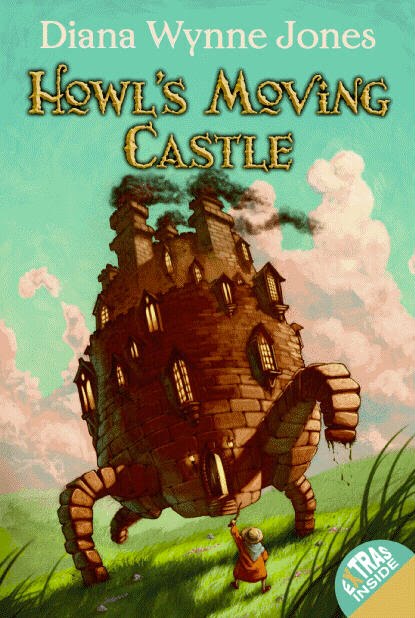
Howl's Moving Castle (2004), from respected Japanese animator Hayao Miyazaki.
Diana Wynne Jones is famous for her fresh, convoluted plots and for the invention of a character called Chrestomanci. She is also known for skewering sword-and-sorcery conventions, e.g., in books like
The Dark Lord of Derkholm, which postulates that all of the characters on a particular fantasy world are actors, performing their roles at the behest of a greedy corporate entity for the benefit of a group of tourists. Even better, perhaps, is the companion book, a wry encyclopedia of tropes called
The Tough Guide to Fantasyland, which purports to be a tour guide (cover shown is from first edition). Here's a sample entry, one of my favorites:
STEW (the OMTs [official management terms] are thick and savoury, which translate as "viscous" and "dark brown") is the staple FOOD in Fantasyland, so be warned. You may shortly be longing passionately for omelette, steak, or baked beans, but none of these will be forthcoming, indoors or out. Stew will be what you are served to eat every single time. Given the disturbed nature of life in this land, where in CAMP you are likely to be attacked without warning...and in an INN prone to be the centre of a TAVERN BRAWL, Stew seems to be an odd choice as staple food, since, on a rough calculation, it takes forty times as long to prepare as steak. But it is clear the inhabitants have not yet discovered fast food. The exact recipe for Stew is of course a Management secret, but it is thought to contain meat of some kind and perhaps even vegetables. Do not expect a salad on the side.
Yet much as I love
The Tough Guide, it is ultimately a book for grown-ups, and although Diana Wynne Jones's books are often funny, satire is too small a window through which to consider her work. Let's turn instead to her many marvelous books for children, beginning with the Chrestomanci titles.

Diana Wynne Jones envisions a series of parallel worlds related by differing causalities, or alternative outcomes of key events, and one of the worlds is our own. (Read about Hugh Everett and string theory for quantum mechanics-based thoughts on the concept.) In these worlds, magic is a commodity that is often misused by the criminal element. The most powerful enchanter in the related worlds, recognizable because he has nine lives, is appointed director and policeman over magic in all of the worlds. His title is Chrestomanci, and he can be summoned by repeating it three times in magical emergencies. (Click
here for an A-Z Glossary of the Related Worlds as compiled by Helen Scott on the official
DWJ website.)
The most important Chrestomanci books are
The Lives of Christopher Chant and
Charmed Life, which tell about the current Chrestomanci and his young successor, respectively. Christopher Chant is raised by a lovely, negligent society wife—or rather, by governesses. No one realizes for years that his powerful magic is constrained by the touch of silver. Meanwhile, he is walking the parallel worlds in what he thinks are dreams. As he is used by his avaricious uncle to smuggle

illegal magical supplies, Christopher begins to lose his nine lives at an alarming rate. The tangle eventually gets untangled, but in the meantime, Christopher aids and abets a young runaway who happens to be the goddess of Asheth, along with her menace of a temple cat. To give you an idea of the kind of humor in Jones's books, the goddess wants nothing more than to be a British school girl, like the ones she reads about in a series of dippy books Christopher has brought her because she is bored.
In
Charmed Life, Christopher is a grown-up now married to the Living Asheth, who has renamed herself Millie. He rambles about Chrestomanci Castle and indeed, the known worlds, in embroidered silk dressing gowns—of course, he does tend to be summoned unexpectedly to put out magical fires. The castle is partly a training ground for Chrestomanci's children and for his successor. When Cat (Eric) and Gwendolyn Chant are brought to live there, it takes the grown-ups a while to figure out that Gwendolyn is using her little brother's magic to fuel her own ambitions.

Another key book about Christopher Chant/Chrestomanci is
Conrad's Fate, in which you can see the enchanter and Millie as teens. The rest of the books set in this series of worlds give us a Chrestomanci who simply makes cameo appearances, usually in the role of a rather tongue-in-cheek deus ex machina. But never fear, the young characters in these books do work out their own magic-related dilemmas.
The Magicians of Caprona,
The Pinhoe Egg, and
Witch Week are also Chrestomanci books, and Jones has written four short stories involving her nine-lived enchanter, as well. Of these titles, I particularly like
Witch Week, a tale that plays out in a world where witchcraft is forbidden. The setting is a school called Larwood House, and the book begins,
The note said: SOMEONE IN THIS CLASS IS A WITCH. It was written in capital letters in ordinary blue ballpoint, and it had appeared between two of the geography books Mr. Crossley was marking. Anyone could have written it. Mr. Crossley rubbed his ginger mustache unhappily. He looked out over the bowed heads of Class 6B and wondered what to do about it.
The world of
Witch Week considers such a note to be more than a prank; it's an accusation. But Mr. Crossley hesitates to inform his boss, who will probably call in an Inquisitor, a man authorized to use torture to root out and destroy witchcraft. As the school is rocked by magical happenings, including flocks of birds flying through classrooms and the sudden disappearance of every shoe in the entire school, the students in Class 6B try to uncover the identity of the resident witch and save each other from the forthcoming attentions of the Inquisitor.
%5B1%5D.jpg)
Of course, Diana Wynne Jones has written many books besides her Chrestomanci titles. The most well known is probably
Howl's Moving Castle, a book I dearly loved even before Miyazaki made it into an animated film. In this world, fairy tale rules tend to apply, so as the eldest of three sisters, Sophie knows she is destined to fail if she sets out to seek her fortune. But even working quietly in a hat shop, Sophie manages to offend the Witch of the Waste, getting herself turned into an elderly woman for her troubles. Deciding she has nothing to lose, Sophie hobbles out into the world, where she encounters a floating, traveling castle belonging to the wizard Howl and moves in, looking for adventure as well as answers. Howl is vain and moody, but he has met his match in practical, cantankerous Sophie. Pretty soon the two of them overcome their differences to deal with the growing threat of the Witch of the Waste, not to mention the problem of the fire demon who powers Howl's castle. Jones has written a couple of sequels to
Howl's Moving Castle—
Castle in the Air and
House of Many Ways, the latter being her most recent book (2008).

Most of the author's stories are rambunctious and sometimes mysterious adventures, but one of her very best books is quieter and often poignant.
Dogsbody tells about a girl who is being raised by her aunt and uncle after she is orphaned. The story is told from the point of view of a puppy named Sirius, who gradually becomes aware of how badly Kathleen is treated in the household, especially by her aunt. Yet Sirius has his own enemies and his own past. He is no mere puppy, but the dog star himself in exile, falsely convicted of a crime he did not commit. As allies and enemies converge, both Sirius and Kathleen fight to claim their selves and their futures.
Dogsbody is astoundingly unique, well crafted, and in fact, just plain lovely.

Diana Wynne Jones has a knack for mixing ordinary life and magic that reminds me of Joan Aiken's work (e.g., the recently published collection of Armitage stories,
The Serial Garden). Other than Aiken, I don't think anyone besides Jones has ever achieved the blend quite so beautifully—or with plots that escalate quite so madly. For example, consider
Archer's Goon, another DWJ book I like very much. It begins:
The trouble started the day Howard came home from school to find the Goon sitting in the kitchen. It was Fifi who called him the Goon. Fifi was a student who lived in their house and got them tea when their parents were out. When Howard pushed Awful into the kitchen and slammed the door after them both, the first person he saw was Fifi, sitting on the edge of a chair, fidgeting nervously with her striped scarf and her striped leg warmers.
"Thank goodness you've come at last!" Fifi said. "We seem to have somebody's Goon. Look."
Howard looked the way Fifi's chin jerked and saw the Goon sitting in a chair by the dresser. He was filling most of the rest of the kitchen with long legs and huge boots. It was a knack the Goon had. The Goon's head was very small, and his feet were enormous. Howard's eyes traveled up a yard or so of tight faded jeans, jerked to a stop for a second at the knife with which the Goon was cleaning the dirty nails of his vast hands, and then traveled on over an old leather jacket to the little, round fair head in the distance. The little face looked half-daft.
Howard discovers that his father has been writing two thousand words of nonsense and sending them to Town Hall every month for some inexplicable reason. This month, the pages are missing. Howard gradually learns that there is more than one person trying to get their hands on the pages, and that each of these individuals is a kind of sorcerer who "farms" part of the city arrogantly and sometimes criminally. The mystery takes still more twists and turns before Howard learns the complete truth, and all along the way, the Goon looms just over his shoulder.

Aside from many wonderful standalone titles and several story collections, one other group of books is worth mentioning: the Dalemark Quartet. Here Jones delves into more serious and traditional fantasy. Dalemark is split between the freedom-loving earls of the North and the tyrannical earls of the South, so war often breaks out between the two sections of the land. I am especially fond of the first book,
Cart and Cwidder, which begins with the murder of a musician who has been driving around the countryside with his children, putting on performances. But there was more to Clennen than meets the eye, and his children discover they must carry out his last mission while evading the reach of the ruthless earls of the South. Like many of Jones' books, this is a good example of the way the author draws a realistic picture of the bickering and support between siblings even as her plot takes us on an adventure colored by magic.
I will mention that
Eight Days of Luke draws on Norse mythology, and that
The Ogre Downstairs unites a quarrelsome group of newly minted stepsiblings when the kids are given magical chemistry sets and start getting themselves into trouble—there's a whiff of Edward Eager in that one.
The Magicians of Caprona features two warring magical houses reminiscent of the Montagues and the Capulets.
The Homeward Bounders works with the idea of parallel worlds in a more ominous way than the Chrestomanci titles do, creating a solitary and iconic young hero by book's end. Note that both
Hexwood and
Fire and Hemlock are Young Adult books, with a more mature sensibility. (I also recommend DWJ's adult fantasy,
A Sudden Wild Magic, which has one of the funniest resolutions I've ever read in my life.)

Other notable books include
The Merlin Conspiracy,
A Tale of Time City,
Wild Robert,
Power of Three,
Aunt Maria (U.S. title),
The Time of the Ghost, and
The Game, along with short stories in the author's own collections and other anthologies. I especially like "Chair Person" from
Stopping for a Spell and "What the Cat Told Me" from
Unexpected Magic.
Diana Wynne Jones had a strange childhood, which might explain in part how she turned out to be such an interesting person. You can read a brief but fascinating
autobiography on her website, but I'll just quote from an
interview on BookBrowse here:
I started writing children's books when we moved to a village in Essex where there were almost no books. The main activities there were hand-weaving, hand-making pottery, and singing madrigals, for none of which I had either taste or talent. So, in intervals between trying to haunt the church and sitting on roofs hoping to learn to fly, I wrote enormous epic adventure stories which I read to my sisters instead of the real books we did not have. This writing was stopped, though, when it was decided I must be coached to go to University. A local philosopher was engaged to teach me Greek and philosophy in exchange for a dollhouse (my family never did things normally), and I eventually got a place at Oxford.
At this stage, despite attending lectures by J. R. R. Tolkien and C. S. Lewis, I did not expect to be writing fantasy. But that was what I started to write when I was married and had children of my own.
As a children's fantasy writer, I am sometimes asked who my influences are. Since I suspect interviewers don't want to hear a list of a hundred-plus books, I reluctantly narrow it down. And yes, Diana Wynne Jones is on my shortlist, more than anything because her work reminds me to use my own imagination boldly.

You may rejoice to hear that the latest DWJ drought is almost over: the author has a book called
Enchanted Glass coming out in April 2010. Her website says of the book, "A stand-alone book, not part of any series, there are the expected magicians, but it also includes giant vegetables, revenge by cauliflower cheese (?!) and fortune-telling using racing tips." So yes, rest assured—Diana Wynne Jones is as unusual and funny a thinker and writer as ever.
I will end with one more quote from the author, also from the BookBrowse interview. The interviewer asked Ms. Jones if she prefers writing for children or adults, and what the differences are. The author replied, "Writing for adults, you have to keep reminding them of what is going on. The poor things have given up using their brains when they read. Children you only have to tell things to once."
To learn more about Diana Wynne Jones, visit her
website, or click
here to read an excellent Publishers Weekly interview from June 2006. See either her website or this nice
Wikipedia article for a list of the author's books and short stories.
Note: I was inspired to write this post because I am hosting a book club discussion of The Lives of Christopher Chant
on the Enchanted Inkpot fantasy blog tomorrow. You are welcome to join us.

 asn't really occurred to him just how strange his own life is: the kids at school, bus drivers, even his own parents tend to forget about him. But the experience intensifies when his mother drops him off. Afterwards, he tries to call her or his father, but he can never get through. He writes a letter, but the words disappear from the paper before he can get to the mailbox as his uncle's two big cats watch him far too knowingly.



%5B1%5D.jpg)