Sunday, November 25, 2012

Post Teaser and Nice News...

Okay, I'm back from Seattle, full of turkey, and playing catch-up. I have started doing a sort of complicated post that's going to be book picks for your Christmas shopping... I hope to have it up mid-week, but we'll see how it goes!

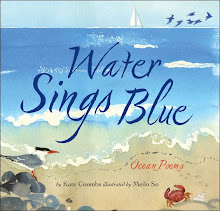
In the meantime, I have some good news about my poetry collection, Water Sings Blue: it has made Kirkus's list of the Best Children's Books of 2012. There are 100 books total in fiction, nonfiction, picture book, MG, YA, graphic novel, early reader, and poetry, so of course I'm in very good company.

Here's the Kirkus list as a starting point for your holiday book shopping.

Or there's the New York Times list of the best illustrated books of the year.

Not to mention the Boston Globe-Horn Book Awards for Excellence in Children's Literature.

You might also want to check out the Cybils nominations if you haven't already. I'm especially big on the poetry list, and not just because Water Sings Blue shows up there, too. It's simply that I feel people often don't know where to find good poetry for children. You certainly can't count on B&N to carry a full selection of the latest poetry collections! So this list makes a good place to browse.

Now, if you're looking for classics to buy for your children, grandchildren, and students, try USA Today's 100 Greatest Books for Kids list. Better still, here's Betsy Bird's Top 100 Chapter Books from her poll earlier this year at Fuse #8, along with her Top 100 Picture Books.

More soon, I promise!

Note: The "Blue Whale" spread below is an example of Meilo So's truly gorgeous artwork for Water Sings Blue.

Update 12-17-12: Wow! Water Sings Blue made a Wall Street Journal best 10 books of the year list!


Wednesday, November 14, 2012

Off to Seattle!

I'm flying out tomorrow to attend a huge national convention for social studies education in Seattle, NCSS (National Council for the Social Studies). Tons of workshops to choose from! And some good seafood, I hope.

So. I will not be posting here at Book Aunt this weekend. But come by next weekend for some new action-suspense YA fiction with a touch of magic, or at least superpowers.

Sunday, November 11, 2012

November Quick Picks: Middle Grade Magic


Here where I live it snowed and snowed the last few days, making me want to quote Winnie the Pooh. And to give you a handful of very cool middle grade fantasy books to read inside while it’s snowing. Or even if it’s not wherever you are—good books are perfect for a snowstorm or for a blue-skied summer day!


The Cup and the Crown by Diane Stanley

I liked The Silver Bowl, so I was pleased to get my hands on the sequel. Intrepid maid-turned-noblewoman Molly, who helped Prince Alaric in the last book, is going to help the boy who is now King Alaric by tracking down a magical loving cup that he wants to give as a bridal gift to the far-away princess he is to wed. Molly has some magic, and she has seen the cup in her dreams. Now she and a few companions, including her best friend Tobias, set out to find the cup. She finds more, though—a hidden city where her lost relatives live, second and third cousins. This should be a good thing, but it turns out the city of Harrowsgode does not let anyone go who comes there. What’s more, when the city fathers find out about Molly’s magic, they decide to add her to their pack of magic-makers whether she likes it or not. Now she has to escape, save her friends, and solve the mystery of the cup all at the same time.

This is a well-paced, satisfying story, and you really don’t need to have read the first book to enjoy it. A couple of plot points test credulity, but the whole flows so nicely that I really don’t think you’ll mind. Molly is a heroine to cheer for, and the discoveries she makes in this book build both her character and the story Stanley clearly plans to keep telling. Besides, any book with a hidden city, a clever rat catcher, kites, and magic should capture your fancy!

First line: The great hall was much as she remembered it: the tapestries, the massive iron candle stands, the enormous fireplace, the great gilt screen behind the dais.

Visit the author's website and find out more about the next book, The Princess of Cortova.


In a Glass Grimmly by Adam Gidwitz

Last year Gidwitz’s book A Tale Dark & Grimm made quite a splash—and the splash was the sound of an ax falling into a pool of blood. His second book is just as good, as long as you like your fairy tales with that traditional ingredient, horror. This book has more humor than the first one, mostly because of a frog who acts as part comic relief and part conscience (or at least the voice of common sense), a la Jiminy Cricket. We meet a boy named Jack who tries too hard to please the village boys, and then his cousin, a princess named Jill who tries too hard to please her cold-hearted mother. Also the aforementioned frog. Then a scary old woman promises the two kids their hearts’ desires in return for fetching her a magic mirror. This is all after an episode straight out of “The Emperor’s New Clothes.” And so it goes, with giants, mermaids, goblins, an enormous salamander, and the terrible Others all making an appearance.

I don’t know if I just got used to it with the first book, but the intrusive narrator didn’t bother me this time around. I did find In a Glass Grimmly a little more contrived, a little more messagey: the wizard behind the curtain is showing a bit here. However, this one is a more cheerful read, and I liked following Jack and Jill around the grisly realm of fairy tales. (Never fear—they do fall down a hill at one point.) Anyway, even with all of the blood and guts Gidwitz throws in, young readers will know the whole time that these two kids are going to make it.

First line: Once upon a time, fairy tales were horrible.

Watch the funny, visually stunning book trailer.


The Great Unexpected by Sharon Creech

I’m trying to think how to explain this book, and I have to say it’s sort of a mix of Tuck Everlasting (the setting and tone), The Secret Garden crossed with A Little Princess (um, a different setting and tone that gets together with the first setting and tone and hangs out), and a dash of Jacob Have I Loved. Plus déjà vu. Naomi and her best friend Lizzie Scatterding live in a small American town with colorful characters like Crazy Cora, Witch Wiggins, and Mister Farley. Two strangers come to town, an elusive and appealing boy named Finn and an odd foreign man named Mr. Dingle. Meanwhile, an old woman named Mrs. Kavanagh and Miss Pilpenny across the ocean in Ireland are scheming to—well, it’s not clear what they’re scheming to do, exactly. But they’re the ones who sent Mr. Dingle to Blackbird Tree. As for Finn, he seems to have shown up by magic, and he may represent the quarrel that caused all the trouble for the two women in Ireland. Or he may be lost. Or magical. Or something. But Naomi gets jealous over Finn… and there are all these little statues of crows that seem to mean something. Not to mention a horrible fear of dogs.

This book is a strange jumble, but a likable one. Some parts of the plots are a little unclear, but I still liked The Great Unexpected. In fact, the way all these mysteries fit together is worth following. At the end, a few things are left floating in an Irish mist. But enough of it makes sense to leave readers happy. The book is perhaps more magical realism than flat-out fantasy—a whimsical, atmospheric story. As always, Sharon Creech knows how to tell a tale. And her language is just wonderful.

First line: If you have never had a body fall out of a tree and knock you over, let me tell you what a surprising thing that is.

Sharon Creech introduces the book in this video, reading from the beginning.


Goblin Secrets by William Alexander

This book is a National Book Award Finalist, and it’s got people talking. I’m always a bit dubious about that sort of thing. However, Goblin Secrets lives up to the hype—it’s beautifully told and has some wonderful world building, not to mention a nicely melodic theme of masks. Goblin Secrets is that rare creature, a steampunk novel for middle grade. Alexander’s genius is that he simply wraps the steampunk elements into the story, melding them so fluidly (or so clockworkedly) into the world he creates, which also has fantasy elements, that the whole thing feels complete and of a piece. So: Rownie is one of the children who lives with and serves a version of Baba Yaga—if the witch and her house had clockwork legs and chicken feet, respectively. In a city where the king won’t let anyone wear a mask and act in plays except maybe a troupe of goblins, Rownie’s older brother Rowan has gone missing. And he’s an actor. Rownie runs away from the witch Graba and joins the goblins, searching for his brother. Everything just gets more complicated from there, with plenty of magic, plotting, and a river threatening to flood.

I liked Rownie, and I liked this book. Alexander’s characters with their masks and secrets roam the fresh fantasy world he’s created like actors on a stage: the author has even titled the sections of his story Act I, Act II, etc. That stage is definitely one of Alexander’s strengths. The use of the clock tower and a train station are especially good. I highly and happily recommend Goblin Secrets.

First line: Rownie woke when Graba knocked on the ceiling from the other side.

Here's the author reading from the book. He seems really sweet!

Note: The book cover shown above is the older one. I like it better than the new one.

Update, 11-20-12: Don't take my word for itAlexander just won the National Book Award for Young People's Literature for this book. And it's his first novel!


The Peculiar by Stefan Bachmann

More steampunk and deadly machinations, this time from a young writer named Stefan Bachmann. Like Alexander, Bachmann has a knack for world building. Mind you, I wanted to hold books like Eragon, also by a teen, against Bachmann, but to no avail. He's a very good storyteller. His alternate England includes hair-raising slums full of homely half-breed fairies, young changelings called Peculiars. Adults try to hide their Peculiar children from sight, and well they should: lately someone has been killing such children and throwing their bodies in the river with the insides missing. Yes, this is a dark world in many ways. It has a Privy Council that is being enthralled by an arrogant Sidhe lord incongruously named Lickerish. A young council member named Arthur Jelliby accidentally finds out about Mr. Lickerish’s diabolical plans and feels compelled to do something about them, albeit fussily. So does a young Peculiar named Bartholomew. Eventually the boy and the man team up. By then things are pretty dire since Bartholomew and his sister are at risk for being the next two bodies in the river. Certain problems are dealt with, but others remain, with a sequel obviously intended.

When I realized that this story included creepy Sidhe lords, I was afraid it would be predictable, but the author holds his own pretty well considering all those tropes about supercilious high elves. Bachmann blends the steampunk elements nicely into his tale, too, making The Peculiar another readable book for middle graders. Your child may find it a little too scary, but then, as Adam Gidwitz has pointed out, a lot of kids do like a horror element in their fantasy.

First line: Feathers fell from the sky.

Check out the book trailer. The author, who is now 18, composed the score for it because yeah, he's an underachiever. I actually like the intro trailer more because even though it doesn't have moving parts, the music includes the ticking of a clock, which makes it far more fitting as well as more intriguing to listen to.

Sunday, November 4, 2012

Poems for an Autumn Day

Mind you, the poems aren’t fall-themed—but each of these books is worth curling up with on a gray day or even one of those blue-sky days blazing with leaves. Don’t forget the apple cider!


Outside Your Window: A First Book of Nature by Nicola Davies, illustrated by Mark Hearld (February 2012)

This book is a case of that old expression: the whole is greater than the sum of its parts. Though Outside Your Window is a collection of poems, it is also an introduction to nature. Many of the lines sound like a very pleasant science teacher explaining things such as birds, cows, and seasons. I was often reminded of prose poetry or simply well-stated prose. But then, some of the poems—and certainly some lines, are startlingly poetic. They are rendered all the more so by the poetry of Hearld’s illustrations, which wrap around Davies’ work like a quilt sewn by Mother Nature.
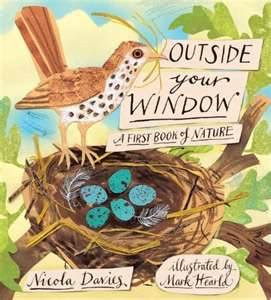


Be sure to take off the dust jacket. The look and design of the bare cover are wonderful in their own right. Hearld’s artwork manages to combine a look of 1950s children’s book illustration (e.g., Feodor Rojankovsky’s Caldecott winner, Frog Went A-Courtin’) with nonfiction nature illustration. The textured grandeur of his mixed-media style is made all the more intriguing by its often-small subjects. For example, a poem called “Night” is illustrated by a full spread that begins with yellow stalks of barley on the left, outlined by blues in a printerly way. A brown-and-blue mouse eating fallen grains of barley at the bottom of the page leads us across the gutter into a dark blue night holding the white-lettered poem. A moon, a star, and an owl overlook the right-hand page. What this description leaves out is that the whole thing sweeps and swirls as if brushed by a night wind. Hearld’s artwork makes the book into something positively spellbinding—and yet the poems are ultimately science-minded. The book is a strange and wonderful piece of art, poems and all.

I have questioned the poetic qualities of Davies’ work. We get, for example, lines such as these:

The frogs are croaking in the pond
and laying eggs like spotted jelly.
Next week the spots will be wiggly tadpoles.
Next month they’ll grow a pair of legs.
By summer they’ll be tiny frogs that leap off into the world.
And one night in another spring, when they’re big frogs, they’ll be back!

This particular poem’s best lines frame the ones I just gave you with frog calls: “Rrrruurrrp. Rrrrrruuurp. Rrrrrruuup.”

However, I should note that such descriptions take on a greater meaning because of Davies’s sharp eye for the details of nature. I had no idea that “Lambs’ tails wiggle when they’re happy…You’ll see it happen when a lamb is feeding….” Or that after dandelions bloom, “they fold up like furled umbrellas pointing at the sky./Then each rolled umbrella opens/into a puff of down.” The description of a gull’s flight is particularly fine. First the gull “runs into the wind, wings working hard for takeoff.” Then it “scoops the air with big, long strokes….” After soaring, the gull glides: “Now it bends [its wings] to make a W/and slides down the wind toward the sea.” Each of the four small stanzas is introduced with a flight sound or verb in a larger font.

Davies often uses repetition, cumulative refrains, and other devices to give her poems a more song-like quality. Her poem “Cherry Blossoms” ends each stanza with “blossoms”—the word is used once in the first stanza, twice in the second, and three times at the last. It’s a simple but true way to describe the drifts of pink that increasingly cover the ground.

I would have liked to see more metaphors, but when they appear they’re very good. “Plant [seeds] in some soil,/crumbly and moist as cake mix,” for instance. At the end of a poem called “Honey” that describes the work and sound of bees bringing nectar, we are told that their buzz and hum is “The sound of sweetness and the smell of flowers,/of sunny, sleepy summer—/the sound of honey.” That last line is just perfect.

Davies has another stupendous stanza at the end of “Tide,” but I’ll share the one at the end of “Night,” whose illustration I talked about above. Davies describes a night with its breeze, an owl, a star, a “moon [sailing] white and silver/in the dark sky.” Having led us into the night, she closes with:

Sometimes you can feel,
sometimes you can feel,
sometimes you can feel the world is turning.

So yes, at first I felt that many of the poems were a bit bland. But then I began to see this book in a different light. It really does give us eyes for looking at the world of nature that lies outside the window. And while its voice is often simple, it flashes powerful language every so often like streaks of lightning. Here’s another one, where Davies extends a cliché and makes it new. Speaking of a horse, she says:

…its dark eye is quiet,
and its nose is velvet,
softer than your own cheek.

I should mention that Davies gives us moments of humor, as in her poem “Five Reasons to Keep Chickens.” She also gives advice, mostly of the kind that will help children better care for the world. Sometimes it’s just nice; for instance, she tells us we should say thank you to worms. The book ends with instructions about how to save seeds and how to make winter cakes for birds.

Outside Your Window grew on me like a seed sprouting up into a plant. It’s a hodgepodge, yes, but in the best possible way—like compost (and there is a poem about compost). Even when Davies is just chatting about nature in that kindly teacher’s voice, there is something soothing and enlightening about her words. Other times she really sings, and Hearld sings with her. I recommend this book wholeheartedly.


National Geographic Book of Animal Poetry: 200 Poems with Photographs that Squeak, Soar, and Roar! edited by J. Patrick Lewis (September 2012)

Like Davies’ book, this one is chockfull of poems—a poetical bang for one’s buck, which I like very much. There have been a lot of books of animal poems over the years (e.g., Eric Carle’s collection, Animals Animals), but some genius finally came up with the idea of pairing photos from National Geographic’s vast collection with an anthology of poems, in this case one created by our current US Children’s Poet Laureate. Huzzah!

While many of the poems are from the past, by poets such as Emily Dickinson, Robert Frost, and Ogden Nash, more recent and current poets are also well represented. The poems are grouped in nicely parallel sections. After a brief set of introductory poems called “Welcome to the World,” sections proceed as follows: “The Big Ones,” “The Little Ones,” “The Winged Ones,” “The Water Ones,” “The Strange Ones,” “The Noisy Ones,” and “The Quiet Ones.” A section of four poems called “Final Thought” concludes the book. The fact that there are sections about noisy and quiet animals endeared the book to me even while I was still in the table of contents.

But really, how do we judge a collection like this? Probably by looking at the overall qualities of the poems and the ways in which they represent their subjects. Variety of styles, voices, and ideas is important. Another consideration is the fit between illustrations and text. These big picture criteria are difficult to wrangle on a poem-by-poem basis, which leads me to take the old-fashioned approach: going with my gut. So yes, this is a terrific collection! But I will provide you with some examples to back that up. As is required so often in life, let’s begin with the elephant.

The book offers four poems about elephants on a left-hand page with a really great photo of an elephant on the right—the photo, labeled “Asian elephant” in very tiny letters at the lower left, shows an elephant in a pond with green hills behind, tossing water onto his head with his trunk. The most well-known and oft-anthologized poem on the spread is “Eletelephony” by Laura E. Richards (“Once there was an elephant/Who tried to use the telephant—/No! No! I mean an elephone/Who tried to use the telephone…”). The other three poems are brief: an anonymous quatrain that has probably been around awhile comments on the “great big trunk” that “has no lock and has no key,” but is carried everywhere by the animal, along with two more modern poems, another quatrain and a haiku. These are the latter two:

Elephant

A threatening cloud, plumped fat and gray,
Snorts a thunder, rains a spray
And billows puffs of dust away—
A weather maker every day.

—Ann Whitford Paul


Anthology

So many stories
Locked inside the amber eye
Of one elephant

—Tracie Vaughn Zimmer


Of course, not every animal gets more than one poem. The variety of poems—and animals—is just right, however. I’ll list two subjects from each section to give you an idea: cow and orangutan, ladybug and lizard, bat and hummingbird, starfish and walrus, armadillo and blue-footed booby, pig and raccoon, Luna moth and sloth. As you can tell by the elephant examples, some of the poems are silly and others are serious. Here are excerpts from two other poems, one of each type:

from “Moray Eel”

Nighttime’s my bright time.
It’s head-out-and-bite time.
Give-shellfish-a-fright time.
Swim-quick-as-a-kite time.
Stay-out-of-my-sight time.
Or fins-up-and-fight time.
When I am the blight of the sea.

—Steven Withrow


from “Dog”

The sky is the belly of a large dog,
sleeping.
All day the small gray flag of his ear
is lowered and raised.
The dream he dreams has no beginning.

Here on earth we dream
a deep-eyed dog sleeps under our stairs
and will rise to meet us.
Dogs curl in dark places,
nests of rich leaves.

— Naomi Shihab Nye

The photo that accompanies the moray eel poem is a head-on shot of an orange-faced eel with teeth glaring and yellow eyes bulging off to the sides. The dog photo is a bright green field of grass with a small dog’s head sticking up out of it, mouth open in a grin and ears jutting like a bat’s.

The best poem in the book is arguably Lewis's own, a poem so comprehensive and gorgeous that it rightfully introduces the collection. Only you might miss it if you're not careful: it's printed on the front cover beneath the dust jacket. The poem is titled "Instructions Found After the Flood," and I'll give you just the first seven lines (of 19).

Let the red fox quicken the seasons.
Let the zebra buck and clatter in the cage of his skin.
Leave the glass lagoons to the blue heron, whose eye is steady.
Let jungles whisper jaguar, whose paw is velvet.
Let the worm explore the globe, his apple.
Let the spider embroider the air.
Let tongue and belly be called reptile.

You see what I mean? This poem, like the collection, is deeply satisfying. Not every anthology is as rich as National Geographic Book of Animal Poetry, but every public and school library and, I hope, personal library needs this book.

Sunday, October 28, 2012

Not Your Grandma's Picture Books


It's true. Picture books don’t have to be about pink princesses who live sugarishly ever after…


The Conductor by Laëtitia Devernay

I found out about this French illustrator’s book when it won the Society of Illustrator’s Original Show: Children’s Book Illustration gold medal this year. Then I learned that Devernay won a major British award for the book as well, top prize from this year’s V&A Awards. (I looked high and low to figure out what V&A stands for. It’s Victoria and Albert—the museum. Of course.)

Here's a plot summary: A conductor conducts the leaves on trees, which turn into birds and fly around a bit before coming back to the trees to be leaves again. This summary does not do the wordless book justice, however. Each spread has its own design and beauty, evoking Escher a little and, for children’s literature fans, the scene in which Milo conducts a sunrise in The Phantom Tollbooth—or rather, when he sees sunset conducted the night before.

Devernay illustrates the entire book using a couple of greens, a very pale yellow and black. There’s a whole lot of white space going on, as well. The trim size is unusual: it’s about 5 and ¾ by 13. (I measured.)


The Conductor has something to say about music, about trees, and about birds, but in a way it’s about none of these things. It’s only about them as they interact, creating something new. Perhaps I don’t care much about green lollipop trees with an almost paisley pattern or a little conductor in a black coat and striped pants. Maybe birds don’t move me, either. But when the conductor lifts his baton and the leaves begin to transform, rising into the sky—then I care very much. That is the magic of Devernay’s book.

I’m not going to tell you about the spread where the conductor takes his bow, or what he does with his baton. You really should find out for yourself.

I will say that the book may be too subtle for many young readers. This book certainly might appeal to an artsy, thoughtful child, though. And artsy, thoughtful grown-ups, too.

Note: As for the other winners of the Society of Illustrators' Original Show in the children's book category, we’ve got silver medals for The Beetle Book by Steve Jenkins and This Is Not My Hat by Jon Klassen, with a Founders Award to The Insomniacs, illustrated by the Brothers Hilts (author Karina Wolf).


Who Pushed Humpty Dumpty? by David Levinthal, illustrated by John Nickle

This book is so much like the movie Hoodwinked in certain respects that at first I looked all over to find some kind of credit. After all, that movie is about a land of fairy tale creatures in which a big bad wolf turns out to be an investigative reporter. He gets some help with crime solving from Little Red Riding Hood and a debonair frog P.I. in a fedora—Nicky Flippers.

For its part, Levinthal’s book is about a land of fairy tale creatures in which a debonair frog solves crimes. Oh wait—I stand corrected. Officer Binky is “a toad in a fedora,” according to the flap copy. So let’s move on.

Who Pushed Humpty Dumpty? gives us five fairy tale cases: a break-in at the home of the Bear family, the case of the death of a witch who lived in a gingerbread house, the title case, the case of a beauty pageant involving Snow White and the Queen, and the case of Jack and that beanstalk.

The book is more of a read-aloud for kids as young as 7. It’s really more geared towards the 8-to-10 crowd. Not only is the text small (usually an easy way to guess a picture book’s intended audience), but the whole thing’s a satire. Satire goes right over the heads of most younger readers.

However, that said, I really liked this book! Here’s how it begins:

There are eight million stories in the forest. This is one of them.
It was a typical Sunday morning for the Bear family. They had gone out for a walk while their porridge was cooling.
I was working the robbery detail out of the Pinecone Division. My name’s Binky. I’m a cop.

As always, John Nickle’s illustrations are just right. (Allow me one fairy tale pun!) I especially like the page on which Officer Binky is taking notes from the three Bears. He’s standing in front of a layered tower of bears—so all in one shape we have Binky (back to us) in front of Baby Bear, who’s in front of taller Mrs. Bear, who’s in front of taller Mr. Bear. All three bears are frowning and pointing one accusing clawed paw in the direction of the page on the other side of the spread. That page is divided in four. The first three frames contain the following clues: A strand of blond hair, an empty porridge bowl, blue cloth on a broken chair, and a rumpled quilt. The last frame shows Binky driving off. (He’s barely tall enough to see over the steering wheel.) He says, “I’d heard that story before. It could only be one dame: Goldilocks! I nabbed her trying to make her getaway.” The perp has an excuse, but she ends up in jail just the same.

I won’t tell you much about the other cases, but they are presented with panache, too. Hansel and Gretel’s encounter with the witch is told after the fact using sepia illustrations, a nice touch. The Humpty Dumpty mystery has an un-egg-spected solution. (Make that two fairy tale puns.) Setting the Snow White story in a beauty pageant gives the tale a whole new twist. And then there’s Jack. I’ll bet you think you know where that one’s going, but you’re probably wrong.

Meet Binky. And read his case files. You'll like them.


The Three Ninja Pigs by Corey Rosen Schwartz, illustrated by Dan Santat

I’ve been looking forward to this one. Just check out Dan Santat’s book trailer. The whole concept makes me laugh. There have been a lot of fairy tale parodies out over the last 10–15 years, but The Three Ninja Pigs gets off to a much funnier start than most. Just read the title!

Oh, all right, I suppose I’d better open the cover and look inside. Let’s pause at the front jacket flap:

Why do wolves think they can come to town and blow all the houses down? These three pigs just aren’t going to take it!
The first starts aikido lessons—he’ll make mincemeat out of that wolf!
His brother learns a little jujitsu—he’ll chop that guy to pieces!
But when the wolf actually appears, it turns out these two pigs aren’t quite ready after all. Good thing their sister has been training every day to master some serious karate moves. KIYA!

Yep, that’s my new favorite thing about this book: the third pig is a girl. Plus she’s a better ninja warrior than her brothers. (That would be because they don’t practice.)

Forgot to mention: the story is written in rhyme. I'm generally not fond of this choice for a narrative picture book, but I've decided to get over it for the moment in order to enjoy these ninja piggies.

Dan Santat’s illustrations are just as funny as the premise. For one thing, he delivers on the martial arts action. Well, perhaps not for the two pig brothers. I like the way Santat shows aikido practice—including the first little pig snoozing on the floor while an irritated instructor looks down at him. The teacher in Pig Two’s jujitsu class is a classic mentor. I think he's a water buffalo, but he reminds me of Obi Wan Kenobi. “Excellent progress,” he says, “But Pig-san, you MUST study more.” To which Pig Two replies, “No way! Sayonara, Sensei.”

In contrast, Pig Three studies karate diligently. After she gets better and better, she even breaks boards “by performing a perfect pork chop!”

Pigs One and Two don’t do so well with the wolf. Not even when Two yells, “Retreat! Or you’ll suffer defeat by the hair of my chinny-chin-chin.” But Pig Three isn’t joking when she says, “I’m a certified weapon.”

I think you’ll like the wolf, who wears red karate clothes, does that “bring it” move like in Karate Kid, and says to Pig Three, “Yo, Bacon,” at least until he sees her moves. Then he rethinks the idea of taking her on.

Of course, I agree with critics of spoofs like this one that kids should read the original first. Once they’ve done that, it's time for the porcine ninjas!

Note: A glossary at the back explains terms like sensei and provides pronunciations.