Showing posts with label Randall Jarrell. Show all posts

Saturday, March 10, 2012

When Maurice Sendak and Randall Jarrell Teamed Up

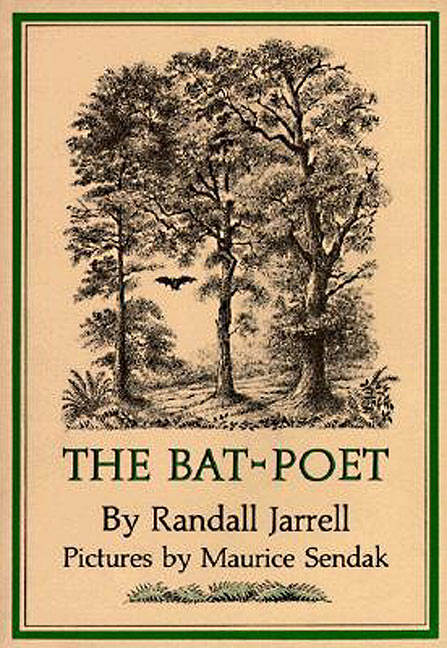
The other day I was in a great little used bookstore in Salt Lake City and found a book I'd never seen before by poet Randall Jarrell, with illustrations by Maurice Sendak, Fly by Night. I brought it home to form a trio with two other books created by Jarrell and Sendak: The Animal Family and The Bat-Poet. Here's a look at all three:

Fly by Night (1976)

This is a fairly random piece of writing, which I suppose makes sense, considering it's about the world of dreams. Jarrell tells of a boy who can fly—or float, actually—at night. He appears to be somewhere between 8 and 10. In the first few paragraphs David seems pretty ordinary, living in a pretty neighborhood where he climbs trees with the cat. But then we learn "At night David can fly." Though apparently he has trouble remembering these dreams and how to fly when morning comes. Anyway, we follow David one night as he floats into his parents' bedroom, where he can see what they are dreaming:
He comes to his mother's and father's bedroom, and floats in over them. His father is a big mound under the blanket, with his head sticking out at the top. His mother is a medium-sized mound, but where her head should be there's nothing but pillow—she's put the pillow over her head to help herself go to sleep.

His mother and father are dreaming: he can see their dreams. Just over his father's head it's round and yellow and warm, like firelight, and his father, looking very small, is running back and forth with David on his back, only David is as big as ever. His father is panting. His mother is dreaming she is making pancakes: she pours them out, and turns them over, and piles them in a pile on a plate. Her dream is round and yellow too, but it has got mixed up with the pillow, so that the feathers the pillow is stuffed with float through her dream like snowflakes.

After David floats out of the house, the cat on the porch advises him:
Wake by night and fly by night,
The wood is black, the wood is white,
The mice are dancing in the moonlight.

The mice and rabbits talk to him, too, and then David floats out into the woods, where he meets a female owl that takes him under her wing and back to her nest to join her nestlings till morning. This is where I came to my favorite metaphor in the book, when we're told that the owl has caught a fish which "shines in the moonlight like a spoon."

At the owl's nest, David meets the baby owls, which surprise him by being white and by having "a sad, absurd look." Then we get a long narrative poem from the mother owl titled "The Owl's Bedtime Story." (About this point you'll probably decide that the mother owl is a stand-in for David's own mother.) The owl escorts floating David home, and when he wakes up in the morning, as promised, he can't quite remember his dream.

This is a solemn tale, one that probably has more appeal for dreamy adults than for kids. It also makes an interesting counterpoint to the book Sendak published six years earlier, In the Night Kitchen (1970). Compare the two illustrations shown above right, for example. I should point out that Jarrell's piece was first published in 1969, so it's entirely possible that the text of Fly by Night was one of the inspirations for Sendak's own book, In the Night Kitchen, though that book is much more jovial in tone and takes off in a different direction. Still, both books feature naked floating boys who are dreaming. Which is to say, the child in Fly by Night looks a little like Mickey five years later, still up to nighttime adventuring.

I will say, aside from the fact that a lot of people dream about being naked in an embarrassing way, there's something inherently naked about dreaming, about the way one's psyche is bared in dreams.

The nicest piece of art in the book is a full spread of David floating away home, with the owl's face filling a large piece of space on the upper right and views of a mother with a baby below left and a lamb with its mother below right, plus other interesting things like a fox, a shepherdess, two ducks on a pond, a bridge, a couple of rabbits, and some marvelous trees (all in a scene vaguely reminiscent of the old masters).

Fly by Night is an odd book, but if you're a collector of Maurice Sendak's work, let alone Randall Jarrell's, it's worth tracking down a copy. There's something sweetly surreal about this one.


The Animal Family (1965)

Another slightly surreal tale from Jarrell, The Animal Family, is about a hunter who lives alone on the coast of a nameless country. He has no neighbors, and he is lonely now that his parents have died. But one night he hears someone singing, and he goes down to the shore to find out who or what it is. Little by little he befriends a mermaid, teaching her his language. He tries to learn hers, but he's pretty bad at it. There's gentle humor here:
The hunter said her words awkwardly and ruefully, like something learned too late, but she said his like an old magician learning a new trick, a trick almost too easy for her to need to learn. The hunter said to her, bewildered: "You never make mistakes."

"What is mistakes?"

"The wrong word—the wrong sound, one you don't mean to make. The way I do. Mistakes are what I make when I try to talk the way you talk."

The mermaid repeated in a satisfied voice: "Mistakes." She had one more word.

The mermaid ends up moving into the hunter's cottage. She is intrigued by his world, amused by things like the way he uses fishing gear to catch fish instead of just swimming and grabbing them like everyone else in the ocean does. I should not
e that she respects dolphins but thinks seals are numbskulls. (Like I said, funny!)

In time the hunter feels a longing for a child. This is expressed in a dream he does not understand, but the mermaid figures it out. "It means you want a boy to live with us. Then you'll be your father's shadow, and I'll be your mother's, and the boy will be yourself the way you used to be—it will all be the way it used to be." So the hopeful hunter goes out and brings home a bear cub. The new addition to the family turns out to be messy, yet loved. A few years later the hunter finds a lynx cub and brings home a second baby. But it is the lynx that finds the last child to join this strange little family...

Jarrell's story is full of funny details about how the mermaid perceives the hunter's world and about what it's like to raise the bear and lynx babies, not to mention the youngest child. The gentleness, even tenderness of the story is balanced out by the author's rather matter-of-f
act tone. Again, I'm having trouble picturing the child who will appreciate The Animal Family—maybe a creative kid, a bit of a deep thinker. The book might make a nice bedtime read-aloud. I do know a lot of grown-ups who would probably like it and would consider the book something of a fable. It is certainly a nice riff on families. (E.g., the way even the most seemingly homogenous families are made up of disparate, surprising personalities.)

I should note that Sendak deliberately avoids showing the characters in his illustrations. Instead he mostly gives us scenery in his pen-and-ink drawings (see example, right). About the only details that allude to the characters are a boat and a bow and arrow. I
think the illustrator was wise to go this route, since these characters, especially the mermaid, might have been spoiled by being captured in artwork. The timelessness of the tale is thus preserved.


The Bat-
Poet (1964)

I once loaned this third book to a friend who's a children's playwright, and when she returned it she said, "It's about what it's like to be a poet!" I would agree, but I will add that The Bat-Poet is more broadly about what it's like to be a writer or a creative person. Now, for the next few paragraphs, I'm going to steal from myself, since I wrote about The Bat-Poet in June 2010:

Character is king, and especially in this book. The little brown bat at the heart of poet Randall Jarrell's tale is just so eager and sweet and shy and curious, yet manages all this, like a real human child, without being overly sentimental. The small bat wants to know things, and then he wants to sing, and when that doesn't work, he begins to make up poems, trying to give shape to the yearning he has inside, a powerful need for self-expression. That description sounds like pop psychology, I'm afraid, but all of these ideas are couched in a nice little plot about a bat who's not like the others. He sets out to explore the day world, for example, and he gets a creative crush on the vain yet talented mockingbird. Little by little, he puts his observations into words.

Here's a piece of his first poem about the day, for example:
At dawn, the sun shines like a million moons
And all the shadows are as bright as moonlight.
The birds begin to sing with all their might.
The world awakens and forgets the night.

To which another bat responds, "The sun hurts... It hurts like getting something in your eyes." But the bat-poet eventually finds a better audience in the form of a semi-interested chipmunk.

Poetry fans will find two of Jarrell's most well-known poems embedded in this story, descriptions of an owl and of a baby bat. (The latter begins, "A bat is born/
Naked and blind and pale.") I'm noticing Jarrell really liked owls!

Sendak depicts the animal characters in this one, still using pen-and-ink. My only quibble is that Jarrell's owl in the poem is pretty terrifying, but Sendak's owl isn't. The chipmunk and the little bat are wonderful, however. And again, the illlustrator gives us a superb full spread near the end of the book. It shows a bat in flight above a forest with a lioness and her cub.

The Bat-Poet won't appeal to every child, only the more thoughtful, patient reader, probably in the 10-to-12 range. If you have a child who writes poetry, or if you write poetry yourself, this is a book for you to share, a peaceful yet gently humorous story about the joy of creating.

All three of these books are as much for adults as they are for children. At least, they are for a rather special kind of young reader. Randall Jarrell's poetic voice is clear and touched with perfect metaphors. It is also thought-provoking and poignant. I suggest you experience the quiet beauty of his children's books—and the power of Maurice Sendak's illustrations.

Saturday, June 5, 2010

When People (and Bats) Write Poems...

Once, years ago, I loaned a friend Randall Jarrell's book The Bat-Poet. When she returned it, she said, "It's about what it's like to be a poet." I was sort of surprised—I thought it was just a good story. But of course, she was right.

I remember reading somewhere that at least one parent in a lot of children's books is often a writer, or that the young main character is often an aspiring writer. This isn't surprising: Don't they say, "Write what you know"? Yet I wonder if there's room in the world of children's books for books about writing. I mean, isn't there something self-indulgent about that? Perhaps even more so when it comes to poetry, a form often dismissed as being too airy-fairy for real life, real people.

I'm biased, naturally, but I will point out that what these books have to say about writing is important. Not that kids should necessarily become professional writers later in life, but that writing is a tool for being human. Almost as good as fire and refrigeration, in fact. Here, then, are two classics about writing poetry, plus two new books on the same theme.


The Bat-Poet, written by Randall Jarrell and illustrated by Maurice Sendak (1964)

Character is king, and especially in this book. The little brown bat at the heart of poet Randall Jarrell's tale is just so eager and sweet and shy and curious, yet manages all this, like a real human child, without being overly sentimental. The small bat wants to know things, and then he wants to sing, and when that doesn't work, he begins to make up poems, trying to give shape to the yearning he has inside, a powerful need for self-expression. That description sounds like pop psychology, I'm afraid, but all of these ideas are couched in a nice little plot about a bat who's not like the others. He sets out to explore the day world, for example, and he gets a creative crush on the vain yet talented mockingbird. Little by little, he puts his observations into words.

Here's a piece of his first poem about the day, for example:
At dawn, the sun shines like a million moons
And all the shadows are as bright as moonlight.
The birds begin to sing with all their might.
The world awakens and forgets the night.
To which another bat responds, "The sun hurts... It hurts like getting something in your eyes." But the bat eventually finds a better audience in the form of a semi-interested chipmunk.

Poetry fans will find two of Jarrell's most well-known poems embedded in this story, descriptions of an owl and of a baby bat. (The latter begins, "A bat is born/Naked and blind and pale.")

The Bat-Poet won't appeal to every child, only the more thoughtful, patient reader, probably in the 10-to-12 range. But if you have a child who writes poetry, or if you write poetry yourself, this is the book for you to share, a peaceful yet gently humorous book about the joy of creating.


Love That Dog by Sharon Creech (2001)

It seems everyone I know has already read this book, but I just got around to it recently. And yeah, I got all teary reading it! This novel in verse is narrated by a boy in Miss Stretchberry's English class—a boy with a clear, strong voice. Initially, he doesn't want to write poems. So his first offering is this:
September 13

I don't want to
because boys
don't write poetry.

Girls do.
But little by little he begins to write more, although at first he writes simply to complain about things like William Carlos Williams' famous red wheelbarrow poem. As the poems evolve, it becomes clear that something is troubling this kid. He has something to say, and maybe he will eventually be able to say it, to write a poem about his dog, or more than one poem.

Creech's young writer later falls in love with the work of Walter Dean Meyers and, with his teacher's encouragement, invites the author to visit his class. The author agrees, which worries our narrator some, since one of his poems is an imitation of a Meyers poem. Will Meyers be mad at him for doing that?

Love That Dog includes some of the poems the narrator's class studies at the back, among them "Dog" by one of my own favorite poets, Valerie Worth.

I can see why Sharon Creech won the Newbery (for Walk Two Moons). In the spare format of this 86-page book, she evokes more character and feeling than most people manage in hundreds of top-to-bottom pages. Beautiful book for anyone, but especially for boys who don't think writing and poetry is for them.


The Dreamer, written by Pam Muñoz Ryan and illustrated by Peter Sís (2010)

There's a reason Ryan's latest book is winning rave reviews. It's one of the most poignant (fictionalized) biographies you'll ever read, and, like The Bat-Poet, offers insight into the creative heart. Peter Sís's illustrations simply add to the air of magical realism in this tender story of a young Pablo Neruda, whose flights of fancy clash with his militant, macho father's worldview and, if you can call it that, parenting.

It's astonishing that the child of such a determined dream crusher could survive and flourish as a creative person, but young Neftalí Reyes manages it. (The poet later takes on "Pablo Neruda" as a pen name.) He is helped in bits and pieces by other family members, but mostly by his own quiet determination. Note that Neftalí's difficulties are exacerbated by a stutter. Ryan offers us sorrows, but also moments of power from the famous Chilean poet's boyhood. For example, when his father takes him and his sister and stepmother to the beach, he forces the children to swim out into the sea every morning even though they're not very good at it and are frightened. Yet the boy also manages to find books, a secret hideaway, and a wounded swan that he cares for without his father knowing. Throughout The Dreamer, we see Neftalí collecting small objects like leaves and shells and rocks, but also images and words, which he treasures.
Neftalí grabbed a book from the bedside table. Even though he did not know all of the words, he read the ones he knew. He loved the rhythm of certain words, and when he came to one of his favorites, he read it over and over again: locomotive, locomotive, locomotive. In his mind, it did not get stuck. He heard the word as if he had said it out loud—perfectly.

We follow Neftalí to the point where he apprentices to his uncle the printer, who gives the boy a taste of political activism. After the print shop is burned down by hardliners, Neftalí goes away to study at the university, dreaming of using his words to support the rights of the poor and the indigenous peoples in his homeland. At every step of his journey, his father tries to stop the boy from pursuing his vision—and yet Neftalí perseveres. There's an obvious message here, but it doesn't read as didactic thanks to the powerful current of the author's storytelling, which carries readers along in the river of Neftalí's life.

The Dreamer is another book for the thoughtful reader, or perhaps it would make a good 4th-7th grade classroom read-aloud in conjunction with examples of Neruda's poetry and some Latin American history.

The cover art and design are exceptionally lovely, by the way.

So far, I'm calling this one and Laura Amy Schlitz's The Night Fairy for next year's Newberys.


Word after Word after Word by Patricia MacLachlan (2010)

The Newbery award-winning author of Sarah, Plain and Tall writes slim books, but she packs a lot into them. They have the feel of poetry that way, which is apt in this case. Word after Word after Word is the story of a group of fourth graders who have a visitor named Ms. Mirabel come teach their class about writing every day for a month. Ms. Mirabel is colorful and unconventional, at first making the more traditional classroom teacher, Miss Cash, nervous. (The contrast between Ms. and Miss is deliberate!)

We see a handful of the students dealing with what's up in their lives, eventually translating their experiences into poetry. The kids team up in a nice way, sharing some of their feelings as they sit talking beneath the huge lilac bush at Henry's house. For example, Evie is miserable about her parents' divorce and is determined to find her father a new wife, while May is upset that, as she puts it, "My very, very, very dumb mother is going to adopt a very, very dumb baby."

Upon hearing about this, Ms. Mirabel says, "I remember loathing my baby brother." Narrator Lucy asks her if she loves her brother now, whereupon MacLachlan bucks the cliché by having the writing teacher reply, "No, Lucy. He's not a very nice person, as it turns out." These and other little surprises keep the story fresh, although the basic premise may seem fairly ordinary.

Russell doesn't like writing, but he does have a baby brother of his own that he brings around. Early on we read:

"Some words may make you happy, some may make you sad. Maybe some will make you angry. What I hope"—a sudden gust of wind made Ms. Mirabel's hair lift—"what I hope is that something will whisper in your ear."
"What does that mean?" asked Russell.
Miss Cash sighed loud enough for me to hear. Russell always asked questions that made Miss Cash sigh.
Ms. Mirabel didn't sigh. She smiled brightly.
"You will know," she said.
This book is partly about the power of words. It is also about the power of lives. Lucy's mother has cancer, and her parents' efforts to protect her are just upsetting her. Lucy tries to write about hope, but "Sadness was all I had."

Yet there is humor here, too, as Evie dubs a new neighbor "Sassy DeMello" and maneuvers to get her together with her father, with unexpected results. With just a few lines of dialogue, MacLachlan is capable of painting a character perfectly. She is especially good at presenting the way children talk and think.

Some might say this book is heavy-handed in its presentation of kids and their problems, and of the power of writing. I think MacLachlan is simply comfortably open in pointing out what we all know, that everybody struggles with something, that life really is uneven and surprising and sometimes upsetting—but that people together can handle just about anything. A friend of mine once remarked of an experience I shared with her, "That's just so lifey." Which is a good way to describe Patricia MacLachlan's Word after Word after Word.

Of course, the title makes me think of "step after step after step," and that's how life must be lived, like it or not.

I'm thinking of another title by this author, Journey, and I would say that MacLachlan, like Kate DiCamillo, writes books that quiver with symbolism and meaning. By "quiver" I am referring to the motion made by sound waves and light waves. These are books that feel like poems in their own right, that view life and the people in it as real and metaphoric at the same time. I won't say that Word after Word after Word is MacLachlan's best book, but it's a book you'll like spending time with. All of her books are like that.

For those of you who are writers or whose children or students are budding writers, this summer bouquet of books should provide resonance and inspiration. Nonwriters will also find themselves uplifted, whether as readers or as participants in classes or the larger culture. One reason we write is to be understood, and all four of these books express an understanding, not only of poets, but of what it means to live and struggle and grow as a human on this planet.

Update: The Boston Globe-Horn Book Awards have been announced, and Pam Muñoz Ryan's The Dreamer is an honor book for Fiction/Poetry. Read the complete list here.