Sunday, March 27, 2011

The Loss of Diana Wynne Jones

I woke to the news that Diana Wynne Jones passed away night before last. (Thanks, Charlotte's Library.) Due to some random difficulties I will not get into, I will not be posting reviews this weekend, but I really must acknowledge such a tremendous loss to the world of children's literature in general and fantasy in particular.

Did you know that Diana Wynne Jones was a major influence on Megan Whalen Turner as well as Neil Gaiman? (Um, and on me?) She actually hooked Megan up with her editor at Greenwillow.

And yes, there's a reason Diana received a Lifetime Achievement Award from the World Fantasy Association in 2007.

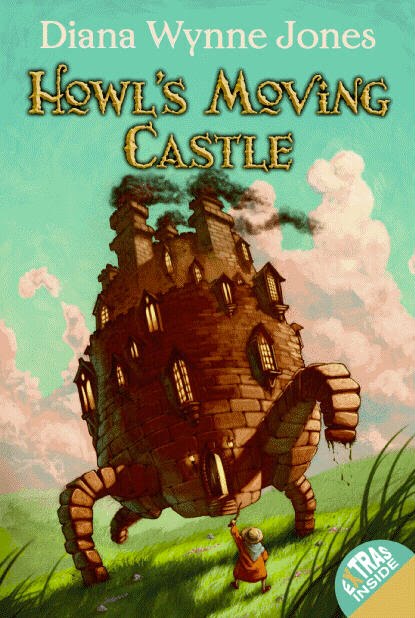
Diana's fantasy is known for its humor, its intricacy, and its creativity. Perhaps you're familiar with her book, Howl's Moving Castle, which was made into an animated feature film. And who else has ever used a conga line as a magic weapon, as in her adult fantasy novel, A Sudden Wild Magic?

Here is my detailed post about Diana Wynne Jones and her work, "The Queen of Children's Fantasy," from a year or so ago. See also my review of her book, Enchanted Glass, which was published last year.

Good-bye, Diana. You will be missed very much.

Note: Look for one last book, Earwig and the Witch (for younger readers), this fall.

Update: Two more links from Charlotte, an obituary in The Guardian and thoughts from Neil Gaiman. See also Amy's thoughts at Amy's Library of Rock.

Really good update: Judith of Misrule has compiled an extensive list of links to obituaries and musings on the great Diana Wynne Jones. Thank you, Judith!

4/13/11 update: We have a Diana Wynne Jones tribute post up at the Enchanted Inkpot. (Thanks, Grace Lin!) You can stop by and leave your own thoughts about Ms. Jones in the comments.

Friday, March 18, 2011

Secret Weapons: Choosing the Right Books

NOTES FROM THE TRENCHES

As a teacher and reading zealot, I swear by the mantra, "The right book for the right child." This directive is a fishing how-to, the intent being to hook a young reader. Or a non-reader, actually. I want that kid who doesn't reach for a book to start reaching.

When a child has specialized needs and interests, finding the right book can be a little tricky. The other day a fellow teacher asked me to suggest a book for her student who's a teenage father. I could picture a book cover, but I couldn't remember the title or the author. It wasn't till I got home that I was able to track the thing down on Amazon: Angela Johnson's The First Part Last.

Sometimes choosing the right book feels like an art form. Ask any librarian! But I think it's an art you can learn, or certainly get better at. Here are some examples of book picks for my recent and current students, who are mostly teens, but include younger kids, as well. (I'll change the names for privacy purposes.) You should know that I'm a full-time home teacher for the school district, working with students in grades K-12 who are homebound for two months to a year with serious medical conditions such as cancer.

Eddy—He's a second grader who thinks that reading is hard, especially when he's faced with an entire page of prose. He'll say, "That's too long. You read it." But his skills really aren't that bad. Eddy likes video games about Spiderman and Batman. My four-pronged approach is this:
1. Read him a good picture book to start each class session.
2. Have him read the stories in the required reading book by taking turns—he reads the left-hand page, I read the right-hand page. Humor him when he wants to trade pages because his side is longer.
3. Leave him a Let's Read and Find Out science book for homework. Have him read 1/4 to 1/3 when it becomes apparent that reading an entire book in one fell swoop is overwhelming.
4. ESPECIALLY—give him Jarrett J. Krosoczka's Lunch Lady series to read.

Bingo! This kid is simply nuts about Lunch Lady. I want him to do math, but he just wants to sit and read Lunch Lady to me. He finds little inside jokes and recounts them. He especially likes the bit in Lunch Lady and the Summer Camp Shakedown when a camp counselor says, smiling, "Shouldn't we tell them the story about..." and in the next frame gets this diabolical face, yelling, "The Swamp Monster?!?" (I'm paraphrasing because my student still has the book!) Anyway, Eddy likes to hide in doorways and act out that part for my benefit.

"Okay," I say, "you can read Lunch Lady to me now, and then we'll do some more math." And this reluctant reader will read to me from Lunch Lady for 15 or 20 minutes straight before he gets tired. Plus I have him read more for homework. There are five books, and I wish there were more. But I'm thinking Zita the Spacegirl next. After that, I'll try weaning him away from graphic novels with Captain Underpants.

One more thing—today when I got to Eddy's house and walked in, the first words out of his mouth were, "Do you have another Lunch Lady book? Because I know you told me to read 10 pages, but I finished the whole book." I said yes I did and continued getting ready to start class, but he said, "Can I see the new book? I just want to see it." He felt a lot better once he'd seen the book and held it in his own two hands. Like I said, crazy mad book love!

Carolina—She's an eleventh grader who likes literature and wants to be an architect. Carolina had already read three of the four Twilight books when I met her. I brought her some Sarah Dessen books, Hex Hall by Rachel Hawkins, a couple of other YA paranormals and school romances, and a book about American architecture to go with our study of U.S. history. I also got her some books about the first woman doctor, Elizabeth Blackwell, because she wants to write a paper about her.

As part of our American Literature class, I've supplemented our readings from Ralph Waldo Emerson and Henry David Thoreau with excerpts from Pilgrim at Tinker Creek by Annie Dillard and with the poetry of Mary Oliver.

When a student is already a reader, you want to focus on broadening their horizons. Don't forget nonfiction and poetry!

Jeffrey—This student just turned eighteen, and he's not that interested in reading. But he told me that he did get into James Patterson's books for a while. In short, Jeffrey likes mystery and suspense. I brought him a few different things: The Bourne Identity, The Hunt for Red October, and Hunger Games, for example. I also got some Sherlock Holmes and Agatha Christie. He is currently reading Christie's And Then There Were None, which, I told him, is probably the most famous mystery ever written, apart from the Sherlock Holmes stories. (Okay, and Poe's "The Murders in the Rue Morgue." I know!) At first the old-fashioned setting was off-putting for him. I told him to give it another chapter or two and then we'd switch books to something he likes better. (This is an important rule. And if they just plain hate the book, I drop it right away.) But he got hooked on the story, and now he's enjoying it very much.

Then a few days ago Jeffrey said, "Oh, my younger sister really likes The Hunger Games." She's fourteen. She saw him reading and wanted to read something, too. Jeffrey's sister asked him about the stack of books I had left with him, so he suggested she try The Hunger Games. Now she wants to read all three books! This reading bug is contagious...

Aiden—He's not my student, but his mother used to be a secretary in our office. She was worried that her son didn't like to read, so she e-mailed me four or five months ago and asked me for book recommendations. Since Aiden is ten, I suggested Diary of a Wimpy Kid by Jeff Kinney. Well, I saw Aiden's mom this week, and she told me with breathless excitement that he's read all four of the Wimpy Kid books cover to cover. (Of course, I let her know about Book #5, "the purple one.") She went on to tell me that Aiden is now competing fiercely in his class's reading contest: whoever reads the most books wins a prize.

Max—A seventeen-year-old who didn't like most of my book picks, but I kept trying. I eventually succeeded with a combination of poetry (by contemporary teens, see my post about that), Simone Elkeles's Perfect Chemistry, and Rachel Cohn and David Levithan's Dash and Lily's Book of Dares. I knew we were getting somewhere when Max reached the end of Dash and Lily and was cranky because it was over and he wanted to know what happened next.

Zoe—The daughter of another teacher, this ten-year-old girl has learning disabilities, and she used to really despise reading. When I suggested to her worried mother that she might like the Babymouse series by Matthew and Jennifer Holm, my friend was a little dubious. (Graphic novels?) But I pushed it, and she said she'd give it a try. Well, a few months later Zoe's mom was raving about these books! Zoe fell in love with them and read all ten, the first interest she'd ever shown in any books, ever.

David—A twenty-four-year-old studying for the GMAT (the test for getting into business school). I agreed to tutor him for a few weeks at the request of a friend. He was definitely having trouble, and I pointed out that one of his challenges is that he's not a reader. I put together a reading "starter kit" for him and suggested he vary his DVD habit by reading every other night and watching movies the off nights. His reading kit contained: Into Thin Air, Jon Krakauer's book about climbing Everest; In-N-Out Burger: A Behind-the-Counter Look at the Fast-Food Chain That Breaks All the Rules by Stacy Perman; and a stack of magazines including Fortune, Sports Illustrated, Newsweek, and Discover.

Keep in mind that a lot of boys are not into fiction, but feel like it is shoved down their throats all through elementary, middle, and high school. If they prefer nonfiction, run with it! In particular, consider books about science, sports, and cars. (Because yeah, a lot of boys really do love that stuff, just like many little girls gravitate toward Fancy Nancy.)


WHY ARE SOME KIDS AVERSE TO READING?

Of course, readers have different reasons for being reluctant. The two most common are lack of ability and lack of interest. In the case of lack of ability, the endless well-meaning pushing of books by teachers and parents can become a real burden, such that kids can become downright phobic about reading. I have a relative who couldn't read as a child, and when the umpteenth person, his grandmother (who happened to be a reading specialist), sat down with him to show him how, he said, "Look, Grandmother—Mom's tried to teach me to read, and Dad's tried to teach me to read, and all my teachers at school have tried to show me how to read, and it's not going to happen, so please don't bother."

The punchline of this story is that he learned to read when he was ten because he fell in love with Louis L'Amour's westerns.

One more pointer: the reading phobic kids are really attracted to thin books. Much less scary!

The children who simply think reading is a dull business are a little easier to hook. You just have to find the book that knocks their socks off. I make some kind of general pitch, too. I tell them they'll do better in school if they read for pleasure. I tell them I take a book when I have to stand in line at the post office. But most of all, I tell them they just haven't met the right book yet, and that I feel their pain if someone made them read books that bored them.

I also mention that books can be as much fun as movies, if not more so. For that matter, the question I use to start my "book diagnosis" is, "What are your favorite books?" And when kids shrug, I say, "Okay, what are your favorite movies and TV shows?" This helps me pin down the right genre(s) even for non-readers. I like to keep in mind, too, that most fiction readers prefer either realistic fiction or sci-fi/fantasy. (Though I consider high-action spy books another sort of fantasy, to tell you the truth!)


SECRET WEAPONS

Now, while book picks should be lovingly handcrafted for the specific student, there are a few sure-fire hits that seem to appeal to a lot of kids, particularly if they're not into reading. I call these my secret weapons. Here are some key titles:

For Grades 1 and 2

Go, Dog. Go! (The perfect book for beginners. It's long, so break it up and let kids explore all the miniature stories at their leisure. Hop on Pop is another goodie.)

Green Eggs and Ham (Not necessarily The Cat in the Hat, which is more difficult.)

—Frog and Toad books by Arnold Lobel (Brilliant, but a bit gentle for the rowdier kids.)

—Fox books by James Marshall (More action-packed than Frog and Toad. Also funny!)

—Let's Read and Find Out Science books (Terrific second-grade science titles, like the one where you follow a hamburger to see how digestion works.)

—Lunch Lady series by Jarrett J. Krosoczka (Offer to help readers with the occasional hard word.)

—Geronimo Stilton series (Not my favorite, but cute. More to the point, lots of kids love them and will read all 30+ books as if they were eating potato chips.)

—Captain Underpants series by Dav Pilkey (I cringe when grown-ups question the quality of these books or object to the potty humor. Don't they know any 8-year-old boys? I'll just add that the vocabulary is surprisingly sophisticated—tell young readers you'll help them with any hard words.)

—Shel Silverstein's poems, e.g., Where the Sidewalk Ends (Nice little pockets of text, weird and funny and subversive.)

Flat Stanley by Jeff Brown (Very reader friendly. And short—again I say, reluctant readers' faces light up when they see short books.)

—Magic Tree House series by Mary Pope Osborne (A bit bland, but many kids will glom on and read all zillion of them, which is excellent.)


For Grades 3-6

—Roald Dahl's books, especially Charlie and the Chocolate Factory and James and the Giant Peach (Still grabbing kids after all these years!)

Holes by Louis Sachar (But explain the flashbacks first, or kids may get confused.)

Grossology by Sylvia Branzei or Oh, Yuck! by Joy Masoff (The science of snot. And so forth.)

—Diary of a Wimpy Kid series by Jeff Kinney (Hilarious and hugely popular.)

—Babymouse series by Matthew Holm and Jennifer L. Holm (Graphic novels with girl appeal.)

—DK's Eyewitness series (Nonfiction; see their Eye Wonder books for younger readers.)


For Grades 6-8

—Gordon Korman is my favorite author for hard-core reluctant readers in this age group. Try his easy-but-suspenseful On the Run and Island series, among others. (On the Run skews a bit younger. It's like The Fugitive with kids.)

—The Goosebumps series by R.L. Stine (You'd be surprised how many 15- and 16-year-olds still list these as their favorite books. Think of them as a gateway drug: use them to work up to the really good stuff.)

—Rick Riordan's The Lightning Thief and sequels (These books are grabbing the attention of a lot of kids who haven't been that interested in reading previously, much like the Harry Potter books did 10-15 years ago.)


For Grades 9-12

—Sarah Dessen's books for teenage girls (My favorites are The Truth about Forever, Just Listen, and Along for the Ride.)

—Alex Rider spy series by Anthony Horowitz (One British boy who's a reluctant spy.)

—Cherub series by Robert Muchamore (A team of young Brits who are spies.)

—The Hunger Games books (Boys and girls like these, the hottest thing since Twilight.)

I recommend five pages a day as a starting point for reluctant readers. Taking turns (whether pages or paragraphs, but usually pages) is a good way to launch a super reluctant reader. Even if you don't specifically ask them to read independently, you can mention, "Oh, If I'm not around, you can read a little on your own if you want to. You'll have to tell me what happens next if you do that, though." Or I'll say lightly, "I'm assigning you 5 pages, but if you want to read a few more pages because it's just getting to the good part, that's okay." Like they won't be in trouble if they do that! I always ask kids to tell me what's happening in the book each time we meet. It's important to listen with sincere, even avid interest when they come back and report the latest goings-on in their book. It's like book gossip: "Really? So what happened when Violet ate the gum?"

Of course, the obvious academic justification here, besides reading comprehension, is that summarizing is a pretty useful school skill. For those adults who worry that "reading for pleasure" is just too fun and want kids perusing War and Peace at the age of nine to prove their giftedness, lighten up! If it helps, you can replace the term "reading for pleasure" with "reading practice," but don't tell the children. I can assure you that kids who read are better writers because they've seen thousands of models of how sentences and paragraphs should be constructed. They are also clearly better equipped to handle the mountains of text that will come their way in high school and college. But this really only works if they are happy readers, choosing their own books and finding their own satisfying paths through the realms created by the wizardly shelves of libraries and bookstores.

By the way, my mom used to read aloud to my younger brothers and sisters even when they were in their teens. (I was off at college!) Everybody really enjoyed the ritual and warmth of sharing a story.

One thing I'll emphasize is that I'm very casual about all this, like a good co-conspirator. And I always bring at least six books for a student to choose from. I pitch each book, usually letting the child read me the flap copy. Then I let them make their selection, pointing out that they can keep two or three if they want till they've read enough to make more of a decision. If it turns out they don't like any of them, I ask a few more questions and try again.

Welcome to the club, kid.


See my previous post on this topic, "Ten Books at a Time." And I have an Amazon Listmania list which includes additional titles: "Children's Books for Reluctant Readers."

Note for Worried Parents: Perfect Chemistry has some violence, drinking, and a brief teen sex scene. Sarah Dessen's books occasionally have mild references to sex and teen drinking. The Cherub series is pretty frank about teen sex, especially in the later books, though it's not nearly as important a plot component as the sometimes-violent (or video game-esque) military-style spy action. And, as most people know by now, The Hunger Games trilogy is quite violent.

Feel free to suggest other sure-fire book picks in the comments!


Suggestions from the Comments

—From GreenBeanTeenQueen: Emma Jean Lazarus Fell Out of a Tree by Lauren Tarshis, A Crooked Kind of Perfect by Linda Urban, and The Wedding Planner's Daughter by Coleen Murtagh Paratore (for tween girls); Found and other Margaret Peterson Haddix books (for tweens); Michael Carroll's Quantum Prophecy series (for teen boys who are reluctant readers); and The Agency series by Y.S. Lee (for teens who want mysteries).

—from YNL (Pink Me): "Other secret weapons: Ellen Hopkins for teen boys, The Far Flung Adventures as bridge books out of Magic Tree House and into longer stuff, and the very YA-looking cover on the exciting middle grade Super Human by Michael Owen Carroll. That one will interest young people who really really want to be moving into stronger stuff but who are only ten years old."

Playing by the Book recommends another book about teen fatherhood, Malorie Blackman's Boys Don't Cry, and provides a link to a podcast with the author.

—Tammy Flanders of Apples with Many Seeds adds: "I too recommend Margaret Peterson Haddix as well as Gary Paulson and Jon Scieszka, especially for boys."

Saturday, March 12, 2011

The Inimitable Shaun Tan

Did you watch the Academy Awards? If you did, you probably know that The King's Speech won Best Picture and Colin Firth won Best Actor. You might remember that Natalie Portman won Best Actress and Toy Story 3 won Best Animated Feature Film, while Christian Bale and Melissa Leo won for Best Supporting Actor and Actress, respectively. But the burning question would be, "Who won for Short Animated Film?"
The answer, of course, is our own Shaun Tan (along with Andrew Ruhemann). And by "our own," I mean, he's a children's book guy! This would be an author-illustrator who made a short film of his picture book, The Lost Thing, and won an Oscar. Ta-da!

Of course, Academy Awards aside, Shaun Tan has made a name for himself in the world of children's books as an innovator—to the point of being strange. Because isn't that what it takes to really go in new directions?

I first discovered Shaun Tan when I came across his book, The Red Tree. It's a picture book, but you would probably hand it to kids between the ages of 10 and 18, and you should seriously consider giving it to any 23-year-olds, 45-year-olds, and 88-year-olds you know while you're at it. The Red Tree is a riff on dealing with confusion, obstacles, depression, just about anything that makes life feel insurmountable. Like Pandora's box, this book ends on a note of hope. Watch for a red leaf hidden in every spread... Here's one of my favorite images (above right), which is accompanied by the words, "nobody understands."

Lucky, lucky you! Arthur A. Levine Books just came out with Lost and Found: Three by Shaun Tan, a book uniting The Red Tree, The Lost Thing, and The Rabbits in one volume.

The Lost Thing
, as mentioned above, is the story that inspired Tan's Oscar-winning animated short. You know all those cute old-fashioned picture books in which a sweet little child finds a lost kitten and brings it home and takes good care of it? Well, this is an out-there reimagining of that type of premise. Think E.T., only without the Bambi eyes. And really, the Lost Thing isn't an alien at all. Here's how the story begins:
So you want to hear a story? Well, I used to know a whole lot of pretty interesting ones. Some of them so funny you'd laugh yourself unconscious, others so terrible you'd never want to repeat them. But I can't remember any of them. So I'll just tell you about the time I found that lost thing.
Our narrator stops "working tirelessly on [his] bottle-cap collection" when he spies the lost thing, which looks like a cross between a giant red old-timey water heater and an octopus. Only not. Naturally, the young narrator takes the lost thing home. Gently weird comedy ensues.

When reading The Rabbits (written with John Marsden), it's probably a good idea to remember that Tan is Australian. The story has universal application, certainly, but my mind flies to an image of the British colonization of Australia—and other lands—before circling outward to picture our planet's domination and industrialization in general by wealthy nations and corporations. Yep, The Rabbits is an allegory, and it doesn't have a happy ending. Call this a precursor to The Arrival, Tan's depiction of the immigrant experience. Only The Rabbits is a much darker story.

Tales from Outer Surburbia is a book of illustrated short stories, all of them odd and more or less allegorical, beginning with Tan's oracular water buffalo (see illustration, right). I'm especially fond of "Eric," a new take on alien visitors, or rather "foreign exchange students." Or "Distant Rain," which sets out to answer the question, "Have you ever wondered what happens to all the poems people write?" "No Other Country" will have you looking for your own inner courtyard, whereas "Alert But Not Alarmed" will have you finding new uses for a backyard missile. As a group, the stories are poignant, even haunting. They will leave you wondering and pondering.

Tan's masterpiece up to this point, The Arrival, is a lengthy, wordless illumination of what it's like to be an immigrant. The entire book is done in sepia tones, with the occasional use of blacks and grays. A man leaves his country and crosses the sea to make a new home for his wife and daughter. He will send for them as soon as he gets settled. He looks like he's leaving some vaguely Eastern European country and traveling to the United States or, of course, Australia, but you will soon realize that the country he reaches is not any identifiable one on our planet, but a wholly alien landscape. Except, that's what it's like to immigrate. The man's confusion, people's small kindnesses, the reasons others have left their own countries—all these and more are described in subtle, wonderful illustrations (see artwork below left). After I read this for the first time, I just sat on my couch in shock, smiling with the knowledge that someone had created such a thing, a book as touching as it is beautiful.

As an artist, Tan often works in shades of brown or gray, occasionally lit by spots of color. He uses mixed media, including acrylics, colored pencil, and collage. He is fond of depicting machinery that is neither completely contemporary nor steampunk, more like the rusting gears of a mid-priced, elderly space station one or two galaxies over. I'm guessing he wouldn't mind having a drink with Han Solo in that intergalactic bar in Star Wars, but Tan's work isn't straight sci-fi, either. Here are a few memorable details:
—The title page of The Red Tree shows a grandfather clock in a field of cut wheat or yellowing grass. A scattering of small letters is white on the grass background and gray out of frame. If you look again, you will see that the spill of letters includes a handful of red ones. These turn out to be the book title.
—In The Arrival, Tan has invented a whole new language so that you, the reader, will be confused right along with the immigrant when trying to read street signs and other public print.
—The passage of time during the ocean voyage in The Arrival is shown by a gorgeous spread which is essentially a diary of clouds.
—In Tales from Outer Suburbia, the Table of Contents is made up of postage stamps.
—You know that feeling of gloom and depression we sometimes characterize by saying someone has a black cloud over their head? Well, in The Red Tree, Tan illustrates this in the middle of a big city by having a gigantic, ugly fish floating along just over the main character's head. (Only "floating" seems like too light of a word in this context! See artwork, below right.)
—You've never seen sheep like the ones in The Rabbits. You will never want to see sheep like that in real life. And check out how the cows, which have too many legs, are pre-marked to be cut up into meat.
—In The Lost Thing, the main character's bottle-cap collection is only mentioned once, but the endpapers depict row upon row of bottle caps.

Shaun Tan has won numerous awards, including the Hugo and Nebula awards for fantasy art and Australia's 2010 Dromkeen Medal for his contribution to children's books. Check out his biography on Wikipedia for a complete list.

For most people, even the talented ones, creativity is a gentle hum, or maybe a bee-buzz. For Shaun Tan, it's a roar. Not the roar of a waterfall or even a lion or a movie T-Rex. It would have to be the roar of something new, something with gears and tentacles and hair like flowers. There's a lot of great creativity out there, but only a few others strike me as working (or having worked) at this level: Andy Goldsworthy and Itchiku Kubota, for example.

The most obvious gift someone like Shaun Tan bestows upon the rest of us is the work itself, but I'm also grateful for the inspiration I get from seeing the farthest reaches of possibility (AKA Outer Suburbia). Reading Tan's work makes me want to take my own creative life to the next level. To try something new. To give out a little roar of my own.

Note for Worried Parents: Shaun Tan's work is not for small children. It's thoughtful and mature, even a little dark. But it will inspire some rich conversations with older children. My suggestion is 10 and up, or, depending on the child, 12 and up.

Also: I recommend you go to the "Books" page of Tan's website and click on The Arrival, then read his explanation of how he researched and created the book. It really adds to the reading experience to learn about some of his thinking during the process.

Update, 3-29-11: Shaun Tan has won that highly prestigious international book award, the Astrid Lindgren Memorial Award. As well he should!

Update, 4-7-11: Here are Betsy Bird's thoughts on Shaun Tan's win at Fuse #8, along with a link to the author-illustrator's video response.

Update, 4-26-11: Another nice interview, with the rather cool info that Shaun Tan was a concept artists on Pixar's WALL-E. No wonder that movie looked so great!

Update, 8-21-11: Shaun Tan has won the Hugo Award 2011 for Best Professional Artist.

A Review of Second Sight by Cheryl Klein

When I heard that editor Cheryl Klein was publishing a book about writing for children, I naturally wanted in. I've visited her blog, Brooklyn Arden, every so often and have been impressed by her ideas, her verve, and her voice. Plus she works with Arthur A. Levine. Their imprint, besides being recognized as the lucky duck who acquired Harry Potter here in the U.S. for Scholastic, is known for some very cool books. Arthur and Co. just came out with the newest Shaun Tan book, for example, Lost and Found: Three by Shaun Tan. (See post above about Tan's work.)

I will admit that I expected something a little different from Klein's book. I thought I'd see a freshly outlined series of strategies. Instead, as the author warns us up front, she has put together a "Best of" collection of her talks and blog posts on topics relevant to writing children's books. I will also note that the author is, in her words, "a narrative nerd." After listing other nerd types such as music nerds, science nerds, and sports nerds, Klein explains in her introduction:
I am a narrative nerd. I love reading stories, taking them apart and seeing how they work, then putting them back together with each piece polished and gleaming...
This book, Second Sight, is a collection of much of my thinking on these narrative and writing topics between 2003 and 2010, as expressed in talks delivered at writers' conferences and posts on my blog and website. The title refers to the service I try to provide my authors—a second, independent look at their work—and to what I hope this book might teach in turn....
Therefore, as Klein goes on to explain, you will find a certain amount of overlap among some of the material here. When I first realized that, I was a little apprehensive, but my worries vanished as I read the book. It does not feel like one of those old-fashioned records that used to get stuck on one shred of a tune; rather, it feels like a spiraling evolution of thought. In a word (or two), it works.

Here are a few sample topics from the Table of Contents:

—Defining Good Writing (Possibly Sententious)
—The Annotated Query Letter from Hell
—The Annotated Query Letter that Gets It Right
—Four Techniques to Get at the Emotional Heart of Your Story
—Words, Wisdom, Art, and Heart: Making a Picture-Book Cookie
—Twenty-Five Revision Techniques
—On the Author-Editor Relationship

And yes, there's a chapter called "A Few Things Writers Can Learn from Harry Potter"!

Now, in some ways I'm the perfect—by which I mean perfectly tough—audience for this book. (Toughest crowd for a workshop, in my experience? Teachers. They instantly assume they could teach whatever-it-is better than the presenter.) The thing is, I've been to a lot of SCBWI conferences in my day, and I feel like I've heard it all. Call me jaded, but in essence, what this means is that it takes quite a bit to get me to perk up and listen.

But that's exactly what this book did. Because one good reason for reading a book is to meet a fine mind and get a look at how it views the world (see Annie Dillard post below). In this case, Cheryl Klein has given an awful lot of thought to what makes children's books tick, and she shares her insights in a way I found intriguing.
And what makes a good character? I'm going to begin with theory here and go on to practice. A character can be defined the same way as a spoon can: by what he is (essence) and by what he does (action). A spoon is, according to Webster's, "an eating or cooking implement consisting of a small shallow bowl with a relatively long handle." But it is just a small, shallow bowl with a handle until it is used. The thing that makes it more than a small shallow bowl with a handle—its very spoonness—consists of its utility in stirring, measuring, and eating.
It's the same way with a character in fiction.
Theory abounds, but as the above excerpt implies, the book includes plenty of practical advice, too. For instance, we are told how to avoid overactive and adverbial dialogue tags and unbelievable first-person voices (in "The Rules of Engagement"). Klein illuminates each of her rules and suggestions with specific examples. The unbelievable first-person voice is a six-year-old boy who describes his grandmother as "wearing a mauve muumuu, neon-pink Jimmy Choo kitten heels, a white cashmere turban fastened with a gigantic marcasite brooch, and delicate frangipani perfume."

Along with counsel such as "a character is a plot," we get tools like the character worksheet. We are also told how to tune up a plot (in "The Art of Detection").

Second Sight includes some sensible cautions.
But there's also a dangerous trap you have to watch out for. I think many people seek to get published for recognition and affirmation: Out of all the people or manuscripts in the whole world, someone has chosen ME, my thoughts, my self. And that provides affirmation that I am good, whole, and worthy.
Instead, Klein says, the focus must be on writing "the story you've always wanted to hear, the story you've never read anywhere else, the one that scares you with the pleasure of writing it."

As that quotation demonstrates, Cheryl Klein is a wordsmith herself, which makes this read that much more pleasurable. In "Defining Good Writing," she starts with "Good prose. The sheen of the writing—its quality on a sentence-by-sentence level." The word "sheen" is just perfect.

Then, too, Klein endears herself to me by being in love with a particular series in the same way I am: "I read and reread Hilary McKay's Casson series more because I love the characters so much than because of their plot construction (although they are tremendously well-put-together in retrospect)."

I will point out that Second Sight is not a fluffy book, it's a thoughtful one, best suited for people who are serious about writing for children and teens. So I don't recommend it to the person who meets a children's book writer at a party and says, "Oh, I've always wanted to write a book for kids! I have the cutest idea about a puppy who pouts!" I do recommend it to the children's book writer being addressed (who is backing away slowly, pondering a run to the bathroom or the refreshment table). Or to almost anyone who actually attends SCBWI workshops, belongs to a writing group, and has racked up half a dozen rejection letters.

If you are one of those people, I suggest you get your hands on Second Sight.

Note: I requested a review copy of this book from the author. Here's a link to the purchasing information.

Wednesday, March 9, 2011

Spring Leaves and True Confessions

Considering approximately 97 percent of the books I read are written for children and 99 percent are fiction, I find it a little surprising that one of my very favorite authors is a writer of nonfiction whose books are marketed to adults.

That would be Annie Dillard, Pulitzer Prize winner and author of two books I love, An American Childhood and Pilgrim at Tinker Creek.

Ms. Dillard is not only a philosopher and amateur naturalist (in the least amateurish sense of the term), but she is also a wordsmith of breathtaking clarity and beauty. I like the way she looks at the world, how she thinks about it, and most of all how she describes it.

It should tell you a lot about her that she wrote her master's thesis on the significance of Walden Pond in Henry David Thoreau's writing. She eventually married a biographer she met after writing him a fan letter about his book on Thoreau.

But today, I simply want to share with you some of her words from Pilgrim at Tinker Creek because they make me look at trees in a whole new way. And I love trees, maybe even more than I love Annie Dillard's writing.
There's a real power here. It is amazing that trees can turn gravel and bitter salts into these soft-lipped lobes, as if I were to bite down on a granite slab and start to swell, bud, and flower. Trees seem to do their feats so effortlessly. Every year a given tree creates absolutely from scratch ninety-nine percent of its living parts. Water lifting up tree trunks can climb one hundred and fifty feet an hour; in full summer a tree can, and does, heave a ton of water every day. A big elm in a single season might make as many as six million leaves, wholly intricate, without budging an inch; I couldn't make one. A tree stands there, accumulating deadwood, mute and rigid as an obelisk, but secretly it seethes; it splits, sucks, and stretches; it heaves up tons and hurls them out in a green fringed fling. No person taps this free power; the dynamo in the tulip tree pumps out ever more tulip tree, and it runs on rain and air.

Images: Tulip tree leaves and Tinker Creek.

Saturday, March 5, 2011

Book Aunt's First Annual WHY NOT? Children's Book Awards

You know, it's really getting to me. Newbery awards, Caldecotts, Printz awards, Spirit awards, Academy awards, and now SLJ's Battle of the Children's Books. Not to mention things like Top Ten Literary Crushes (male and female lists) over at Amy's Library of Rock and elsewhere. I feel a sudden strange compulsion to hand out awards...

It's either that or prune the roses. So, without further ado, I give you the Pistachios (because awards are supposed to have nicknames). Naturally, I mostly ignore the 2010 thing and jump all over the place because hey, Dr. Who and I know how to get around!


GRAND STUFF

Most Iconic Children's Books of All Time

—Picture Book: Where the Wild Things Are by Maurice Sendak
—Middle Grade: Charlotte's Web by E.B. White
—Young Adult: The Outsiders by S.E. Hinton

Books That Redefined the Genre

The True Story of the Three Little Pigs and The Stinky Cheese Man and Other Fairly Stupid Tales by Jon Scieszka and Lane Smith
Don't Let the Pigeon Drive the Bus and Elephant and Piggie books by Mo Willems
The Invention of Hugo Cabret by Brian Selznick
Holes by Louis Sachar
The Giver by Lois Lowry
Stop Pretending: What Happened When My Big Sister Went Crazy by Sonya Sones
Speak by Laurie Halse Anderson

Books That Redefined the Market

—Harry Potter series by J.K. Rowling
—Twilight series by Stephenie Meyer
—Diary of a Wimpy Kid series by Jeff Kinney
—The Hunger Games trilogy by Suzanne Collins


AUTHOR CATEGORIES

Authors Who Really "Get" Kids

—Picture Book: Kevin Henkes
—Middle Grade: Dav Pilkey and Jeff Kinney
—Young Adult: Sarah Dessen

Best World Builders

—Philip Reeve, most notably in the Hungry City Chronicles
—Shaun Tan: anything he writes/illustrates
—Scott Westerfeld, Leviathan and sequels

Best Weird/Cool Writers

—M.T. Anderson (with the Pals in Peril series and his Octavian Nothing books, he's got range like Mariah Carey!)
—Mac Barnett, The Brixton Brothers series and Oh No!: Or How My Science Project Destroyed the World (with illustrator Dan Santat, who's also pretty weird and cool)
—Barry Deutsch, Hereville: How Mirka Got Her Sword (graphic novel; orthodox Jewish girl fighting monsters)
—Neil Gaiman (obviously!), The Graveyard Book
—Adam Gidwitz, A Tale Dark and Grimm (bursting on the scene with gore and snark)
—Emily Gravett, with picture books like Little Mouse's Big Book of Fears

Best of the Trillion YA Paranormal Writers

—Kelley Armstrong, The Summoning and sequels (Darkest Powers)
—Holly Black, Tithe and sequels
—Meg Cabot, The Mediator series and other titles
—Rosemary Clement-Moore, Prom Dates from Hell and sequels (Maggie Quinn books)
—Lili St. Crow, Strange Angels and sequels
—Rachel Hawkins, Hex Hall and sequel (one so far!)
—Maggie Stiefvater, Lament and Shiver

Best Newcomers of 2010

—Erin Bow, author of Plain Kate
—Adam Gidwitz, A Tale Dark and Grimm (see Weird/Cool Writers above)
—Clare Vanderpool, author of Moon Over Manifest (this year's Newbery winner)


NEW MEDIA

Most Innovative PR Ever

—James Kennedy, author of the equally innovative book, The Order of Odd-Fish

Best Geek-Chic Brainiac YouTube Star

—John Green, author of Looking for Alaska and other way-intelligent books

Best Publisher's Blog

Under the Green Willow by, yes, Greenwillow (HarperCollins)

Best Kidlit Video Postings

—Betsy Bird's "Video Sunday" feature at A Fuse #8 Production


BOOK CHARACTERS

Top Ten Literary Families (revised from a mere 5!)

—The Casson family from Hilary McKay's Saffy's Angel, etc.
—The Murry family from Madeleine L'Engle's A Wrinkle in Time and sequels
—The Quimby family from Ramona the Pest and other books by Beverly Cleary
—The Ingalls family from Little House in the Big Woods, etc. by Laura Ingalls Wilder
—The Pevensie family from The Lion, the Witch and the Wardrobe by C.S. Lewis
—The Logan family from Roll of Thunder, Hear My Cry and sequels by Mildred D. Taylor
—The Tillerman family from Homecoming and sequels by Cynthia Voigt
—The Clock family from The Borrowers and sequels by Mary Norton
—The Penderwick family in Jeanne Birdsall's book by the same name and sequels
—The Melendy family in Elizabeth Enright's books, starting with The Saturdays

Top Ten Literary Couples

—Laura Chant and Sorry Carlisle in Changeover by Margaret Mahy
—Meliara and Shevraeth from Crown Duel by Sherwood Smith
—Sophie and Howl in Howl's Moving Castle by Diana Wynne Jones
—Ella and Prince Char in Ella Enchanted by Gail Carson Levine
—Amy and Perry in The Ordinary Princess by M.M. Kaye
—Dashti and Tegus in Book of a Thousand Days by Shannon Hale
—Auden and Eli in Sarah Dessen's Along for the Ride
—Dash and Lily in Dash and Lily's Book of Dares by Rachel Cohn and David Levithan
—Kate and Thomas and Cecilia and James in Sorcery and Cecilia: Or the Enchanted Chocolate Pot by Patricia C. Wrede and Caroline Stevermer
—All right, all right! Katniss and Peeta in The Hunger Games trilogy by Suzanne Collins (or Katniss and Gale if you're feeling cranky about the whole thing)

Note: The next two lists are in alphabetical order.

Top Ten Girl Characters (excluding ones already named in Best Couple!)

—Anne Shirley of the Anne of Green Gables series by L.M. Montgomery
—Beka Cooper in Terrier and sequels by Tamora Pierce
—Charlotte (the spider) from Charlotte's Web by E.B. White
—Flavia de Luce from The Sweetness at the Bottom of the Pie and sequels by Alan Bradley (I know, they're books for grown-ups, but get a load of the 11-year-old mad scientist/detective who's the narrator!)
—Frankie Landau-Banks from The Disreputable History of Frankie Landau-Banks by E. Lockhart
—Harriet M. Welch from Harriet the Spy by Louise Fitzhugh
—Lunch Lady from the middle grade graphic novel series by Jarrett J. Krosoczka
—Mary Lennox from The Secret Garden by Frances Hodgson Burnett
—Rose Casson from Hilary McKay's Saffy's Angel and sequels
—Tiffany Aching from The Wee Free Men and sequels by Terry Pratchett

Top Ten Guy Characters (excluding ones already named in Best Couple!)

—Bartimaeus (the genie) in The Amulet of Samarkand and sequels/prequels by Jonathan Stroud
—Charlie Bucket in Charlie and the Chocolate Factory by Roald Dahl
—Christopher Chant (later Chrestomanci) in The Lives of Christopher Chant and other books by Diana Wynne Jones
—Durango from Black Hole Sun by David Macinnis Gill
—Gen (Eugenides) from the Queen's Thief books by Megan Whalen Turner
—Henry York from the 100 Cupboards trilogy by N.D. Wilson
—Moon Blake from Alabama Moon by Watt Key
—Maniac Magee from the book of the same title by Jerry Spinelli
—Percy Jackson from The Lightning Thief and sequels by Rick Riordan
—Stanley Yelnats from Holes by Louis Sachar


ODDS AND ENDS (MOSTLY 2010)

Best Use of Crazy Little Blue Men

The Wee Free Men and sequels by Terry Pratchett (I Shall Wear Midnight in 2010)

Best Underwear and Snot Jokes

Manners Mash-up: A Goofy Guide to Good Behavior by Tedd Arnold et al.

Best Use of Metafiction in a Picture Book

Interrupting Chicken by David Ezra Stein

Girliest Homage to Ludwig Bemelmans' Madeline

Miss Lina's Ballerinas by Grace Maccarone, illustrated by Christine Davenier

Best Alien Invasion

Pod by Stephen Wallenfels

Best Under-Awarded Book

The Night Fairy by Laura Amy Schlitz, illustrated by Angela Barrett


TOP HONORS

Best Writing in General

—Winner: Queen's Thief series by Megan Whalen Turner
—First Runner-up: Granny Dowdel books by Richard Peck
—Second Runner-up: When You Reach Me by Rebecca Stead
—Third Runner-up: Dairy Queen trilogy by Catherine Murdock

Best in Show: a book that's yet to be beat; innovative, iconic, rich, and beautiful

The Arrival by Shaun Tan (see image to right)


Watch this site next March when I may (a) forget all about this or (b) hand out a whole different set of awards!

Please note your suggestions for awards in these or additional categories in the comments.
Because when it comes to the Pistachios, our motto is "Why not?"

Saturday, February 26, 2011

A Review of Kat, Incorrigible by Stephanie Burgis

This book is due out in the United States on April 5th, but I cheated and ordered it from England a few months ago because it looked like a lot of fun. So my copy is called A Most Improper Magick and has a different cover, and this review is jumping the gun as far as North America is concerned. But that rather suits the title character, who is nothing if not impulsive.

As Booklist puts it, "This first title in the Unladylike Adventures of Kat Stephenson series evokes Jane Austen, Georgette Heyer, Alfred Noyes, and Libba Bray with tongue firmly in cheek." Which tells you quite a bit about what's in the mix: Regency England, the marriage market, wit, a highwayman, and—I guess Libba Bray's on the list because of the inclusion of magic in this particular setting, with reference to Bray's Gemma Doyle trilogy.

Kat Stephenson has a plan to save her family from financial ruin. Unfortunately, her big sisters tend to keep track of her, and Elissa puts a stop to Kat's swashbuckling enterprise. This is how the book begins:
I was twelve years of age when I chopped off my hair, dressed as a boy and set off to save my family from impending ruin.
I made it almost to the end of my front garden.
"Katherine Ann Stephenson!" My oldest sister Elissa's outraged voice pinned me like a dagger as she threw open her bedroom window. "What on earth do you think you're doing?"
Curses. I froze, still holding my pack slung across my shoulder.
Undaunted, Kat tries to come up with another tactic. Because she is not going to stand by and watch Elissa marry a horrid older man, Sir Neville, playing the tragic heroine just because Kat's brother Charles has gambled till the family is in dire straits. Then there's Angeline, who is secretly tinkering with magic herself and learning that love spells are bound to backfire in unexpected ways. Her subplot is one of the most clever things about this book, along the lines of "Be careful what you wish for."

Besides her sisters' troubles, Kat must deal with a threat of her own, as an organization of magically gifted grown-ups becomes aware of Kat's abilities and puts the pressure on. They are determined to take Kat under their wing and tutor her in magic, but she doesn't trust them one bit.

Kat's father is ineffectual and distracted, but her mother is the more interesting parent, even though she's deceased. Her magical abilities are considered a shameful family secret. It's only because Kat is so nosy that she finds out Angeline has gotten her hands on their mother's magic books. As Kat admits, she isn't above a bit of blackmail when necessary. And she is eager to experiment with magic herself, leading to a whole new plan of attack, not to mention a lot more trouble.

Throw in a highwayman, a wicked stepmama, and a villain with secret, unpleasant motives, and you've got Kat, Incorrigible.

This book is a fairly light read, but it is eminently likable, especially due to the humor, much of which is generated by Kat's exuberant personality. Furthermore, Kat and her sisters are an entertaining trio whose interactions should ring true for anyone who has sisters. (I have four myself, so I know I can relate!)

Book Two is titled A Tangle of Magicks, at least in England. It's due out in April, as well, only across the Atlantic. I'm almost positive I hear Amazon UK calling my name....

Update, 5-25-11: Here's an interview with author Stephanie Burgis at the Enchanted Inkpot!

A Review of The Rise and Fall of Mount Majestic by Jennifer Trafton

I was trying to think of the right word to describe this book, and the list I came up with began with "gleeful" and went on to "playful," "giddy," "whimsical," and "a rambunctious romp." Which should begin to give you an idea about The Rise and Fall of Mount Majestic. Or, as Ingrid Law puts it in a cover blurb, "Magical! A buoyant, lively debut." Here's a sample, moments after we've been introduced to our heroine, Persimmony Smudge:

But then her hat had blown away, and with it all her heroism. It was a large-brimmed blue hat with embroidered fruit all over it. It looked more like a drowning apple tree than a hat, but she loved it. Usually she felt invisible—a poor girl with worn-out clothes, a forgettable face, and hair that was neither golden yellow nor chocolate brown nor fiery red, but rather like dirty dishwater. People didn't notice her, but they noticed her hat. It made her feel less Smudge-like.
Persimmony is one of a cast of colorful characters, including a guy named Worvil who has made worrying into an art form, a Rumblebump court jester named Guafnoggle, an army captain who's far more interested in poetry than fighting, a potter who makes pots that give people what they need most (not what they want!), and an amazingly bratty king who's about ten years old and likes making up words his teacher, Professor Quibble, will fuss about. King Lucas the Lofty is such a huge fan of pepper that he eats it with everything, and the island's pepper mill has become an oppressive place in its endless attempts to please the small monarch's palate.

After Persimmony breaks one of Theodore's magic pots and gets lost in the forest, she eavesdrops on the Leafeaters, a group of elf-like people obsessed with politeness. They live under the forest, where they complain about the humans. Most people don't go in the forest at all because of the poison-tongued jumping tortoises, which live in the trees and are really vicious. And the Rumblebumps choose their Grand Stomper using an orange starfish, and there's a mutiny at the pepper mill, and Worvil goes to the Snoring Cave and actually sees the giant's face, and Leafeaters Rhedgrave and Rheuben have been put in the stocks, while Persimmony winds up in the soup...

Uh—there's a lot to keep track of here. But it's all very fun, so just go with the flow! The most important plot point, which I don't mind spoiling since it's spelled out on the flap copy, is that Persimmony lives on an island with a mountain in the middle, and it turns out there's a giant sleeping beneath the surface of the earth. He's the reason Mount Majestic rises and falls daily, carrying Lucas's palace with it. When Lucas has somebody dig for gold in the dungeons, following the advice of a magical lyre, they do find gold, but are able to identify it as an enormous belt buckle.

Meanwhile, the Leafeaters are digging, too, down at the foot end of things, and someone should probably stop them before the unthinkable happens and the giant wakes up.

The author has a good time with her decidedly wacky premise. The tone of this one reminds me a little of some of my favorite older fantasies, such as Carol Kendall's The Gammage Cup and The Whisper of Glocken or Natalie Babbitt's The Search for Delicious.

The Rise and Fall of Mount Majestic is such a cheery, frolicsome book! Its antics are complemented by illustrations from Brett Helquist, whose name you might recognize. He's the artist who brought Lemony Snicket's A Series of Unfortunate Events to life. The book jacket is especially nice, and I like the deckle page edges, as well.

We get a few messages tucked in here and there—things like "Don't be a selfish brat unless you want to be really lonely" and "Who knows what the future may bring, so enjoy the moment." Every so often this book feels frenetic, and you may find yourself wishing for a quiet interlude... Fortunately, there are a couple of those, too. Come along with Persimmony as she exercises more common sense and courage than just about anyone else on her island, trying very hard to keep the giant under the ground from waking up.

A Review of The False Princess by Eilis O'Neal

This book reminded me a little of Palace of Mirrors by Margaret Peterson Haddix, which also deals with the idea of decoy princesses. Here we meet Princess Nalia the day after she turns sixteen, when she learns that, despite her upbringing and training, she is not really a princess, let alone the heir to the throne of Thorvaldor. Because of a dire prophecy, she has been merely a placeholder until the real Nalia can be brought to the palace.

The king and queen scarcely do right by Nalia, now known by her birth name of Sinda. They send her to live with her aunt, who turns out to be a dyer in a small village. Sinda's aunt can hardly stand her, and that's even before Sinda turns out to be inept at the smallest task involved in creating dyes. Aunt Varil's hostility is only one of the reasons Sinda suffers in her new life: she misses her best friend, a young aristocrat named Kiernan. But she is so miserable about her suddenly-low status that when he comes looking for her, she turns him away with harsh words.

For a time it seems that Sinda will be comforted by a village boy named Tyr. Ultimately, however, what changes is that Sinda learns she has magical ability. She returns to the capital, hoping to study in the college of wizards. Instead she winds up working as a scribe/apprentice to an eccentric magic-maker named Philantha. In time Sinda reconnects with Kiernan and even meets her replacement. In doing so, she discovers a conspiracy so convoluted that it will require the help of her friends as well as her own efforts to untangle all the skeins. Along the way, her peril grows greater, as does the danger to everyone else involved—until the day comes when she must face the entire court and tell the truth without losing her life.

This is a good story, a sort of fairy tale for teens. It's interesting to see an inversion of that childhood fantasy, "Am I really a misplaced princess, adopted by these commoners?" Looked at the other way round, the question seems especially pertinent for teens, who worry, "Am I really anything special?" By the time this story is over, Sinda has made a new place for herself in the world, though not one she would have anticipated a few years or even a week or so earlier, when she was struggling to get along with her resentful aunt. In fact, she plays at least five distinct roles in The False Princess, reminding me a little of the way young adults change their college majors, let alone their life plans. I doubt this is what the author specifically had in mind, but I do think the book is well suited to representing the kind of transitional uncertainty often felt by, say, sixteen- to twenty-three-year-olds.

Because Sinda is pretty unhappy for large chunks of the book, she is sometimes a bit depressing to hang around with; however, she guts it out, and that makes her rather appealing. Here's Sinda arriving at her aunt's cottage:

My aunt was a tall, thin woman with an angular set to her bones. Her hair was light brown, with strands of gray running through it, and her nose was long and sharp. I didn't see much of myself in her. We studied each other for a moment, and then she exhaled a puff of breath through her nose.
"You look like her," she said. "Your mother."
In my mind, I saw the queen, who was all softness and grace, whereas I had always been small and dark.
As if she could see my thought, my aunt pursed her lips. "I mean your real mother." It was a dry voice; it reminded me of reeds clacking together.
"I hope..." I licked my lips to wet them. "I hope that I have not inconvenienced you too much. It seems that you are my only living relative, and they could not think where else to send me."
My aunt looked at me for a long time, then barked at the footman, "Bring her things in, if she has any." Then, to me: "Well, you might as well come inside, too."
She turned, the light from the lantern suddenly hidden behind her body, and I followed, wanting whatever scrap of brightness I could find to push back the dark.

Solving the mystery behind Sinda's role as a substitute princess takes us in various surprising directions, some of them more fast-paced than others. (The part about researching the prophecy dragged a little for me.) In general, one of the best things about this book is the plot twists, but I also enjoyed Sinda's friendship with Kiernan, which is obviously heading toward something more. Though I wasn't completely surprised to see it, I was still pleased to note that Sinda's change in station had absolutely no affect on Kiernan's loyalty and affection.

In addition, I was intrigued by Sinda's relationship with her adoptive mother, the queen, who must give Sinda up without looking back after raising her for sixteen years. The glimpses O'Neal chooses to show us of the queen's feelings are poignant, all the more so because the queen tries so hard to keep her struggles in this regard to herself. There's some nice character work in The False Princess, alongside pleasing dollops of magic, adventure, and romance.

Note for Worried Parents: You'll find a little oblique talk about sex and some kissing at one point in this book for teens.

A lot of bloggers have weighed in on this one. Here's a
review at Charlotte's Library that provides links to a few other reviews.

Saturday, February 19, 2011

A Review of Manners Mash-up by a Bunch of People

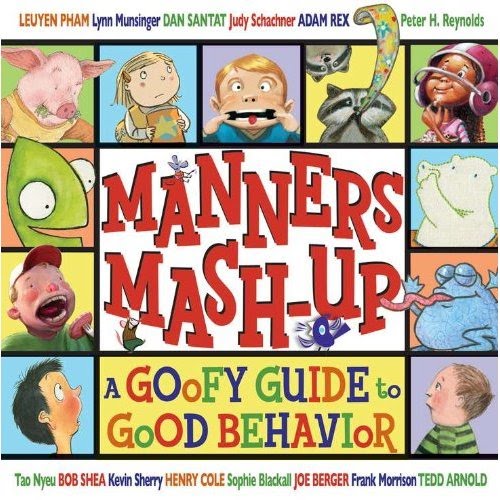
Perhaps you've seen Why Did the Chicken Cross the Road? or Knock, Knock! by a team of terrific children's book illustrators, in which each artist presents a different take on the same theme. Now you can head to the library or bookstore in seach of the latest in this innovative series—Manners Mash-Up: A Goofy Guide to Good Behavior. This is definitely my favorite of the three, worthy of taking its place on the shelf next to such helpful manners books as Sesyle Joslin and Maurice Sendak's classic What Do You Say, Dear? and What Do You Do, Dear?

What's really great about this book—and the reason kids will like it—is that it mostly shows what not to do, though the written rules explain what should be done. That makes Manners Mash-up an outrageous demo of over-the-top behavior, as illustrated with great gusto by a top-flight array of illustrators. Each one addresses manners in a particular setting, starting with the school bus. I'll give you one or two of my favorite rules and illustrations from each spread.

Bob Shea, "Bus Manners": Here the animals match the rule-breaking, as the bear demonstrates the opposite of "Don't soak your seatmate with sleep drool," the skunk shows "Say 'excuse me' when you make a smell," and the giraffe doesn't do too well at "Try to keep your head in the bus," for example. The one about the driver is the best, also the most out there, but I'll leave you to discover that one for yourself.

Lynn Munsinger, "Cafeteria Manners": Featuring a darling cast of pigs, this spread shows us how not to break rules like "No food fights" and "Don't take all the desserts."

Henry Cole, "Don't Stare At": This one is going to please the bathroom humor crowd. It takes place in the main office of a school (with human characters), and includes several key things that should not be stared at, such as "Funny Outfits" and "Gross Things on People's Faces."

Leuyen Pham, "Playground Manners:" More animals! The chimps are throwing sand in the sandbox and a groundhog is hogging the ball, but there are some sweet ones, too, among them "Always watch out for little ones" and "Give friends a boost."

Peter H. Reynolds, "Classroom Manners": We're back to human children with Reynolds, who has the kids demonstrating positive rules with dialogue in voice bubbles. For example, beneath "Ask nicely" a girl says, "May I borrow the purple crayon, please?" (surely an allusion to Harold), while beneath "Share," the boy sitting next to her replies, "My pleasure, Holly! I have an extra one. Keep that one!"

Tedd Arnold, "Good Sports": Probably my favorite, but then, I'm a sci-fi/fantasy buff. Here we get to see "The All-Alien Slimeball Championship" on some moon or planet... There are only four rules, and each is illustrated by a little three-panel cartoon strip. Though the rules are ordinary, the way they play out is not. For instance, when one alien throws a slimeball, another eats it with a GULP and the coach says, "Eating the slime ball is against the rules. You're benched!"

Adam Rex, "Table Manners": The author-illustrator of Frankenstein Makes a Sandwich gives us a mad scientist attempting to have a nice, civil dinner with Igor and a three-headed boy he apparently created in his lab. (The good doctor looks like John Waters, if you ask me.) When the mad scientist says, "And chew with your mouths closed—were you raised in a barn?" the reply is quite literal. And what possible response is there to this instruction? "Igor—don't slouch."

Judy Schachner, "Party Manners": At first glance, Schachner's style doesn't seem to lend itself to poop jokes, but they're there... She can't resist playing with the idea of party poopers! And then we get a girl carrying an alligator I'm not entirely sure is stuffed, plus a raccoon in a party hat hanging upside down from a tree. Favorite rule? "Whack the piñata. Not your friend."

Frank Morrison, "Be a Good Visitor": So far, the cast of characters has been nicely diverse, and now we get a living room gathering that consists mostly of African Americans. "Help out if you're asked" is a great idea, though "Don't play ball in the house" provides a more striking visual. I like the way the adults in this one look like they're at their wit's end over the kids' antics.

Sophie Blackall, "Good Behavior at the Doctor's Office": Sophie gets a little surreal with rules like "Prosthetic legs aren't toys." Watch out for the lady whose head is no longer attached and the child commandeering the receptionist's telephone, not to mention the doctor's name.

Dan Santat, "Proper Behavior at the Theater": Each rule at this opera performance has its own "do not" icon. You can imagine the one accompanying this admonishment: "Please don't pick your nose and leave the boogers under the seat. That spot is saved for old chewed gum wads only. Yummy! Yummy!"

Joe Berger, "Supermarket No-No's": "Don't eat all the free samples" shares shelf space with "Always take cans from the top of the stack" and, best of all, a warning about the produce section.

Kevin Sherry, "Pool Rules": These rules are pretty typical, but I like the artwork, especially the inclusion of a giant octopus who is just hanging out near the shallow end for some reason. Plus there's a nice big sign on top of the bathroom advising kids not to pee in the pool.

Tao Nyeu, "Please Don't Pick in Public": Yeah, this one's all about what not to pick! But the most astonishing thing about Nyeu's spread is that it's done in needlework. Which means that, not only is it darling, but a supposedly staid medium is used to show some decidedly unstaid activities. All animals again; I think my favorite is the crocodile picking his scabs, with a mouse saying, "Ew."

The last spread is a satisfying finale, giving us a small self-portrait or photo of each illustrator with the answer to this question: "What was your goofiest manners mishap?" Peter Reynolds's is a little off-topic and Bob Shea's is just plain weird (though kinda funny); the rest are pretty amusing. For some reason, I especially like the image of a two-year-old Dan Santat throwing chicken bones at the other diners in a restaurant.

So there you have it—a detailed modeling of mostly bad manners which should nevertheless provide fodder for a classroom or family discussion of good manners. What exactly does it mean to be polite? Why do we have rules like that in the first place? And hey, just what's wrong with asking total strangers why they're fat? (You should probably get your finger out of your nose and say "excuse me" before you answer these questions.)

A Review of Ribbit Rabbit by Candace Ryan and Mike Lowery

I met Candace Ryan at an SCBWI Conference in Los Angeles a few years ago, and every once in a while we get together to talk shop. A couple of weeks ago I attended her book launch for Ribbit Rabbit at Once Upon a Time in Montrose, California. (Cool children's bookstore—I want to go back!)

You should understand that Candace has a gift that makes for a particularly intriguing type of picture book—she's a master of wordplay. I'm guessing she's good at Scrabble, too!

In Ribbit Rabbit, Candace uses a mere smattering of words to create an entire plot about two friends and their interactions. Here's how the story begins:
Frog and Bunny are BEST friends.
Ribbit Rabbit.
Rabbit Ribbit.

They go swimming together.
Ribbit Rabbit.
Dip it, dab it.
Amazingly, all of the pair's activities, including a quarrel-and-making up scenario, are then chronicled using the same rhyme pattern. I think my favorite phrase is what is said when they eat peanut butter sandwiches. And there's a whole subplot about a robot toy which leads to a couple of new sounds on the very last page...

Illustrator Mike Lowery has a refreshing new illustrative style that plays particularly well in this book made up entirely of non-white pages of various hues. The predominant colors are beige, blue, green, and a brown-orange shade. A gray background is used only once, when the friends have quarreled.

Lowery's figures are drawn quite simply, but their facial expressions manage to say a great deal, e.g., when Bunny is shown wrapping something, his brows furrowed and his little tongue sticking out with concentration. (Note the child awareness there: a grown-up wouldn't sweat over the task of wrapping a gift, but it's a pretty challenging activity for a little kid.)

I like the way Frog and Bunny engage in imaginative play, the kinds of things they fight over, and the earnest way they make up. The few sentences given in addition to the rhymed phrases are thoughtfully selected. The author has a particularly good way of explaining what happens when two friends quarrel—how fighting can start out small and grow bigger. "Until every BIG and little thing makes them fight." Then after Frog and Bunny have quarreled, we are told, "And they find themselves all alone." Accompanied by a rather poignant spread showing each one on one side of the page, separated by a tall pile of toys, fiddling with two pieces of the toy they have pulled apart. This theme has been covered in dozens of picture books, but there's something especially sensitive about how it is handled in this book.

So, while lots of people out there are rhyming, few of them are creating stories quite as complex and emotionally satisfying as Ribbit Rabbit. It makes me smile to think that Candace's rather sophisticated wordplay is put through its paces in the seemingly humble context of a book for small children. The teacher in me says that little kids will not only like the sounds of this book and the way its story unfolds, they will also broaden their unconscious awareness about the possibilities of language.